Greek Mythology
The Birth and Youth of Theseus — Greek Mythology
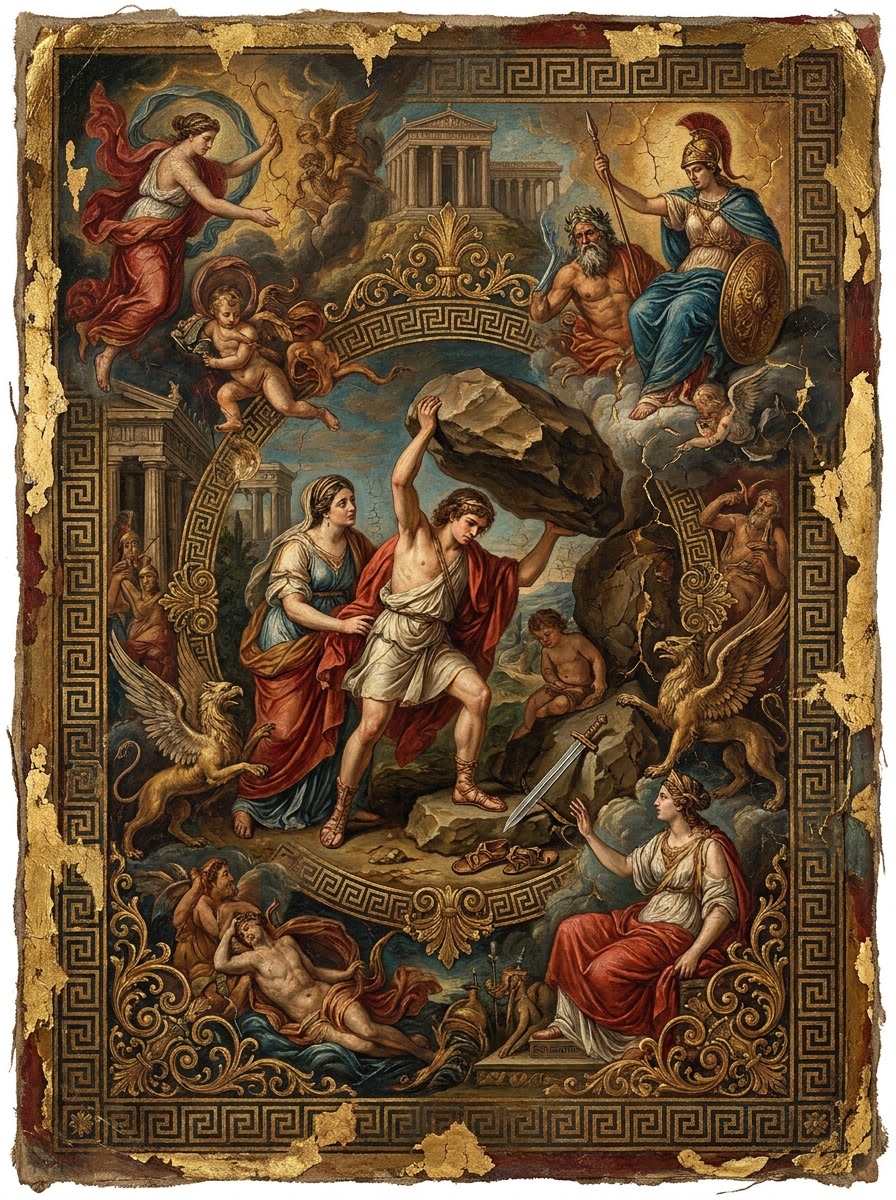
For many years King Aegeus of Athens had no son. He went to Troezen for help and there left behind a child whose birth was kept secret. When Theseus grew old enough, he heaved aside a great stone, took up the sword and sandals his father had hidden there, and chose to reach Athens by the dangerous road rather than by ship.
Article
Summary
Before he left, Aegeus hid his sword and sandals beneath a heavy stone and told Aethra that if she bore him a son, she was to wait until the child was strong enough to move the stone before telling him who his father was. Only then was the boy to take the tokens and go to Athens. Aegeus did this because the royal house of Athens was unstable, and he did not want a child exposed too early to danger. Theseus grew up in Troezen, and both his courage and his strength were greater than those of boys his own age. One story says that when Heracles visited, the children fled in terror at the sight of his lion skin, but the little Theseus seized an axe and rushed forward. When he became a youth, Aethra led him to the stone, and he strained until it moved, drawing out the sword and sandals at last. Only then did he learn that he was the son of the king of Athens. His mother and grandfather urged him to sail to Athens, for the land route was full of robbers and set with deadly traps. Theseus refused. He would not come to his father like a child under escort, but would win the journey by his own courage. So he girded on his father’s sword, put on his father’s sandals, and set out from Troezen for Athens.
The King Without an Heir
As the years passed, King Aegeus of Athens grew older, yet his hall still had no son who might inherit the throne.
The thought weighed on him like a stone. Outside the palace, the altars in Athens still smoked, and in the market people still bought and sold wool, jars, and olive oil, but Aegeus never felt that his house was truly secure. His brother Pallas had many sons, hard-muscled young men who rode through the city, sparred in public, and kept their eyes on the throne. Aegeus knew that if he died childless, Athens might well fall into their hands.
So he left Athens and journeyed to Delphi to ask Apollo for counsel. The road climbed steeply, and the sanctuary stood among cliffs and pines. Those who came to seek the god brought lambs, honey-cakes, and fragrant herbs, and waited outside the shrine. Aegeus offered his sacrifice and asked how he might win an heir.
The answer from the priestess only troubled him more. The god did not say plainly, “You will have a son,” nor did he tell him whom to wed. Instead, he received a veiled command whose meaning was hard to seize: before he returned to the highest point in Athens, he must not loosen the mouth of his wine-skin.
Aegeus pondered the words for a long time and still could not understand them. Fearing that he might misread the divine message, and fearing even more to do the wrong thing on the road, he did not go straight back to Athens. Instead, he turned aside and came to Troezen.
The King of Troezen
The king of Troezen was Pittheus, an old man known for his sharp mind. People said he understood oracles and men alike. When Aegeus came to his house, he was welcomed as an honored guest. At table, wine was poured, roasted meat was carved, and servants brought water for the guests to wash their hands. Yet Aegeus remained heavy with thought.
Pittheus saw at once that something was troubling him, and asked why he had returned from Delphi so unsettled. Aegeus told him the oracle. Pittheus listened without answering at once. He thought for a while.
He understood the meaning of the words, and he also understood what it would mean if Aegeus left a bloodline behind in Troezen. Pittheus had a daughter named Aethra, young, beautiful, and of royal blood. That very night, he contrived to bring Aegeus together with her.
Another tradition tells the tale differently. In that same night, people say, Aethra followed a dream’s guidance to the seashore and crossed the water to a small island. There, with the wind low and the waves striking the rocks, she offered sacrifice to the gods and was favored by Poseidon. Because of this, Theseus was later said to have had two fathers: among men, Aegeus of Athens; among the gods, Poseidon.
Not long after, Aegeus prepared to leave Troezen. Before he went, he did not make everything public. He knew that Athens was no quiet place, and that if Pallas’ sons learned he had a child, they would not wait peacefully for him to grow.
So he brought Aethra to a great stone. It lay heavy on the ground, with low grass around it, and dry earth and small insects in the cracks. Aegeus bent down and hid his sword and a pair of sandals beneath it.
He said to Aethra, “If the child is a girl, let her remain here and say nothing of me. If it is a boy, then when he is old enough to move this stone, tell him my name. Let him take out the sword and sandals and come to Athens with them. But until then, keep silence.”
Aethra remembered every word. Aegeus then climbed into his chariot and departed, dust rising behind the wheels. He returned to Athens and went on ruling, while in the palace of Troezen a child who would shape the future of Athens was already growing in his mother’s womb.
The Secret Beneath the Stone
Aethra gave birth to a son. Pittheus named the child Theseus.
The boy grew up in Troezen. The sea lay near at hand, and the wind carried salt in it. Olive trees covered the slopes, and there were training grounds outside the city. From the first, Theseus was not like the other children. He ran quickly and did not cry when he fell. If a horse was startled, he did not step back, but went forward and seized the reins. He learned his letters, his songs, and the rites of the gods with care, and when it came to spear-throwing, wrestling, and hard exercise, he practiced until he was soaked with sweat.
Pittheus loved the boy dearly, though he did not reveal his birth too soon. Aethra too kept the secret. Often she watched him practice with his sword in the courtyard and thought of the stone that hid the sword and sandals, but still she waited until he had truly grown.
Once, the great Heracles came to Troezen as a guest. He wore the lion skin, and the lion’s head hung over his shoulders, with the open jaws and sharp teeth seeming almost alive. When the children in the palace saw him, they screamed and ran, thinking a real lion had burst into the hall.
Only the young Theseus did not flee. Seeing the “lion” at the doorway, he snatched up an axe and rushed forward, ready to defend the house. The adults quickly stopped him. Heracles looked at the boy and could not help laughing. Everyone remembered the same thing: Theseus was still a child, but his courage already belonged to a hero.
Year after year passed. Theseus’ shoulders broadened, and his arms grew strong. He was no longer merely a youth in a royal house, but like a tree hardened by sea wind. At last, Aethra knew the time had come.
One day she led him outside the city. The sun lay bright on the stones, and the great rock still rested there, silent as it had for years. Standing beside it, Aethra said to her son, “You have long asked who your father is. Now you may find out for yourself. If you can move this stone, what lies beneath will tell you where you must go.”
Theseus looked at his mother, then at the stone. He asked no more questions. He bent down and set his fingers into the crack beneath it. The rock was heavier than he had imagined, and the earth clung to it tightly. He first tried to lift one edge, but it did not stir. Then he planted his feet, bent his knees, tightened his back and shoulders, and pulled again.
The soil split, and small stones rolled aside. Slowly the great rock shifted, and at last he upended it. Beneath it lay a sword and a pair of sandals. The blade still bore the marks of old days, and the shoes, though long hidden in darkness, still looked fit for a king.
Only then did Aethra tell him the whole story: how Aegeus, king of Athens, had come to Troezen, how he had hidden these tokens, and how he had commanded that if his son ever grew strong enough to move the stone, he should take the sword and sandals and go to Athens to claim his father.
Theseus listened in silence for a long while. He took the sword and strapped it at his side, then put on the sandals. In that moment, he was no longer merely the grandson of Troezen’s king. He knew that far away in Athens there was a father who had never seen him, and that there were also people who might not wish to let him live long enough to reach him.
The Boy Who Would Not Take the Sea
Aethra could hardly bear to part with her son. Pittheus also urged caution.
From Troezen to Athens, it would have been easier to sail along the coast. A ship could leave the shore and run north with the wind, and unless storms or pirates intervened, it would reach its destination quickly enough. But by land the way led through the territory around the Isthmus of Corinth, across hills and woods. That road already had a hateful reputation. Robbers, cutthroats, and strange, violent men haunted the narrow paths, the rocks, the pine forests, and the river crossings. They lay in wait for travelers and struck when they found them alone. Many who set out with baggage and attendants never returned, and their bones were never found.
His mother wanted Theseus to sail to Athens. His grandfather said the same. “Take your tokens to your father,” they told him, “but there is no need to throw your life away on the road.”
Theseus would not.
From childhood he had heard of Heracles’ exploits. That hero was not a man who kept away from danger. He was the one who rid the world of savage beasts and wicked men one by one. Theseus admired him, and he did not want his first approach to his father to be as a child hidden away and quietly ferried in by sea.
He said to his mother, “If I am truly Aegeus’ son, then I ought not to fear the men along the road. If those robbers only prey on the weak, then all the more reason for me to go that way. When I arrive in Athens, I want my father to see not only his sword and sandals, but also what I have done.”
Aethra heard him and wept, but she did not try to hold him back again. She knew that once this boy decided on a thing, he rarely turned aside. She adjusted his belt, fastened the sword for him, and told him not to reveal his birth to anyone before he reached Athens. Pittheus also prepared his gear and had food, a cloak, and what he would need on the road sent to him.
At dawn, Troezen still lay under a thin veil of mist. From the shore came the sound of oars, but the road outside the city stretched toward hills and forests. Theseus did not walk to the harbor. He shouldered his pack, wore his father’s sword, put on his father’s sandals, and took the land road.
Aethra stood behind him and watched as he went. The young man did not look back many times. At the crossroads, he paused only long enough to salute his mother and grandfather, and then continued onward.
From that day, the child of Troezen walked the road to Athens. The secret beneath the stone had been revealed, and Theseus would now let his own steps make his father acknowledge him, while the whole dangerous road learned his name.