Greek Mythology
The Birth and Youth of Heracles — Greek Mythology
Before Heracles was even born, Hera had already bent his fate onto a harder road. Once he came into the world, serpents, the lyre, the wild mountains, and a lion each came before him in turn. From the cradle onward the child showed astonishing strength, until, in youth, he chose a path of hardship and glory.
Article
Summary
In Thebes lived Queen Alcmene, beautiful and upright, while her husband Amphitryon was away at war. Zeus came to her in Amphitryon’s shape, and Alcmene conceived a child of a god; when the true Amphitryon returned, she conceived another child, mortal by birth. Before the two brothers were even born, the quarrel in heaven had already begun.
The Husband Who Returned by Night
In the city of Thebes lived Amphitryon and his wife Alcmene. Alcmene was of noble birth and steadfast character. While her husband was away on campaign, she remained in the palace, waiting for the sound of his chariot to return to the gate.
One night, Amphitryon came home.
At least, that was what Alcmene saw. The man wore her husband’s face, spoke of things only her husband would know, and brought news of victory. He entered the house and met his wife like a warrior long absent from home. Alcmene suspected nothing. She believed her husband had ridden back through the darkness.
But it was not Amphitryon. It was Zeus.
Before dawn, Zeus departed. Later, the real Amphitryon returned from the battlefield. He came in joyfully, eager to tell of his triumph, but Alcmene looked at him in astonishment and said she had heard all this the night before.
Amphitryon’s face changed. He was no fool, and his wife’s manner was not that of someone telling a lie. He sent for a seer, and only then learned that Zeus, king of the gods, had entered his house wearing his own likeness.
In time Alcmene bore two sons. One was the son of Zeus; the other, the son of Amphitryon. The divine child would be called Heracles, and the mortal child Iphicles. Yet before they had even come into the light, Hera in heaven had already learned what had happened.
Hera Delays the Birth
Zeus grew proud. Before the gods he declared that a child was soon to be born among the descendants of Perseus, and that this child would one day rule over the people around him.
When Hera heard this, she understood at once: Zeus meant the son in Alcmene’s womb. She did not burst into anger before them all. Instead, she made Zeus swear that the first boy born that day from the bloodline of Perseus would become lord over the others.
Zeus, not thinking carefully, gave his oath.
That was exactly what Hera had been waiting for. She went down at once to the earth and came first to Alcmene’s door, where she held back the hour of birth. Inside, people hurried to and fro. Basin after basin of hot water was carried in and out; the midwives murmured encouragement; Alcmene endured long pain, yet the child would not be born.
Then Hera hastened to another house. There too was a descendant of Perseus, whose wife was heavy with child. Hera urged that child into the world before his time, and so Eurystheus was born first.
Zeus had spoken his oath, and he could not take it back. Heracles, who should have stood above others, had not yet opened his eyes before Hera placed him behind another man. In later years he would be forced to serve Eurystheus, and many of his sufferings had their roots in that moment.
Yet a fate bent aside is not the same as a child born weak.
The Two Serpents in the Cradle
At last Alcmene gave birth to two boys. One carried the strength of a god in his body; the other was only the son of a mortal man. The brothers lay in the same chamber, wrapped by their nurses in swaddling clothes, their tiny hands not yet able to grasp anything.
Hera still would not spare the son of Zeus.
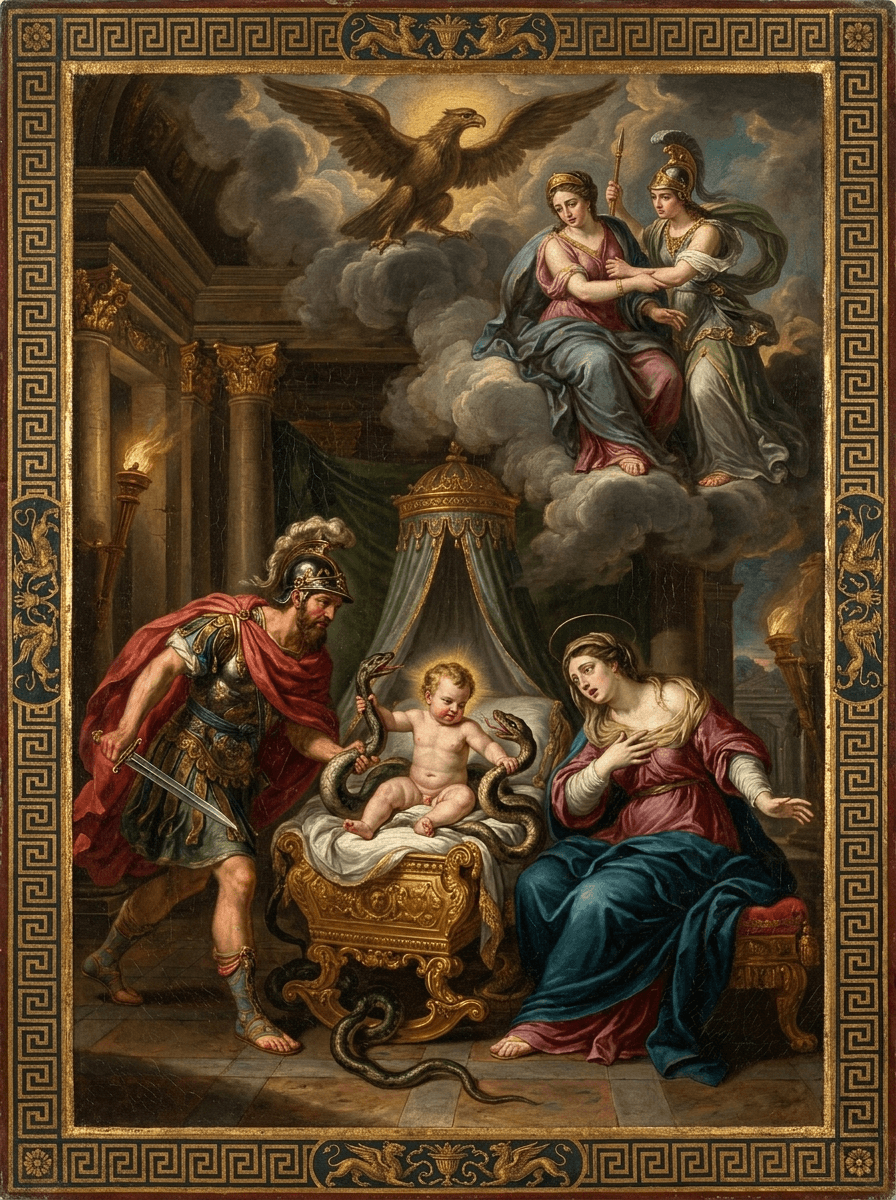
One night, the lamps in the room burned low, and even those keeping watch had begun to doze. Two great serpents slipped in through a crack by the door, or out from the shadows, their scales whispering against the floor. They lifted their heads, flicked their tongues, and glided slowly toward the cradle.
Iphicles woke first. The moment he saw the snakes, he screamed in terror, kicking at his coverings and trying to shrink away. His cries roused the household, but before anyone could reach the children, the other infant had already stretched out his hands.
Heracles did not cry.
With his two small hands he seized the serpents by the necks and gripped them as though they were ropes. Their bodies coiled around his arms, twisting and thrashing; their tails beat against the cradle. But the child’s hands tightened more and more. By the time Amphitryon rushed in with a sword, the serpents had gone limp and lay dead in the infant’s grasp.
Everyone in the room stood stunned. The nurse forgot to weep; the servants forgot to run; Amphitryon himself lowered his sword. He looked at the speechless child and felt wonder mixed with fear.
After that, people were all the more certain that this was no ordinary son of an ordinary house. The strength within him had shown itself while he was still in the cradle.
The Child Who Would Not Bow His Head
Heracles grew. His shoulders were broader than those of other boys his age, and his arms stronger. While other children still chased one another through the courtyard, he could already draw a heavy bow, control a restless horse, and hurl a wooden spear a great distance.
Amphitryon wanted him to become a true hero, and so he brought in teachers to train him in many skills. One taught him chariot-driving: how to hold the reins, how to keep his balance when the wheels jolted beneath him. Another taught him wrestling and boxing, so that he would learn to rise the moment he was thrown down. Another taught him archery, telling him to watch the wind, the distance, and where the quarry would flee next.
He learned these things quickly. Bow, spear, horse, shield—whenever he touched them, his whole spirit seemed to wake.
But music was another matter.
His music teacher was Linus. The teacher sat beside him, plucked the strings of the lyre, and told him to follow the sound. Heracles tried several times, but he could not play properly. His hands were too heavy, and his temper too quick. Under his fingers the strings either clattered wildly or nearly snapped.
Linus grew angry and struck him with a teaching rod.
Heracles had possessed astonishing strength since childhood, but he had not yet learned how to master his rage. The blow set his anger blazing. He snatched up the lyre beside him and struck his teacher with it. The instrument that should have made music became a heavy weapon, and Linus fell where he stood and did not rise again.
The room broke into chaos. People rushed in horror to the fallen man, and Heracles himself stood motionless. He had not meant beforehand to kill, but when his hand flew out, the result was far heavier than it would have been for anyone else.
Amphitryon understood then that the boy could no longer remain only within the city. Rafters, lyre strings, teachers, and rules could not restrain the strength that might suddenly break from him. So he sent Heracles into the countryside to watch the herds, letting the mountain wind, the grasslands, and the wild beasts temper his nature.
The Youth in the Mountains
After Heracles came to the pastures, his days grew rougher. At dawn he drove the cattle toward the slopes; at noon he sat beneath the trees and ate coarse food; at night the wind moved through the valleys, and the bells of the cattle sounded one by one in the dark.
There were no splendid halls here, no teacher seated before him with a lyre. Here there were loose stones, thorns, streams, and the tracks left by animals. In such a life, Heracles grew even faster. He ran over hillsides, carried logs, chased straying cattle, and his palms hardened with calluses from reins and bark.
Before long, a lion appeared around Mount Cithaeron. It hid among the woods and rocky caves, coming down by night to attack the livestock. In the morning, herdsmen counting their flocks found only blood dragged through the grass; when the cattle caught its scent, they crowded together in fear.
When Heracles heard of it, he took up his weapons and went into the mountains.
He searched for the lion’s trail. By day he followed the marks of its paws in the mud; by night he rested beneath trees, listening for movement in the grass. This was no game in which a city-bred boy could show off his strength. The lion had claws and teeth; it could spring from the dark, and one slow step could leave a man fallen in blood.
Heracles did not turn back. For many days he tracked the beast, until at last he met it in the mountains. The lion sprang from behind a rock, its mane bristling, its roar shaking the valley. Heracles rushed to meet it and grappled with it. Dust flew up underfoot; shrubs were crushed beneath their struggle; the lion’s claws tore across his body. But Heracles found his chance and held it fast with his mighty arms.
At last the lion fell on the mountain ground.
The young Heracles returned to the people with his kill. From then on, when the herdsmen of that region spoke his name, there was awe in their voices. He was no longer merely a child of great strength. He had faced a savage beast of the wild alone.
The Meeting of the Two Roads
When Heracles reached young manhood, he began to understand that strength by itself cannot tell a person where to go. He could strangle serpents, but he could also kill a teacher by mistake. He could protect the herds, but in anger he could destroy those near him. Power like his, without direction, would one day bring disaster.
A widely told story says that when he was young, he once walked alone to a quiet place, thinking about what sort of life he ought to lead. The dust by the road was soft, the hills rose and fell in the distance, and the youth sat there in silence, like many who have not yet chosen their path.
Then two women approached him.
One was richly adorned, gentle in expression, and fragrant as she walked. She told Heracles that if he followed her, his days would be easy and pleasant. He would not have to suffer hardship, take risks, keep watch on cold nights, or bleed on the battlefield. Fine food, wine, soft beds, and the praise of others would all come to him.
The other woman wore plain clothing, and there was no flattering smile on her face. When she came near, she told Heracles that she could not promise him an easy life. If he wanted true honor, he would have to labor. If he wanted friends to trust him, he would have to keep faith. If he wanted to protect his city and his kin, he would have to face danger. None of the good things the gods give to human beings can be held for long without effort.
Heracles listened and did not answer at once.
The first road was soft, like a carpet already spread beneath his feet. The second was hard and rough, like stones on a mountain path. Yet he knew he had not been born merely to hide in comfort. He had already seen that, if his strength were not restrained, it could wound others; but if it were turned toward hardship, it could also save them.
So he chose the road pointed out by the second woman.
Later people said that the splendid woman stood for ease and pleasure, while the plain woman stood for virtue and toil. From his youth onward, Heracles gave himself to the latter. That choice did not make his life easier; instead, it led him step by step toward greater dangers. Yet for that very reason, his name did not remain only that of “a strong child.” It became the name of a hero told and retold in later ages.
Hera had once delayed his birth, making him fall behind Eurystheus; she had once sent serpents into his cradle, hoping to take his life before he could speak. But the child survived. In a terrified house he crushed venomous snakes in his hands; in the wild country he learned endurance; and in youth he chose the difficult road. So ended the childhood of Heracles, and from that road his suffering and his glory slowly began to unfold.