Greek Mythology
The Birth and Exile of Oedipus — Greek Mythology
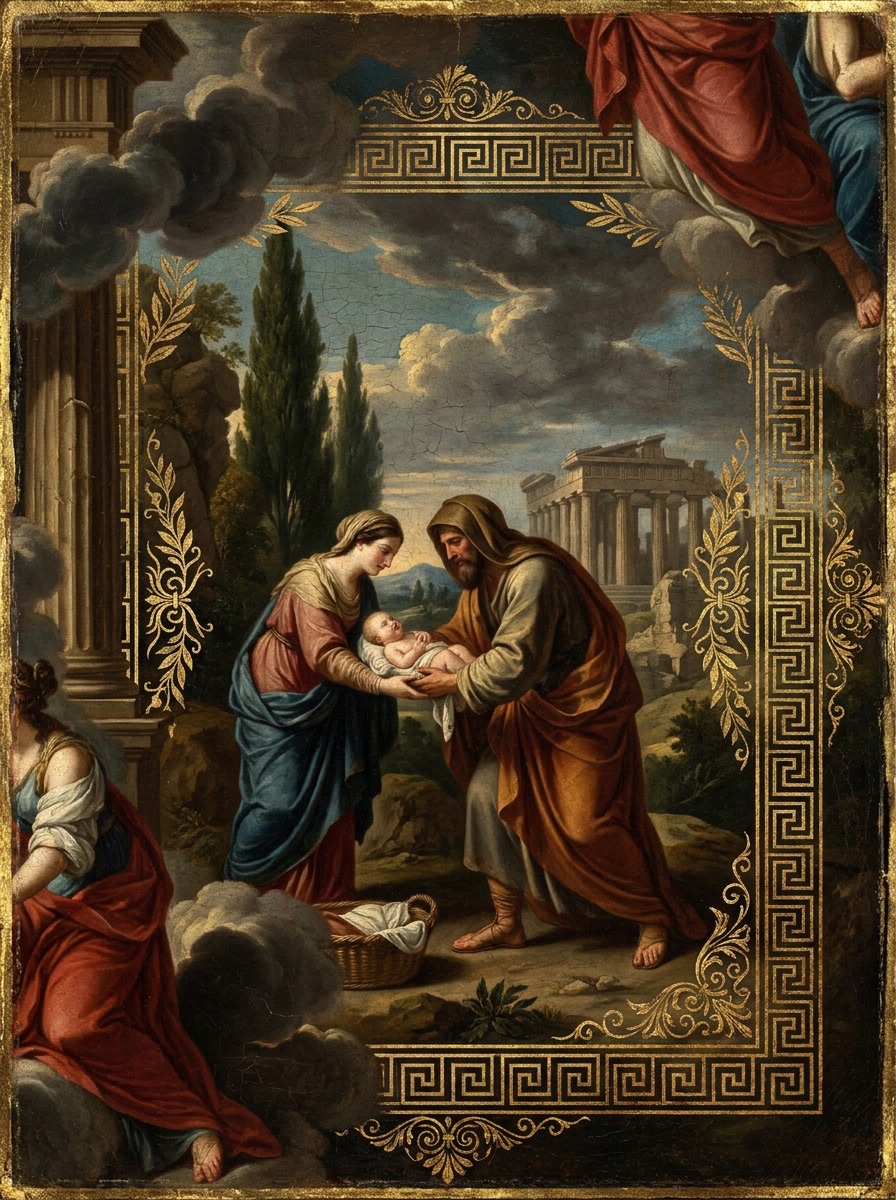
Laius of Thebes heard Apollo’s warning that the son born to him would one day kill his father and marry his mother. Terrified, he had the newborn’s ankles pierced and ordered the child abandoned on Mount Cithaeron. The baby survived, was carried to Corinth, and later fled that city after another oracle seemed to point him toward the same dreadful fate.
Article
Summary
Laius once consulted Apollo and received a terrible prophecy: if he had a son, that son would grow up to kill his father and take his mother as wife. So when Jocasta gave birth to a boy, joy gave way to fear. Laius ordered the child’s ankles pierced and had him handed to a herdsman to be left on Mount Cithaeron. The herdsman could not bring himself to kill the infant. Instead, he passed him on to another herdsman from Corinth. The child was taken to King Polybus and Queen Merope, who had no son of their own and raised him as theirs. Because his feet had been swollen from the wounds, they named him Oedipus. Oedipus grew up in Corinth believing Polybus and Merope were his true parents. Then, at a banquet, a drunken insult made him doubt his birth. He questioned the king and queen, but their answers did not fully quiet his mind. At last he went to Delphi to ask Apollo who he really was. The god did not answer the question he had brought. Instead, the oracle declared that he would kill his father and marry his mother. Horrified, Oedipus thought of the doom that might fall on Polybus and Merope, and so he decided never to return home. He left Corinth and took the road into exile, believing he was escaping destiny. He did not know that the path he chose was carrying him straight toward Thebes, and toward the oracle that had never gone away.
The Oracle in the Palace of Thebes
Thebes stood behind high walls, with roads leading out toward the hills and the grazing lands. At that time the city was ruled by Laius, and his queen was Jocasta. The palace had gold cups, altars, and servants enough for any king, yet Laius carried a shadow in his heart.
He had once gone to Apollo’s oracle. The answer he received was not comfort, but a sentence heavy enough to darken a life: if he fathered a son, that child would one day kill him and marry his own mother.
The words stayed with him like a nail driven into wood. After he returned to Thebes, he could not dismiss them as a dream, nor as a priest’s trick to frighten kings. The ancients believed an oracle did not speak in vain. A man might escape it for a while, but not forever.
And then, one day, the child was born.
It was a boy. The newborn could not yet speak; he only cried in his swaddling clothes. His fingers were tiny, his face pressed against the cloth, no different from any other infant who had just come into the world. But to Laius, this was not only a son. It was the knife foretold in the oracle.
There was no celebration in the palace. Laius would not keep the child. He summoned a trusted servant and gave him a cruel order: take the baby away and leave him to die in the wilderness.
The Swollen Feet
So the child would never return to Thebes, and so he might be recognized as one who had been cast out, Laius ordered his ankles pierced. Some say the king had iron pins driven through them; others say the feet were bound tightly until they swelled. In any case, the wounds left his feet damaged and inflamed.
The infant cried from the pain, his thin wailing echoing against the stone walls of the palace. Jocasta heard him, and yet she could not steady her heart. She was his mother, but she was also the queen; she knew the oracle and feared it. In the end, the child was entrusted to a herdsman.
The man carried the swaddled baby out of the palace and through the city gate. Beyond Thebes rose Mount Cithaeron, with its tangled rocks, pine trees, and paths where wild beasts might pass. The wind moved through the valley, the grass bent low, and the bells of flocks rang faintly in the distance. There was no hearth there, no nurse, no soft bed.
Laius meant one thing clearly enough: leave the child there, and let hunger, cold, and beasts finish what he had begun.
But when the herdsman reached the mountain and looked down at the infant’s bruised face and wounded feet, his heart failed him.
He was no king and no figure from prophecy, only an ordinary man. Yet ordinary men can still alter many lives by refusing one cruel act. He would not kill the baby with his own hands, nor leave him on the stones to die. Instead, he met another herdsman, a man from Corinth who served King Polybus.
The Theban herdsman gave the child to him.
And so the baby was carried away from his parents and away from his city. Laius believed the oracle had been scattered by the mountain wind. Jocasta believed her son would never return. But the child was still alive, only now he had been given a different beginning, and a different name.
A Son Raised in Corinth
The Corinthian herdsman took the infant back to his city. Corinth lay near the sea, where ships came and went and strangers filled the streets. Its king was Polybus, and its queen was Merope. They had no son of their own, and when they heard that a deserted boy had been brought to them, pity stirred in them at once.
His ankles were swollen, and the wounds had not yet healed. Polybus and Merope adopted him and raised him as their child. Because his feet had once been injured and puffed up, people named him Oedipus, a name tied to the idea of swollen feet.
Oedipus grew up in Corinth. In the palace he learned to ride, to throw the spear, to offer sacrifice to the gods, and to sit in the place reserved for a prince at the feast. Polybus treated him like a son, and Merope never made him feel he belonged anywhere else.
He did not know that he had been abandoned on a mountain. He did not know that another pair of parents lived in Thebes. He did not know that the injury to his feet had not been an accident. All he knew was that Corinth was home, that Polybus was his father, and that Merope was his mother.
As he grew into a young man, he became strong and confident in speech, the sort of youth people expected to inherit a kingdom. If not for one drunken remark at a banquet, he might have remained in that certainty for many years more.
A Word at the Feast
One day Corinth held a feast. Cups moved from hand to hand, guests laughed, servants brought meat and flatbread, and when the night grew late, wine loosened every tongue.
At the table someone, half-drunk and careless, mocked Oedipus and said that he was not truly the son of Polybus.
The words struck him like a stone dropped into water. Oedipus flew into a rage and demanded to know what the man meant. The drunkard could not explain himself, or would not; he only laughed vaguely and stumbled on. But the more uncertain the answer, the more it tormented Oedipus.
The next day the man may have forgotten his own insult, but Oedipus did not. He questioned Polybus and then Merope. They soothed him and told him he was indeed their child, that he should not listen to drunken nonsense.
They spoke kindly, and their faces were those of parents. Oedipus wanted to believe them, yet the doubt did not leave him. Once a person has never questioned the source of his own life, it is hard to sleep peacefully after hearing such a thing.
So he decided to go to Apollo and ask.
Apollo’s Terrible Answer
Delphi stood high in the hills, and pilgrims came from every direction, carrying offerings along the stone road to Apollo’s sanctuary. Oedipus went there too. What he wanted to know was simple: who were his true parents?
But the god gave him no answer to that question.
Instead, the oracle declared that he would one day kill his own father and marry his own mother.
Oedipus was drenched in cold fear. He had not learned the truth of his birth, but he had received something far worse: a glimpse of the future. His first thought was not of Thebes, because he had no idea Thebes had anything to do with him. He thought of Corinth, of Polybus seated on the throne, of Merope waiting in the palace for his return.
If they were truly his parents, then the disaster would fall on them.
Oedipus would not let that happen. He would not go back to Corinth. He would gladly lose his inheritance and abandon the home that had raised him rather than risk drawing near his parents. So he turned away and chose another road, carrying fear in his heart and a stubborn will to resist what had been foretold.
He thought that if he did not return to Corinth, he could outrun the oracle.
The Road Away from Home
When he came down from Delphi, the mountain paths stretched on and on before him. Oedipus did not look back. He put Corinth behind him, along with Polybus and Merope, and told himself that he was protecting them.
He did not know that many years earlier another man had tried, by even harsher means, to escape the same prophecy. Laius had pierced the infant’s ankles and cast him onto a mountain; now the grown Oedipus was leaving Corinth, afraid to face the parents he had known. Father and son were both fleeing, and yet the road of each was being quietly drawn toward the other.
Dust lay on the roadside. The way forked and forked again. Wagon ruts marked the earth. Oedipus walked on alone, the old wound in his feet long since healed, leaving only a name and a faint reminder behind.
He did not know whom he would meet, nor where the road would carry him next. For the moment he was only a man in exile, a man who believed he was escaping disaster.
But the old secret of Thebes had not died on Mount Cithaeron. It had grown with the child and followed him step by step back into the world of men.