Greek Mythology
The Belt of Hippolyta — Greek Mythology
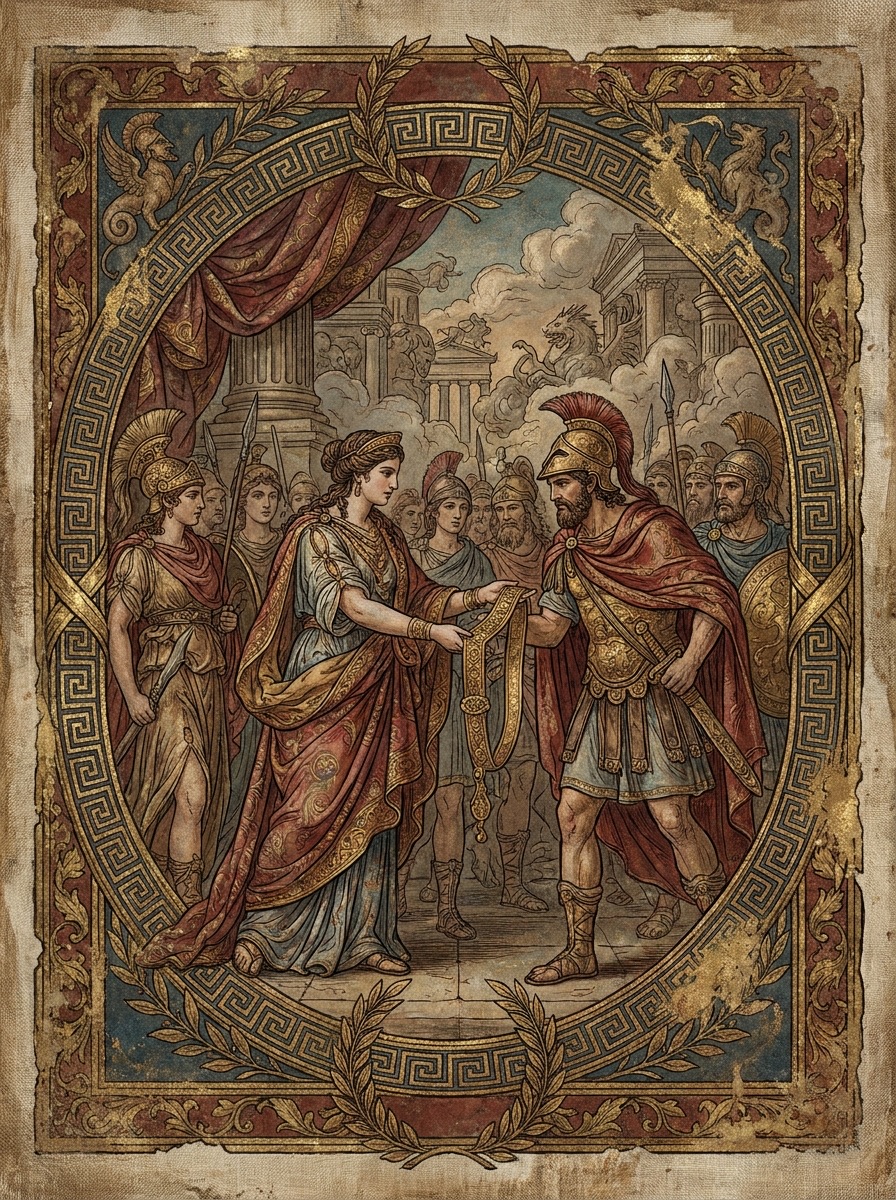
Eurystheus ordered Heracles to fetch the belt of Hippolyta, queen of the Amazons, because his daughter Admete desired the treasure given by the war god. Hippolyta was willing to surrender it, but Hera stirred up suspicion among the Amazons. They rushed to arms, and Heracles, caught in the sudden battle, killed the queen and carried the belt back to Mycenae.
Article
Summary
Eurystheus gave Heracles a new task: he must travel to the far-off land of the Amazons and bring back the belt of their queen, Hippolyta. This was no ordinary ornament. It was a gift from Ares, the god of war, and a sign of Hippolyta’s authority among the warrior women. Eurystheus’ daughter Admete wanted it, and her desire became another labor Heracles was forced to perform. Heracles gathered companions, launched a ship, and sailed along the coasts. On the way they passed islands and foreign shores, met with violence, and even aided a king oppressed by his enemies. At last the ship reached the mouth of the Thermodon River, the land of the Amazons, where women warriors rode horses, carried spears, and guarded their cities and riverbanks. When Queen Hippolyta heard that Heracles had arrived, she came herself to the ship and asked why he had come. Heracles told her plainly that he had been sent to take her belt. Hippolyta did not answer with anger. Instead, she agreed to give it to him, so that he might complete his labor. But Hera would not allow the matter to end so peacefully. Disguised as an Amazon, she moved among the women and spread a rumor that the foreign Greeks meant to carry off their queen. The Amazons believed her, armed themselves, mounted their horses, and charged toward the ship. Heracles thought Hippolyta had laid a trap for him. In the confusion he killed her, took the belt, and escaped with his companions. The belt was finally delivered to Eurystheus, but a task that might have ended without bloodshed left behind the death of a queen and a battle born of misunderstanding.
Eurystheus’ New Command
When Heracles returned to Mycenae, Eurystheus found no comfort in the hero’s repeated victories. The king hid inside his palace, and whenever he heard Heracles’ footsteps, he remembered the lion skin, the boar, and the many-headed Hydra. Fear and hatred rose in him together.
This time, the task he gave Heracles began with a woman’s wish inside the palace.
Eurystheus had a daughter named Admete. She had heard that far away in the east lived a nation unlike any other: women warriors who fought on horseback, bent bows, cast spears, defended their own cities without men, and bowed to no neighboring king. They were called the Amazons. Their queen was Hippolyta, and she possessed a famous belt.
It was not a common piece of goldwork, nor a delicate girdle worn for a feast. The belt, people said, had been given to Hippolyta by Ares, the god of war. When the queen fastened it around her, it was as though she bound the dignity of the battlefield to her own body. When the Amazons saw that belt, they knew she was the leader recognized by the war god himself.
Admete wanted it.
So Eurystheus turned that desire into a command and said to Heracles, “Go and bring me the belt of the Amazon queen.”
The words made it sound like a single treasure, but everyone knew what such a demand meant. To take the queen’s belt was to reach into the very heart of a fierce army. Heracles asked no long questions. He was used to Eurystheus’ orders, and he knew there was no path of refusal open to him. He gathered companions willing to sail with him, prepared a ship, oarsmen, weapons, and food, and set out toward the distant land.
Sailing Toward the Land of the Amazons
After the ship left the Greek coast, the sea wind filled the sail. Heracles stood at the prow with the lion skin over his shoulders, his bow and arrows beside him, and a bronze sword hanging at his waist. As his companions rowed, the blades of the oars struck the water again and again, and white foam fell away from the ship’s sides.
It was not a quiet voyage.
When they came to Paros, conflict broke out on the island. Two of Heracles’ companions were killed by the people there, and in his rage he went ashore to take revenge. Swords and javelins crossed on the island, and blood ran over the stone ground. The islanders could not withstand him. In the end they gave hostages to quiet his anger, and Heracles took with him those who were willing to join his company before sailing on.
Later they reached another unfamiliar coast. There ruled a king named Lycus, who was hard pressed by enemies nearby. When Heracles heard of his trouble, he and his companions helped him in battle. He rushed into the enemy ranks like a boulder crashing down a hillside, and his foes broke before him. After Lycus was rescued, he thanked the far-traveled hero by granting him a piece of land and naming the place in his honor.
But Heracles did not remain there long. He remembered the purpose of the voyage: the belt was in the hands of the Amazon queen, and Eurystheus was still waiting in Mycenae for his return. So the ship put out from shore once more, crossed the wind and waves, and made for the Thermodon River.
The Queen Beside the Thermodon
The land of the Amazons lay near the Thermodon. As the ship drew close to the river mouth, Heracles saw broad ground along the shore, and farther off herds of horses running, dust rising beneath their hooves. The river came down from inland, carrying silt and the scent of grass, and emptied into the sea.
Before long, the Amazons discovered the foreign ship.
They were not women who peered timidly from behind walls. The warriors quickly gathered. Some brought horses, some put on helmets, some slung bows over their shoulders, and spearpoints flashed in the sunlight. They looked toward the Greek ship by the shore, not knowing whether the newcomers were merchants, raiders, or enemies seeking battle.
Word was carried to Queen Hippolyta.
Hippolyta did not at once order an attack. She came to the shore herself, accompanied by several warriors. Around her body was fastened the famous belt, lying against her war dress like a sign no one could ignore. She approached the ship, looked at Heracles, and asked why he had come to the land of the Amazons.
Heracles did not hide his purpose. He came down from the ship, stood on the shore, and said to the queen, “I am Heracles. Eurystheus of Mycenae has sent me to take your belt. His daughter desires it, and I must carry it back.”
Spoken to another ruler, such words might have drawn steel at once. But Hippolyta did not answer in anger. She looked at this hero from a distant land. Perhaps she had already heard his name: he had killed the Nemean Lion, cut down the Hydra, captured monsters alive, and returned again and again from the edge of death.
She did not treat the belt as some trifle to be tossed away. Yet she saw that Heracles had not come creeping like a thief. He had declared his purpose openly and stood before her, waiting for her answer.
So Hippolyta agreed to give him the belt.
If the matter had ended there, Heracles might have sailed away safely with the treasure, and the Amazons would not have lost their queen. But in the myths of Greece, the road of Heracles was seldom allowed to run smooth.
The Rumor in the Crowd
Hera had never loved Heracles.
When she saw that he was about to complete this labor, she would not endure it. She came among the Amazons in the shape of one of their own warriors and began speaking softly in the crowd.
“Why are you standing idle?” she said to them. “That foreign man has not come to ask for a gift. He means to seize your queen. By the time you understand what is happening, Hippolyta will already be aboard his ship.”
Her words fell like sparks into dry grass. One woman heard and turned to tell another; one troop heard and the rumor soon ran farther. The Amazons were already wary of strangers. When they saw Hippolyta speaking with Heracles beside the ship, and saw the Greek vessel drawn up at the shore, they believed the terrible tale.
Horses were brought out, and reins were pulled tight. The women put on armor, fastened their bracers, and took up shields and battle-axes. Some leapt onto horseback, others bent their bows and set arrows to the string. Shouts rose from the camp and carried down toward the sea.
Before Hippolyta had time to explain, the Amazon ranks were already rushing toward the ship.
Heracles heard the thunder of hooves and looked up. Dust rolled across the ground, and rows of spearpoints drove toward him. A moment before, the queen standing before him had agreed to surrender the belt; now her warriors were treating him and his companions as enemies.
Heracles did not know that Hera had been at work behind them. He saw only that the Amazons had suddenly attacked, and one thought took hold of him: Hippolyta had deceived him. She had promised the belt openly, while secretly calling up her army to trap the Greeks on the shore.
With that in his mind, he waited no longer.
The Belt Stained with Blood
Battle broke out beside the river mouth.
The horses of the Amazons charged in, their hooves making the ground tremble. Arrows flew through the air and struck the ship’s planks, the shields, and the sand. Heracles’ companions hurried to raise their defenses. Some guarded the ship, while others drew swords and met the attack. The sea wind tugged at the ropes of the sail, and the ship rocked in the shallows as though startled by the sudden violence.
Heracles rushed at Hippolyta.
Hippolyta was queen of the Amazons, no weak or helpless woman. She held weapons in her hands, warriors stood near her, and the belt given by the war god was still fastened at her waist. But the strength of Heracles was dreadful. He had crushed monsters and powerful enemies before, and now, believing himself betrayed, he struck without mercy.
In the turmoil of battle, Hippolyta fell.
When the queen died, the cries of the Amazons grew fiercer. Some fought to avenge her, some tried to recover her body, and some hurled spears at Heracles. He took the belt from her, gave it to one of his companions to guard, and turned back to face the warriors pressing after him.
By then there was no room left on the shore for explanations. Horses screamed, bronze clashed against bronze, and the mud beside the river was churned by trampling feet. Heracles and his companions fought as they retreated toward the ship. They cut the ropes that held it fast, pushed it into the water, and the rowers bent desperately to their oars.
The Amazons pursued them to the water’s edge, and arrows still flew after the departing ship. But the vessel drew farther and farther from the shore. The arrows fell into the sea, raising little rings of white spray. Heracles stood aboard, watching the river mouth recede behind him, and in his hand he held the thing Eurystheus had demanded.
Brought Back to Mycenae
The voyage home was still long. Waves beat against the belly of the ship, and at night the wind came over the dark water. In the hold lay the belt. It had once been the sign of a queen’s authority; now it was the proof that a labor had been completed.
Heracles may never have known that Hippolyta had not first intended him harm. She had been willing to give him the belt and let him depart in peace. But one rumor, hidden by Hera in the crowd, had turned trust into slaughter.
At last the ship returned to Greece. Heracles brought the belt before Eurystheus.
Eurystheus received the object he had commanded Heracles to fetch, and Admete received the treasure she had desired. The ninth labor was counted complete. Yet far away beside the Thermodon, the Amazons had lost their queen, and the belt given by the god of war had forever left the woman who once wore it.