Greek Mythology
Bellerophon and the Chimera — Greek Mythology
Bellerophon left his homeland after the accidental killing of a kinsman, and later, falsely accused by a queen, was sent to Lycia to die. Yet he received the golden bridle, tamed the winged horse Pegasus, slew the fire-breathing Chimera from the air, escaped one plot after another, and in the end, through pride, tried to fly to Olympus and wandered the earth alone.
Article
Summary
Bellerophon, a young prince of Corinthian blood, was brave and strong, but a deed of blood drove him from home. He came to Proetus, king of Argos, seeking purification. Proetus received him, but the queen, Stheneboea, fell in love with Bellerophon; when he refused her, she accused him of trying to dishonor her. Proetus would not kill a guest with his own hands. Instead, he gave Bellerophon a sealed letter and sent him to Iobates, king of Lycia. Inside the letter was an order to kill the bearer. Iobates read it, but he too shrank from violating the laws of hospitality, and so he sent Bellerophon to fight the monster called the Chimera. The Chimera had a lion’s head, a goat’s body, and a serpent’s tail, and flame poured from its mouth. It burned fields and devoured livestock. With divine help, Bellerophon obtained a golden bridle, mastered Pegasus, approached the monster from the air, and killed it with his spear and a mass of lead. Iobates then sent him against the Solymi, against the Amazons, and finally into an ambush, but Bellerophon returned alive from every danger. At last the king understood that the young man was protected by the gods. He gave him his daughter Philonoe in marriage and shared half his kingdom with him. But later Bellerophon’s fame swelled, and his heart rose too high. He tried to ride Pegasus up to Olympus, and Zeus punished him: he fell from the sky and wandered afterward in loneliness among mortals.
The Man Who Left Home with Blood upon Him
In the country around Corinth there once lived a young man named Bellerophon. He was nobly born, quick in body, skilled with horses and with the spear; yet there was blood upon his life, a deed that no telling could wholly clear away. Some stories say he killed his own brother by mischance. Others say the dead man was another kinsman of his house. Whichever tale is followed, blood spilled among one’s own kin could not be brushed off like dust from a cloak.
So Bellerophon left his homeland and came to Argos, where he asked King Proetus to purify him.
In those days people believed that a man stained by blood could not stand clean among altars and men until another king had washed away the defilement. Proetus received him, performed the proper rites, and gave him a place in the palace. Bellerophon was young and handsome, and there was in him the quiet bearing of one who had already passed through danger. Many in the royal house noticed him.
The one who watched him longest was Queen Stheneboea.
In secret the queen fell in love with the stranger. She found reasons to speak with him, sent him garments and good wine, and tried to hold him with her eyes. Bellerophon understood what she wanted, but he would not yield. He knew he had come as a suppliant seeking purification. He lived beneath the king’s roof and ate at the king’s table. To betray his host would be to lay a new stain over the old.
He drew away.
Stheneboea’s desire turned at once to wounded anger. Rather than confess that she had been refused, she went weeping to Proetus and accused Bellerophon of trying to force himself upon her. She spoke as though she had suffered a great outrage, and her voice trembled with it.
Proetus was furious when he heard her. Yet he could not simply kill Bellerophon. The young man had been purified in his house and received as a guest; if the host murdered the guest with his own hand, that too would be a grave offense before the gods. Proetus thought for a long time, and at last he devised a dark solution.
He wrote a letter, sealed it, and gave it to Bellerophon.
“Go to Lycia,” he said, “and carry this letter to King Iobates. He is the queen’s father and kin to me. He will know how to receive you.”
Bellerophon suspected nothing. He took the letter and set out, crossing mountain roads and open plains toward Lycia in southwestern Asia Minor. The sealed message lay close against him like a quiet strip of wood, but written inside it was his death.
The Letter That Carried a Death Sentence
When Bellerophon arrived in Lycia, King Iobates welcomed him generously.
The king did not open the letter at once. A guest from far away must first be fed, bathed, and allowed to rest; that was the ancient custom. Iobates ordered animals slaughtered and tables set, and for many days he entertained the young man. Bellerophon did not know that his life was already weighed down by a letter still unopened.
After nine days of hospitality, on the tenth day, Iobates broke the seal.
There was no long speech inside. The message simply told him to destroy the man who carried it.
The king read the words and let his fingers rest on the edge of the letter. Bellerophon had sat in his hall and eaten his food. Like Proetus, Iobates did not wish to murder a guest outright. Yet he could not pretend not to see the request of his son-in-law.
So he called Bellerophon and said:
“There is a plague in Lycia, and it has brought great suffering upon our land. If you are truly a brave man, go and rid us of it.”
That plague was the Chimera.
The Chimera was no ordinary beast. Ancient tales said it came from the bloodline of monsters, and its body gathered several savage shapes into one: in front it was like a lion, with jaws full of sharp teeth; in the middle it bore the form of a goat; behind it dragged a tail like a serpent. More terrible still, it breathed fire. When it rushed out from the ravines, the grass and trees bent first beneath the heat, and then flames rolled from its mouth, blackening the fields and choking the flocks. When people saw smoke rising in the distance, they knew the monster had come down from the mountains again.
Iobates thought no man could return alive.
But Bellerophon accepted the task. There was no retreat in his young face, yet he was not reckless. Against a creature that breathed flame, feet and shield would not be enough. He needed to strike from a place the monster could not reach.
The Golden Bridle at the Spring
Near Corinth there was a wondrous winged horse named Pegasus. He was no mortal horse. When he ran, the wind seemed to gather beneath his hooves, and when he opened his wings he crossed ridges and cloud-shadow alike. Many had tried to catch him, but none had so much as touched his mane. He often came to drink at a spring; when he lowered his head he looked like a white cloud settled upon the earth, but at the slightest sound he would spread his wings and vanish.
Bellerophon knew that if he could mount Pegasus, he could fight the Chimera from the sky.
But Pegasus did not submit to mortal hands. Bellerophon waited beside the spring, watching the horse descend from the edge of heaven and then wheel away again. He tried creeping close. He tried lying in wait with ropes. Nothing worked. At night he slept beside an altar, turning over in his mind the winged horse and the fire-breathing monster.
When he had almost no hope left, Athena helped him.
The goddess came to him in a dream and gave him a golden bridle shining with light. When Bellerophon woke, the bridle truly lay beside him, gleaming coolly in his hand. At once he knew it was no work of any ordinary craftsman.
He went to the spring and waited.
Pegasus came down again from the sky, folded his wings, and lowered his head to drink. This time Bellerophon did not leap too soon. He gripped the golden bridle and moved slowly forward. Pegasus raised his head and looked at him; hot breath blew from his nostrils, and his forehooves struck the ground. Bellerophon watched for the right moment and slipped the bridle over his head.
Once the golden bridle settled into place, Pegasus was no longer impossible to approach. He remained proud and powerful, but he accepted the rein. Bellerophon sprang onto his back and seized the straps. Pegasus flung open his wings and carried him into the air.
The spring below grew smaller and smaller. The crowns of the trees became dark green specks, and the rocks of the mountains slipped away beneath him. For the first time Bellerophon saw the earth from above; the wind struck his face, and even his breathing felt washed clean by the gods. He knew then that he had found the way to meet the Chimera.
The Fire-Breathing Monster
The Chimera hid among barren mountains and deep ravines. No herdsman dared linger there. The stones were black from flame, and even the roots of the grass were scorched. Bellerophon circled above the pass on Pegasus, and before long he saw a thick column of smoke rising from the valley floor.
The monster had come out.
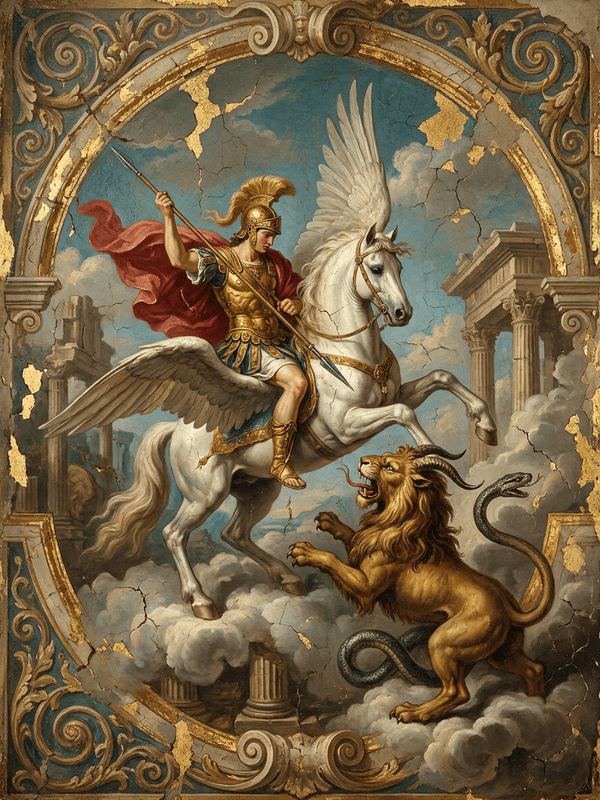
Its lion head lifted high, its mane like dry grass near a fire; its goat-body was solid and grotesque; its serpent tail thrashed behind it, scattering broken stones. It smelled living flesh and raised a roar. Flame burst from its mouth and rushed upward. A wave of heat rolled into the air, and Pegasus swerved sharply aside, the edge of his wings almost brushing the firelight.
Bellerophon crouched low against the horse’s back and steadied himself. He could not come too near, but he could not fly too high either. Too near, and the fire would take him; too high, and his spear would not pierce the monster’s body. He guided Pegasus in wide circles, searching for his chance.
The Chimera, enraged by an enemy above it, kept throwing its head back and breathing fire. Flames struck the cliff face, making the cracks in the stone glow red. In the instant when the creature paused for breath, Bellerophon drove downward and thrust his spear at it. The point cut into the monster’s flesh. The Chimera leapt in pain, and its serpent tail lashed upward. Pegasus beat his wings and rose, escaping the blow.
But a common wound could not kill such a creature.
One version of the tale says that Bellerophon fastened a lump of lead to the point of his spear. When the Chimera opened its jaws to breathe fire, he plunged down from the air and drove the spearhead into its gaping mouth. The monster’s own flames melted the lead, and the burning metal ran into its throat and chest. The Chimera struggled wildly, flame bursting from its mouth in broken blasts, but it could no longer pursue its enemy as before.
It crashed against the mountain wall, clawed up earth and stone, and its serpent tail beat the ground again and again. At last the lion head sank. The huge body collapsed on the blackened earth. In the valley the firelight faded, and only smoke drifted low along the rocks.
Bellerophon brought Pegasus down and looked upon the monster. Only when he saw that it no longer moved did he draw back his spear. He did not linger. The Chimera was dead, and the fields and pastures of Lycia could at last breathe beneath a sky no longer lit by its flame.
Sent to Die Again and Again
When Bellerophon returned to the palace, Iobates was astonished.
The king had expected never to see him again, yet there he stood in victory. The winged horse waited outside the palace, his white mane lifted by the wind, and the servants dared not come too close. Bellerophon told the king that the Chimera lay dead in the valley.
Iobates grew uneasy. He marveled at the young man’s courage, but he had not forgotten the command in the letter. So he sent Bellerophon next against the Solymi, a fierce mountain people who knew every dangerous track and every place fit for ambush. Strangers rarely gained any advantage against them.
Bellerophon went all the same.
He rode Pegasus over the ridges and appeared where his enemies did not expect him. Mountain roads, stony slopes, and deep woods could not halt a horse with wings. After a hard fight the Solymi were driven back, and Bellerophon returned alive once more.
Still Iobates would not give up. He ordered him to face the Amazons, those women warriors who rode with bows in hand, swift in movement, their arrows falling like rain. Bellerophon went out again, and again he won.
At last Iobates set an ambush. He chose the bravest men in Lycia and hid them beside the road, so that when Bellerophon returned they might rush out together and kill him. But even the ambush failed. One by one the attackers fell, and Bellerophon came through the bloodshed and returned once more to the king’s house.
This time Iobates could no longer pretend not to understand. A man sent again and again into death, yet returning every time, must surely be guarded by the gods. The king brought out the old letter and told Bellerophon everything from the beginning. He admitted that he had acted under the order written there, and he acknowledged that Bellerophon had not dishonored the queen but had been trapped by a slander.
To make amends, Iobates gave Bellerophon his daughter Philonoe in marriage and divided half his kingdom with him. Bellerophon settled in Lycia. He had land, a wife, children, and the glory that passed from mouth to mouth among the people. The bones of the Chimera remained in the desolate valley like the remnant of a nightmare whose fire had gone out.
The Man Who Flew Too High
If the story ended there, Bellerophon would be remembered like many heroes: a warrior who slew a monster and saved a people. But the heart of a man can be harder to travel than any mountain road.
His fame grew greater and greater. People spoke of him as the one who killed the Chimera, defeated the Solymi and the Amazons, survived an ambush, and rode the marvelous Pegasus. After hearing such praise for many years, Bellerophon began to harbor a dangerous thought.
He was no longer content to be honored among mortals. He wanted to ride Pegasus up to Olympus itself, to the dwelling place of the gods.
That was no place for a mortal. No peak, however high, and no shining cloud could turn a man into a god. Yet Bellerophon tightened the reins and urged Pegasus upward. The earth fell away beneath him. Rivers narrowed into threads, cities into flecks of dust. The wind grew colder, and the sky opened wider and emptier around him.
Zeus saw his arrogance.
The great god would not allow a mortal to force his way into the home of the immortals. So he sent a gadfly to sting Pegasus. The winged horse was startled; he bucked and twisted violently. Bellerophon lost his hold on the reins and fell from the saddle.
Pegasus flew on toward the gods, but Bellerophon fell back to the earth. The story says he did not die at once, but he was broken by the fall. From then on he kept apart from people and wandered alone across the Aleian plain. He no longer entered palaces as he once had, nor did crowds gather to praise him. If anyone saw him in the fields, they saw only a silent wanderer, avoiding the road and the eyes of men.
He had once slain a fire-breathing monster from the sky. He had escaped one death-trap after another. Yet in the end it was not the Chimera’s flame, nor the swords and arrows of enemies, that defeated him, but his own longing to rise higher than a mortal should.
The people of Lycia still remembered the day the Chimera was destroyed, when the fire in the valley went out and the shepherds drove their flocks again toward green pasture. As for Bellerophon, when people spoke his name, they spoke both of his courage and of his fall.