Greek Mythology
The Battle at the Ships — Greek Mythology
Achilles still remained in his shelter and refused to fight. Under Hector’s command, the Trojans crossed the ditch and pressed all the way to the Achaean ships. Ajax the Greater and the others fought desperately at the sterns, and only when the torches nearly fell upon the planks did the Greeks understand that disaster had come right up to their hands.
Article
Summary
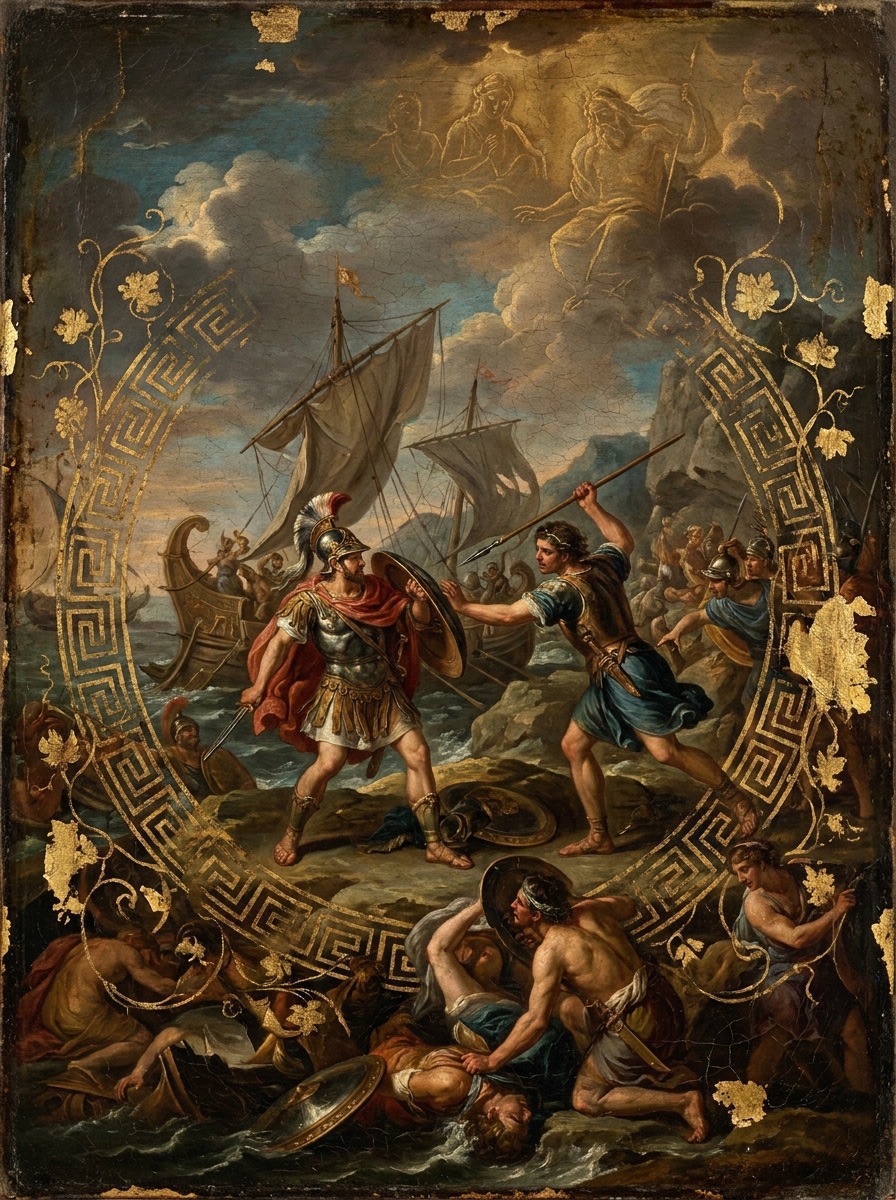
Achilles still sits in his hut and refuses to fight, and the confidence of the Greek army falls as more leaders are wounded. Under Hector's command, the Trojans press all the way to the Greek camp, where the ditch, stakes, wooden wall, and gates are the last defense before the ships. Hector will not let his men hesitate at the ditch; he orders them to leave their chariots and attack on foot while stones rain down from the wall. The heavy gate blocks Hector's advance, so he lifts a stone that ordinary men could scarcely move and smashes it against the fastenings until the gate bursts open. The Trojans pour into the camp like floodwater through a broken barrier. The Greeks are driven into confusion among tents, chariot poles, stakes, and ropes. Ajax the Greater stands between the ships, with Ajax the Lesser and the archer Teucer supporting him, trying to hold the last path to the vessels. Zeus remembers his promise to Thetis and allows the Trojans to gain ground, so that the Greeks will learn the cost of dishonoring Achilles. Poseidon, however, cannot bear to see the Greeks pushed into the sea, and he secretly moves among them in mortal disguise to stiffen their hearts. The Greeks grip their shields again, and Ajax the Greater leaps along the sterns, thrusting back attackers; he hurls a great stone that strikes Hector in the chest and knocks him down. Hector is carried out of the fighting for a time, and the Greeks surge forward. But Zeus soon sends Apollo into the battle, and Apollo lifts Hector up and restores his strength. Moving before the Trojans, Apollo chills the courage of the Greeks and opens a path through them. Hector rushes back toward the ships, no longer seeking only to kill, but shouting for fire: if the ships burn, the Greeks lose their way home. The struggle tightens around the sterns and planks. Ajax stands high with a spear, driving back each man who tries to bring fire, while Teucer's bowstring snaps in the disorder. Hector seizes the stern of Protesilaus' ship and calls for torches, with smoke already nearing the dry timber. From a distance, Patroclus sees the fire by the ships and understands that disaster is at the edge of the camp; yet Achilles still has not come out, and the Greek return depends on the men who refuse to yield beside the vessels.
Panic Behind the Wooden Wall
After Achilles stopped fighting, the Greek camp grew quieter with every passing day.
Once, whenever the sound of armor rang out beside the black ships of the Myrmidons, the Trojans felt their hearts tighten. Now those same ships still stood drawn high upon the beach, their prows facing the gray-white surf, but Achilles sat inside his own shelter and let the cries from the battlefield come to him in waves.
The Greek kings still fought on. Agamemnon had been wounded, Diomedes had been wounded, and Odysseus too had been driven back by spears. Old Nestor looked out over the fighting and saw dust covering the ditch, while beyond the wooden wall spearpoints flashed everywhere. He knew that if the Trojans took one more step forward, the fire of war would reach the ships themselves.
That wooden wall had been built to protect the fleet. Before it lay a deep ditch set with sharp stakes; behind it stood crowded shelters, wagon-poles, horse-lines, and beyond them the long rows of ships. The Greeks had believed the wall could hold back the enemy, or at least give them room to breathe beside the vessels.
But on that day the Trojans did not fall back.
Hector stood at the front, the horsehair crest of his bronze helmet shaking in the wind. His shield struck against his knees, his spear was in his hand, and behind him came countless Trojan soldiers. At first the ditch stopped them: the horses dared not leap down, and the chariot wheels could not easily pass over the stakes. Some men hesitated; others shouted that they should go around by another way.
Then Hector called loudly for them to dismount and fight on foot. He would not wait uselessly before the wall, and he would not give the Greeks time to steady their ranks again. The Trojans left their chariots at the edge of the ditch, took up shield and spear, and pushed forward wherever they could find footing.
From the wall the Greeks hurled stones down upon them. The rocks struck shields with a rolling sound like thunder. One man was hit in the shoulder and fell into the dust; another had barely climbed the slope before a spear drove him back. Across wall and ditch the two sides fought, while shouts, groans, and the pounding of the wooden gate mingled together.
Hector Breaks Open the Gate
A great gate of the Greek camp stood before Hector. Its planks were heavy, its crossbar strong, and its posts were sunk deep into the earth. Many Trojans rushed up and shoved at it, but the gate only shook and would not open.
Hector looked around and saw a huge stone lying on the ground. It was broad and heavy; in ordinary times even two men might not have lifted it. But now, as though a god were supporting his arms, he bent down, gathered the stone up, and strode to the gate.
He raised it and struck the bar with all his force.
The wood cracked. The crossbar split, and the gate-planks shuddered inward. Hector charged again, driving his shoulder and shield against the doors until they burst open. Sunlight streamed through the gateway, dust rolled up, and his figure was the first to enter the Greek camp.
When the Trojans saw the gate open, they shouted and surged after him. Like a river pouring through a breach, they crossed the wall, rushed through the entrance, and pressed toward the ships. The Greeks retreated, bracing their spear-shafts against their shields as they tried to form their line again. But the camp was cramped, crowded with shelters, carts, stakes, and ropes, and the ranks were soon thrown into disorder.
Ajax the Greater did not retreat behind the ships.
He was the son of Telamon, huge in body, and his shield was like a moving wall. He stood between ship and ship, calling his comrades to turn back and hold the last passage. Oilean Ajax fought near him, while the archer Teucer sheltered behind the great shield and shot his feathered arrows whenever he found an opening. As soon as the bowstring sang, some man would fall clutching his throat or chest.
Hector came pressing forward, and the Trojans rushed around him. Spears flew from both sides, driving into ship-planks, shields, and wooden posts. Some spearheads snapped, and bits of bronze fell into the sand. The Greeks could already hear the waves striking the ships behind them, and they knew there was nowhere left to go.
The Sea God Moves Secretly Through the Ranks
Above the battlefield, Zeus had turned his gaze toward the Trojans. He was willing to let Hector prevail, for he had promised Thetis that the Greeks would suffer for dishonoring Achilles. So long as Achilles refused to fight, the Greek army would endure misery beside the ships.
But Poseidon could not bear to watch the Greeks be driven into the sea. He did not openly stand forth in defiance of Zeus, but took the shape of a mortal man and passed among the ranks. He clapped one warrior on the shoulder, gripped another by the hand, and urged them in a low voice not to let the ships be burned. His words were like cold water poured over the face of a dazed man, and many Greeks tightened their hands again around their shields.
Ajax the Greater heard his comrades shouting once more around him, and his own heart grew steadier. He sprang back and forth at the sterns, now holding a very long spear made for sea-fighting. Such a spear was longer than an ordinary one, meant for thrusting from a ship at men who came too close. Ajax planted his feet on the planks like a great eagle guarding its nest and would not let the enemy near.
The fighting swayed back and forth beside the ships.
At times the Trojans reached the sterns and stretched out their hands to seize the rails; at times the Greeks drove them back into the camp with long spears. Bronze clashed on bronze, and the planks thudded under trampling feet. Men fell between two ships, and before they could rise, the feet of both armies passed over them. The sea wind blew in, carrying the smell of salt and the smell of blood.
Hector was still at the front. He searched for a gap in the Greek defense and charged again and again at the place Ajax held. Ajax saw his chance, lifted a great stone, and hurled it. The stone passed over the rim of Hector’s shield and struck him heavily in the chest. Hector fell like a tree cut down, his spear slipping from his hand, his shield pressing against his side.
The Trojans cried out in alarm and at once crowded around to protect him. Polydamas and the other warriors stood in front and dragged Hector away from the flying spears and stones. His face was pale, his breath came hard, and blood welled from his mouth. For a time he could not hear the shouts around him clearly; he felt only the earth roaring beside his ears.
When the Greeks saw him fall, their spirits leapt. They charged out from the ships and drove the Trojans back toward the gate in the wall. If that force had held, perhaps the battle-line might truly have been pushed beyond the ditch again.
Apollo Raises Hector
But Zeus woke from sleep and saw that the battle had changed. Angered that the gods had secretly helped the Greeks, he at once sent Apollo down to the battlefield to raise Hector and drive the Trojans once more toward the ships.
Apollo came to Hector’s side. Hector was leaning in the arms of his companions, his chest aching as though it had split open, darkness and light passing before his eyes. Apollo asked why he had left the battle, and Hector managed to say that a stone had struck him down. The god heard him and poured fresh strength into him.
Hector soon stood up.
At first he leaned on his spear. Then he could walk. Then, as before, he cried out in a great voice. When that sound reached the Trojans, they turned and saw that he was alive, armed again, and moving forward, and courage flared in their hearts.
Apollo went before the ranks, holding his divine shield. When the Greeks saw that terrible radiance, their chests grew cold and their hands and feet lost strength. The line that had just grown firm began to give way again. Apollo also smoothed the banks by the ditch, making the passage broad, and the Trojans crossed the trench and rushed once more into the camp.
This time they came more fiercely than before.
As Hector ran, he shouted for the soldiers to bring fire. He no longer wished merely to wound the Greeks; he meant to burn the ships. If the ships caught fire, the Greeks, even if they lived, would be trapped on a foreign shore and would never raise their sails for home.
The Greeks understood this, and so no man dared retreat. Each ship was like a small city; each plank meant life or death. The warriors set their backs against the hulls, pressed shield against shield, and thrust their spears outward. Even the wounded dragged themselves into place: those who could throw stones threw stones, and those who could shout shouted for others to stand fast.
Ajax the Greater Holds the Stern
Ajax the Greater stood high upon one of the ships, stabbing downward again and again with his spear. Whenever a Trojan came near the stern, he drove him back with the point; when one spear broke, he took another; when his arm grew weary, he still would not stop. His voice rang through the confusion of the camp, urging the Greeks to remember their fathers and mothers, their wives and children, and the homes that lay far away beyond the sea.
Hector was shouting too. He urged the Trojans not to be afraid and not to long for plunder, but only to bring fire to the ships. He knew that spoils could be divided later; what mattered now was to burn the Greeks’ road home.
The two sides fought hand to hand beside the vessels. Sometimes the spears were too long to draw back in time, and the men pulled out short swords; when the swords struck shields, they seized stones; when stones were gone, they grabbed at helmet-crests, shield-straps, and tunics, wrestling as they fell. Beside the ladders, near the cables, under the oar-racks, men struggled everywhere.
Teucer drew his bow beside Ajax’s shield and shot down several enemies as they rushed forward. But just as he was about to shoot again, the bowstring suddenly snapped, and the arrow dropped to the ground. He looked up and saw the enemy pressing closer, and had no choice but to fall back and take another weapon. Many Greeks felt their hearts sink, as though even the trusty bow had abandoned them at that hour.
At last Hector reached one of the ships. It was the ship of Protesilaus. Protesilaus had died long before, when the Greeks first came to Troy, but his ship still stood on the beach like a house whose master was gone. Hector seized the stern and called loudly for someone to hand him a torch.
The torch passed through the crowd. Pine resin burned and sent up black smoke. The Trojans shouted in triumph, while the Greeks fought to force their way forward and tear the fire away before it touched the planks.
From above, Ajax struck at the men who carried the flame. One fell, and the torch dropped into the sand; another bent down and picked it up. Hector guarded his side with his shield and would not leave the stern. His hand clung to the wooden rail as if he meant to drag the whole ship into the fire.
Fire Against the Planks
By now the battle no longer spread across the plain as it had in the morning. It had narrowed into one furious knot beside the ships. The Trojans saw victory within reach and crowded forward; the Greeks saw destruction before their eyes and stood in its path with all their strength. There was no place for a coward to hide, and no time for the wounded to groan.
At last the torch came close to the ship.
The dry planks, the ropes, and the wooden work of the stern were all hungry for fire. As soon as flame licked them, smoke began to rise. The Greeks cried out and beat at it, while Ajax still stood upon the ship, driving one enemy after another down with his long spear. But there were too many Trojans, and Hector kept urging them on below; the firelight drew nearer and nearer.
Far off, Patroclus too saw the smoke beside the ships. He had been with Nestor, listening to the old man’s grief, and his heart had already grown uneasy; now, when the firelight shone among the shelters, he could no longer sit still. He knew that if the ships burned, even Achilles’ anger would not save the Greeks.
But at this moment in the battle, Achilles had still not come out of his shelter. Those who held the ships were still Ajax the Greater and the dust-covered Greek warriors around him. With shields, spears, stones, and their own bodies, they blocked the enemy; beneath their feet lay their ships, and behind them lay the sea.
Hector pressed his hand against the stern, and the Trojan torches burned beside him. The Greeks’ last defense was no longer the wooden wall, nor the ditch, but a company of men who refused to give ground. Thus the battle at the ships reached its most perilous hour: if the fire rose only a little higher, the Greek army, after so many years of war, would lose the road home.