Greek Mythology
The Augean Stables and the Stymphalian Birds — Greek Mythology
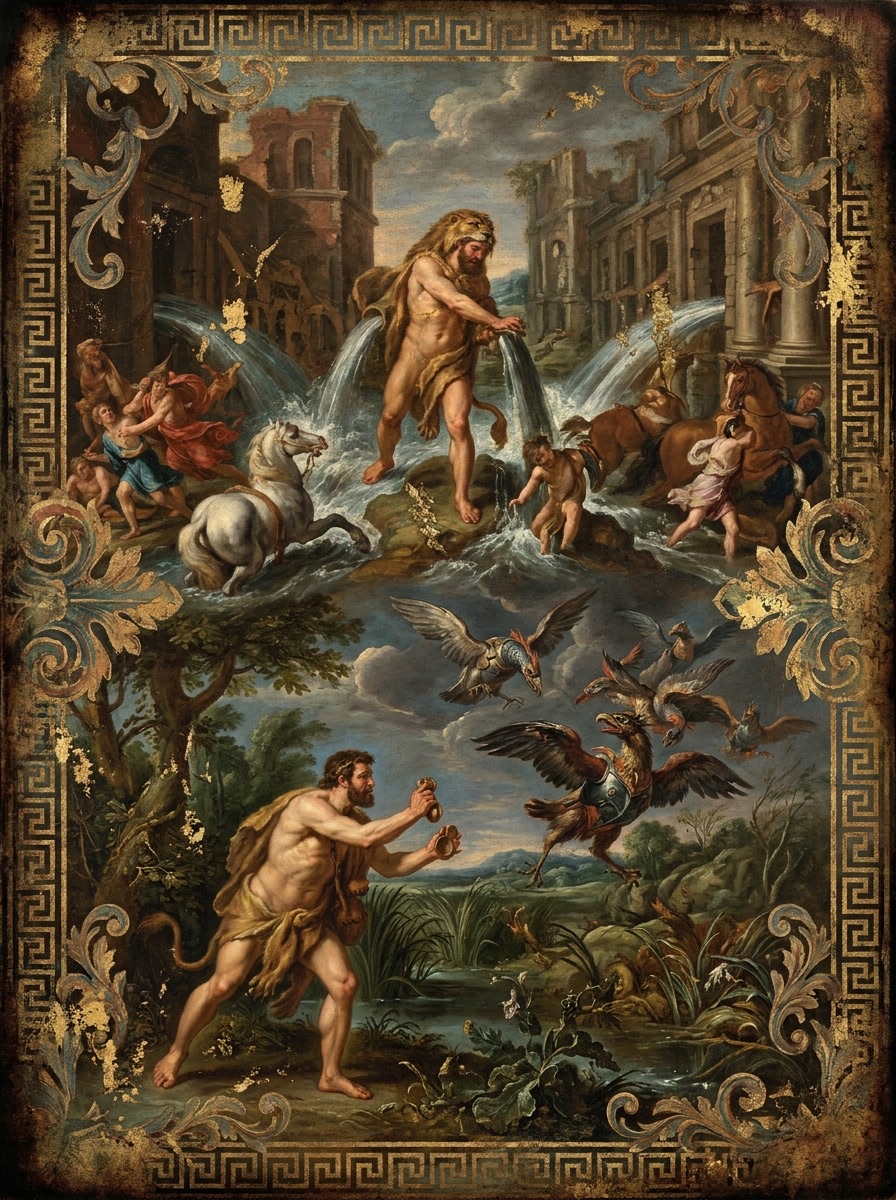
Heracles is sent to clean the stables of Augeas, where years of filth have piled up into a stinking mountain, and then to drive away the Stymphalian Birds. He washes away the dung with river water, startles the birds with a bronze rattle, and finishes both tasks that had seemed impossible.
Article
Summary
Eurystheus would not let Heracles have a moment’s peace. He sent him to Elis to deal with King Augeas. Augeas owned a vast herd of cattle, and the stables had gone uncleared for years; the dung had piled up like little hills, and the stench could be smelled from far away. Heracles did not first say that the work had been assigned by Eurystheus. Instead, he made a bargain with Augeas: if he cleaned the stables in a single day, the king would give him a tenth of the cattle. Augeas thought the task impossible and agreed, while his son Phyleus heard the promise and stood as witness. Heracles did not try to shovel the filth out by hand. He studied the land and the nearby waters, then cut channels from the Alpheus and Peneus so that the rivers thundered straight through the stables. The current broke up years of dung, rotting straw, and hardened muck, and by the end of the day the floor and walls had been washed clean. When Augeas learned that the work belonged to one of Eurystheus' labors, he refused to pay and denied the bargain. Phyleus testified that his father had sworn it, and for that honesty he was driven out with Heracles. Back in Mycenae, Eurystheus used the attempted payment as an excuse to declare that the labor did not count, and Heracles had to continue. Soon he was sent to Lake Stymphalus in Arcadia. There a flock of monstrous birds hid among reeds and trees, ruining crops and attacking people and animals. Athena gave Heracles bronze clappers. He climbed to a high place, struck them until the sound drove the birds into the air, and then shot them down with his arrows, scattering the rest and making the lakeside safe again.
The Stable Filled with Filth
The lion skin from Nemea still hung over Heracles’ shoulders, and the boar’s tusks had already been carried back to Mycenae. Yet Eurystheus still would not leave him in peace. Hidden deep within his palace, that king loved to issue commands and was always looking for some harder, more humiliating task to throw at Heracles.
One day he sent word for Heracles to go to Elis and clean the cattle stables of King Augeas.
Augeas was a wealthy king, and his herds were astonishingly large. The cattle stood crowded together in a broad enclosure, horn against horn, hoof against hoof. The stables had not been cleaned for a very long time. Filth had built up layer upon layer: the dry waste had hardened into a crust, while the wet had soaked down into the ground. The stench leaked through cracks in the doors, between the rails, and from the very base of the walls. No one could approach without wrinkling a nose.
It did not sound like work for a hero. There were no savage beasts, no chariot chase, no spears from an enemy line—only filth, reeking air, and endless labor. That was exactly why Eurystheus had chosen it. He thought that however strong Heracles might be, he could not clear away so much refuse gathered over so many years in a single day.
When Heracles came to Elis and met Augeas, the king looked at the famous stranger and wanted to test his strength. Heracles did not begin by saying that he had come on Eurystheus’ command. Instead, he said to Augeas, “If I clean these stables in one day, will you give me a tenth of your cattle?”
Augeas laughed to himself when he heard it. Such enormous stables, such a mass of filth—many men working many days would hardly be able to finish the job. So he agreed and made an oath.
Heracles also asked Augeas’ son Phyleus to stand as witness. Phyleus was an upright young man, and when he heard his father’s promise, he took it to heart.
Two Rivers Through the Stables
Augeas expected Heracles to take up shovels, pitchforks, and baskets and begin hauling the waste out bit by bit. Instead, Heracles walked around the stables, studying the lay of the land and the course of the water. He found that two rivers flowed nearby, the Alpheus and the Peneus. Their waters rushed on day and night without tiring, stronger than any human hands.
So he stripped away the things that would hinder him, shifted aside stones, pried up the earth, and cut an opening on one side of the stables and a channel on the other. Then he turned the rivers from their course and let them thunder straight through the enclosure.
The cattle bellowed in alarm as the water surged in, and mud splashed under their hooves. Heracles drove the herd to safety, then let the current sweep from end to end. The filth of years broke loose. Black water churned and roared outward, carrying away the hardened muck, the rotting straw, and all the waste trapped in the corners.
The sun moved across the sky, and the river kept washing. By the end of the day, the stables looked like another place. The stench had been carried off, the floor was visible again, and the walls were no longer buried under filth. What Augeas had thought impossible was done in a single day.
Heracles returned to Augeas and demanded the tenth of the cattle that had been promised.
But Augeas’ face changed. He had learned that Heracles had been sent there by Eurystheus to perform a labor, and now he refused to honor the bargain. He claimed that he had never agreed to any such reward.
Heracles looked to Phyleus. Phyleus did not side with his father. He stepped forward and said, “I heard my father promise it with his own mouth, and I heard him swear to it.”
Augeas was both ashamed and furious. He refused to give the cattle and drove Heracles out of Elis, sending Phyleus into exile as well for bearing witness against him. Phyleus left his father’s land, and Heracles had to return to Mycenae.
But Eurystheus seized on the affair at once. He said that because Heracles had tried to claim payment from Augeas, the labor did not count. Heracles understood that the king was only looking for excuses to thwart him, but he still had to go on and obey the command.
The Birds by the Lake
Not long after that, Eurystheus sent him to Arcadia. There stood Lake Stymphalus, ringed with reeds and trees, with soft mud along its edges so deep that a man’s feet could sink as soon as he came near. Beside the lake lived a great flock of strange birds. They hid among the branches and the reeds, and when they rose together their wings sounded like wind tearing through dead wood.
These birds had made life miserable for the people nearby. They pecked at the crops in the fields, scattered the livestock, and even attacked anyone who came too close to the lake. No one dared enter the woods lightly, and no one dared approach the water, for the birds were hard to see. They vanished into the thick leaves and reeds, and if a man moved in too close, the swamp itself would trap him.
Heracles came to the lake and saw the damp forest and the trembling reeds. He had his bow in hand, but there was no way to shoot at birds he could not even find. As he stood there wondering what to do, Athena came to help him.
The goddess gave him a pair of bronze clappers, forged, so the tale said, by Hephaestus. When struck, they gave off a sharp, piercing sound that carried far across open hillsides and over the water.
Heracles took the bronze clappers and climbed to a higher place by the lake. He braced himself and struck them loudly toward the depths of the woods and reeds.
The Sound of Bronze and a Rain of Arrows
At the first blast, the lake seemed to wake all at once. The reeds shuddered violently, and cries burst from the trees. He struck again and again, and the bronze rang out over the water, so sharp it set the ears on edge.
The birds hidden deep within could not bear the noise. They rushed out of the woods in a black cloud, beating their wings and blotting out the sun. Some circled above the lake, some fled toward the distance, and some, panicked, wheeled back into the trees.
That was exactly what Heracles had waited for. He dropped the bronze clappers and drew his bow. Arrow after arrow flew from the string, cutting through the air. Birds flying low were struck and fell into the lake or the mud along the shore; those that climbed higher were overtaken by the arrows and tumbled down from the sky. The frightened flock no longer dared return. The rest scattered in all directions.
Slowly, the lake grew quiet. The reeds still swayed in the wind, feathers drifted on the water, and only a few stray birdcalls remained in the distance. At last the people nearby could approach the shore, and their fields were no longer ruined by the swarms of birds.
Heracles slung his bow back over his shoulder and came down from the hill. He did not linger by the lake. He simply carried word of the deed back with him. The stables of Augeas had been washed clean, and the Stymphalian Birds had been driven off and shot down. Eurystheus still tried to invent new ways to humiliate him, but these two labors remained in memory as proof that a hero is not always one who meets every challenge with force alone. He can also see the strength of a river, heed a god’s help, and turn a task that seems impossible into something done.