Greek Mythology
Atreus and Thyestes — Greek Mythology
Atreus and Thyestes were brothers, born of the same father, yet a throne, a golden lamb, and an act of betrayal turned them into mortal enemies. Atreus took revenge on his brother with a dreadful feast, and from that day the blood-debt passed down to his descendants.
Article
Summary
Atreus and Thyestes were sons of Pelops, heirs to the troubled house of Tantalus. After Eurystheus died, the throne near Mycenae stood empty, and an oracle told the people to choose one of Pelops’ descendants as king. The two brothers therefore found themselves before the same crown: still brothers in name, but already rivals in ambition. Atreus possessed a wondrous golden lamb and had once promised Artemis the best creature in his flock, yet he kept the golden fleece hidden in a chest. Thyestes seduced Atreus’ wife Aerope and received the fleece from her, then proposed that whoever held the golden fleece should rule. Atreus believed the token was still safely in his own house, but Thyestes displayed it before the people and seized the kingship. Zeus then sent Hermes to aid Atreus with a new test: if the sun changed its course, the throne should return to him. Thyestes accepted, certain that the sun would never reverse its path. But the heavenly sign appeared, the sun turned back, and Atreus regained power, driving Thyestes into exile. Even so, the recovered throne did not calm the insult of the stolen fleece, the adultery, and the public humiliation. Atreus feigned reconciliation and invited the exiled Thyestes to return with his sons for a royal meal. Behind the appearance of brotherly peace, he murdered the boys, cooked their flesh, and served it to their father. Only after Thyestes had eaten did Atreus reveal the children’s hands, feet, and heads, turning the banquet into a curse-filled scene of horror before expelling him again. The feast did not end the blood-debt; it pushed vengeance into the next generation. Following an oracle, Thyestes later fathered Aegisthus with his daughter Pelopia, while Atreus, ignorant of the truth, married Pelopia and raised the child as his own. When the hidden parentage came to light, Aegisthus killed Atreus, and the curse of this house passed onward to Agamemnon, Menelaus, and the disasters that followed them.
The Brothers Driven to Mycenae
Atreus and Thyestes were sons of Pelops, and therefore descendants of the house of Tantalus. From the beginning, that family had never known peace. Wealth, banquets, deception, and blood-guilt seemed always to cling to its name. In the generation of Atreus and Thyestes, the old unrest flared up once more, this time between brothers.
They left their father’s land and came to the country around Mycenae. At that time Mycenae had no king. Eurystheus had fallen in battle, and the people of the city did not know who ought to take the throne. So they sought the will of the gods. The oracle answered that one of the sons of Pelops should rule them.
Thus Atreus and Thyestes stood before the people. They came of the same blood and claimed the same lineage, and neither was willing to yield the kingship to the other. Outwardly they were still brothers; inwardly each was already considering how to overcome his rival.
The Golden Lamb Hidden in a Chest
Atreus owned a flock of sheep. One day, among them, a strange lamb was born. Its fleece shone gold, as if sunlight had settled in its wool. Such a creature could not remain unseen, and it could not fail to stir desire.
Atreus had once vowed to offer the finest animal in his flock to Artemis. But when he saw the golden lamb, he could not bear to surrender it. He did not place it whole upon the altar. Instead he slaughtered it, offered the flesh to the goddess, and secretly kept the golden fleece, hiding it away in a chest.
That chest stood in Atreus’ own house, where the secret should have been safest. Yet the danger came from within. Atreus’ wife, Aerope, was seduced by Thyestes, and she gave him the hidden fleece. Once Thyestes had it in his hands, it was as though he held a key that could open the doors of the palace.
Soon afterward, the brothers contended for the throne. Thyestes proposed that whoever possessed the fleece of the golden lamb should be king of Mycenae. Atreus, believing the fleece still lay in his own house, agreed. When the people assembled, Thyestes calmly brought out the golden fleece. As soon as its brightness appeared, Atreus understood that his wife and his brother had betrayed him together.
The Mycenaeans honored the agreement and made Thyestes king. Thyestes took the throne, but Atreus did not accept defeat. He watched his brother occupy the place he believed was his, and he stored every part of the outrage in his heart: the golden fleece, his wife’s betrayal, his shame before the people, and the throne that should have belonged to him.
The Sun Turns Back
Atreus would not concede. The gods, too, entered into the quarrel between the brothers. Zeus sent Hermes to Atreus and told him to make a new agreement with Thyestes: if the sun should change its usual course, then Atreus must receive the kingship again.
The condition sounded impossible. Each day the sun rose from one side of the world and set at the other. Who could make it turn back? Thyestes thought his victory secure, and so he accepted the bargain.
But on the appointed day a wonder appeared in the sky. The sun did not complete its familiar path. Instead, as if driven backward by a divine hand, it changed direction. The people looked up in terror and no longer dared to say that this was any matter governed by mortal men.
Thyestes lost the sign on which he had relied. Atreus regained the throne and drove his brother out of Mycenae. The palace gates closed, and Thyestes became an exile. Yet this was not the end of the hatred. Though Atreus sat on the throne, the old wrong kept gnawing at him. He could not forget Aerope, nor could he forget how Thyestes had stolen the golden fleece.
In time Atreus learned with certainty that his wife had indeed lain with Thyestes. His anger was no longer only the anger of a man cheated of kingship. It turned into a poisonous desire to make his enemy suffer utterly. He did not send men at once to hunt his brother down, nor did he challenge him openly in battle. He devised a darker revenge.
The Invitation of False Reconciliation
Atreus sent messengers to find Thyestes. They were to say that brothers should not be enemies forever, and that the past could be set aside. Atreus was willing to receive his brother back, to be reconciled with him, and to sit once more at the same table.
Thyestes had wandered long in exile, and when he heard this message, perhaps he did not trust it entirely. Yet an exile has no palace, no city, no steady hearth. If his elder brother was opening the door, he chose to return to Mycenae with his sons.
Atreus received him with every outward sign of welcome. He ordered the palace to prepare a feast. The fires burned high, hot broth rolled in bronze cauldrons, and the smell of meat drifted from the kitchens. Servants passed to and fro, setting out cups and tables, and everything appeared to be the delayed banquet of reconciliation.
Thyestes took his place at the feast, and Atreus urged him to eat and drink. Thyestes did not see his children. Perhaps someone told him they had been lodged elsewhere; perhaps he assumed the palace had made its arrangements. Once the meal began, he ate the dishes placed before him under his brother’s watching eyes.
He did not know that Atreus had killed several of his sons, cut their flesh apart, cooked it, and set it before their father. The hall was bright with lamplight, the wine in the cups was dark red, and Atreus waited for the final moment.
The Truth on the Table
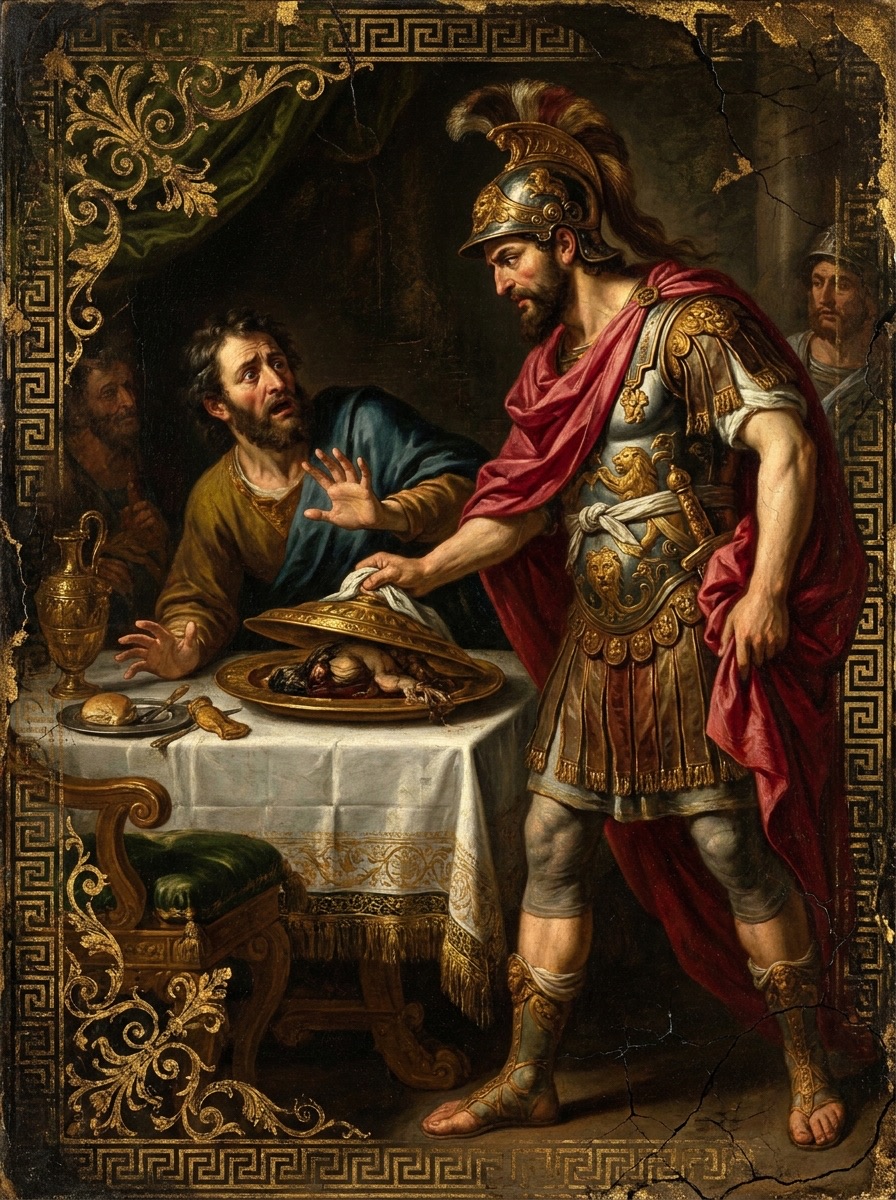
When Thyestes had finished eating, Atreus ordered the remaining things to be brought in. The servants did not carry ordinary dishes. They brought the children’s hands, feet, and heads. In that instant Thyestes understood what he had just eaten.
He sprang up from the table as if struck by lightning. The banquet hall was no longer a hall of feasting; it had become a tomb. He cursed Atreus, cried out to the gods, and tried to vomit up what he had swallowed, but it was too late. The deepest humiliation and anguish a father could endure had been laid by Atreus upon that table.
Atreus did not relent at his brother’s screams. He drove Thyestes out of Mycenae and forced him to carry that horror away with him. Thyestes had lost his sons and his honor; all that remained to him was the thought of revenge.
That feast became the most dreadful memory in the house of Atreus. When people spoke of the palace at Mycenae, they thought not only of gold, chariots, and high walls, but also of the table on which a father had been fed the flesh of his own children. When Aeschylus later wrote of the disasters that overtook Atreus’ descendants, he let this ancient hatred hang over the palace doors like a shadow.
The Blood-Debt Does Not End
After Thyestes left, he still sought vengeance. He consulted an oracle and learned that one day a child would avenge him—and that this child would be born from his own daughter. The prophecy was dark and almost unspeakable, yet it suited the terrible fate that seemed to rule this family.
Later, Thyestes came to his daughter Pelopia in the darkness. Pelopia did not know who the man was. In her terror and confusion she seized his sword and hid it away. Afterward she bore a child, named Aegisthus.
Events turned in a strange circle. Atreus did not know the child’s true parentage. He took Pelopia into his own house as his wife and raised Aegisthus as though the boy were his own son. When Aegisthus had grown, Atreus sent him to kill Thyestes. But the sword was recognized, and the truth came to light. Aegisthus learned that Thyestes was his real father, and he turned back and killed Atreus instead.
Atreus had destroyed his brother’s house with a feast, yet in the end he could not preserve his own life. After his death, the kingship of Mycenae was drawn again into the whirlpool of kin killing kin. Atreus’ sons, Agamemnon and Menelaus, would later step onto the stage of the story, but the palace they entered was already burdened with an old debt.
The story of Atreus and Thyestes ends here: a golden lamb gave rise to a struggle for kingship, betrayal led to a terrible feast, and the blood on that table became the seed of new revenge. The ruin of this family did not end with the two brothers. From their hands, it passed to the next generation.