Greek Mythology
The Arms of Achilles and the Death of Ajax the Greater — Greek Mythology
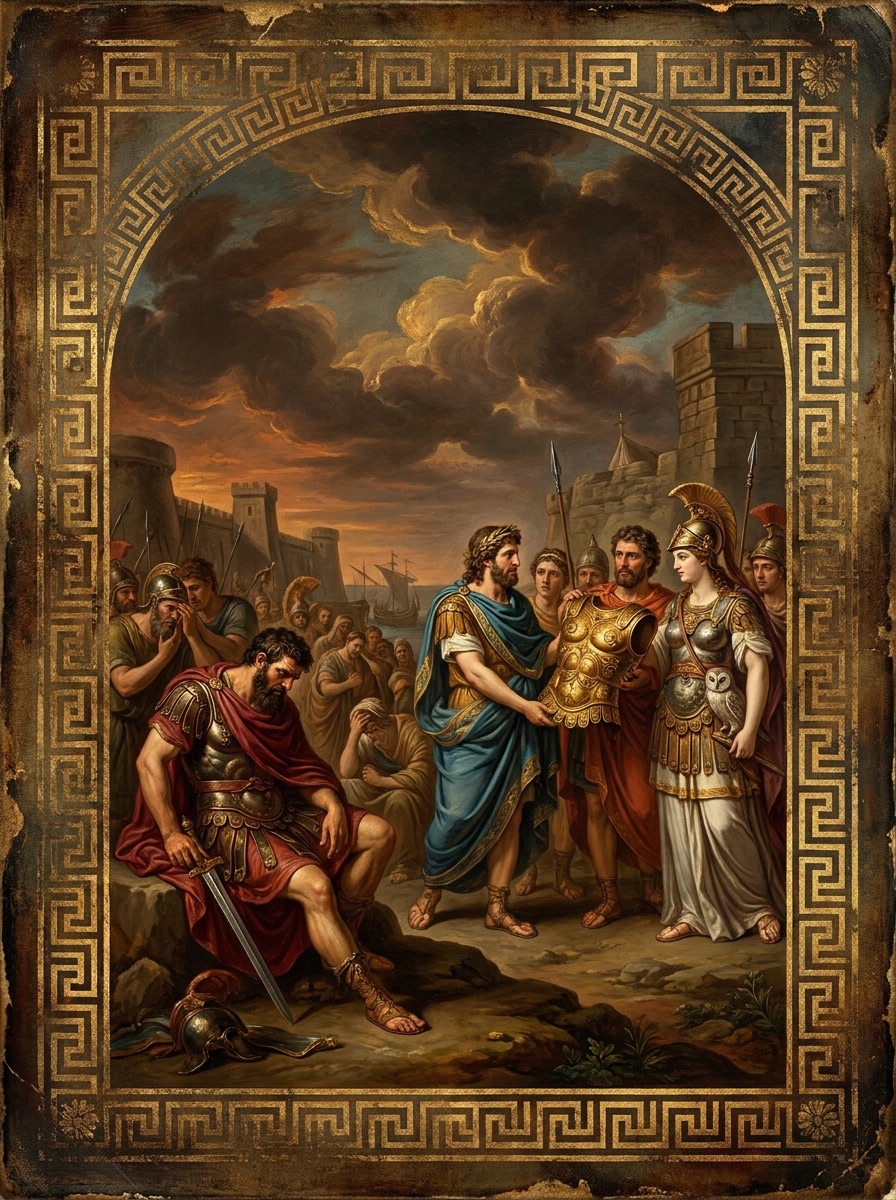
After Achilles fell, his god-forged armor became the heaviest prize in the Greek camp. Ajax the Greater and Odysseus contended for it, and the defeated Ajax, overcome by shame, rage, and madness, went toward his death.
Article
Summary
After Achilles died, the Greeks fought desperately to recover his body. Ajax the Greater shielded the corpse with his great shield, while Odysseus held off the pursuers beside him, until the warriors brought their strongest hero back to the ships. Once Thetis had mourned her son, Achilles’ god-forged armor became the heaviest prize in the Greek camp. Ajax believed that because he had stood over the body and withstood the enemy, he deserved to inherit Achilles’ arms. Odysseus argued that he too had protected the retreat in the mêlée, and that his counsel and stratagems had often saved the Greek army. Chiefs and soldiers hesitated between the two men, but the judgment finally gave the armor to Odysseus. The decision shattered Ajax’s sense of honor. He felt that his strength and years of service had been denied by the whole army, and at night he left his tent in rage, intending to kill those who had shamed him. Athena, unwilling to let the Greek leaders slaughter one another, clouded his sight and made him see livestock as his enemies. In his madness, Ajax cut down cattle and sheep, believing he was punishing Odysseus and the chiefs. When morning brought him back to himself, he saw dead animals and blood everywhere and understood that he had become a mockery before the army. Losing the armor had been humiliation enough, but this divinely sent frenzy seemed to ruin his name beyond repair. Ajax washed the blood away, took the sword once given to him by Hector, and went outside the camp to die by his own hand. The Greeks were shaken and divided: some remembered his night of madness, while others could not erase all the years he had stood where danger was greatest. In the end he was buried by the sea, and the Greek army lost one of its strongest shields, while the glory of Achilles’ armor became a bitter wound.
The Body of Achilles
After Achilles died, the battlefield outside Troy looked as if a storm had torn through it.
The dust had not yet settled before Greeks and Trojans were killing one another around his body. Everyone knew what was at stake. If the Trojans seized the corpse of Achilles and hung his armor on the walls, every heart in the Greek camp would sink. If the Greeks could bring him back to the ships, at least they could give the hero his funeral rites.
Ajax the Greater was the first to reach Achilles. He loomed over the field like a section of wall, holding up his massive shield. Spears struck its face, arrowheads skimmed past its bronze rim, but he did not give ground. He bent over Achilles’ body, shielding it with his own shoulders, covering the fallen hero in the dust with that great shield.
Odysseus also rushed into the mêlée. He did not have Ajax’s towering strength, but he moved quickly, his eyes always searching for an enemy’s weakness. He shouted for the Greeks to close ranks, while his spear drove back the Trojans pressing in. Menelaus, Diomedes, and other warriors came too. Across the field men shouted, horses screamed, and blood mixed with mud until even Achilles’ golden hair was darkened.
At last the Greeks lifted the body. Ajax held the rear against the pursuers, while Odysseus and the others guarded the flanks. The Trojans chased them all the way, hoping for one last chance to seize glory, but the Greeks clenched their teeth and withdrew to the ships, bringing Achilles back into their camp.
A sea wind blew in from the Hellespont, passing over the rows of black ships. Achilles, who had once given courage to the whole army, now lay silent there and would never rise again to take up his spear.
The Mother Rising from the Sea
The news reached the sea, and Thetis came with the sea-goddesses to the Greek camp. They rose out of the foam, their garments like wet white cloud, and their lamentation drowned the sound of the waves. The Greeks stood aside, and no one dared speak loudly.
Thetis bent over her son and touched his face. She had always known that Achilles’ life would be short, yet she had sent him onto the road of highest glory and greatest danger. Now the prophecy had come true. The hero had won undying fame, and lost everything in the world of men.
The Greeks held a magnificent funeral for Achilles. The pyre was built high; spices and fat were poured over the wood; horses and spoils of war were brought to the fire. When the flames rose, a column of smoke climbed straight into the sky. All along the shore, people saw the red glow that night.
After the funeral, Thetis set the arms of Achilles before the gathered army.
They were no ordinary arms. The shield was strong and heavy, its bronze gleaming like moving fire; the breastplate fitted the body of a warrior; from the helmet the horsehair crest hung down and stirred lightly in the wind. This armor had been made by the divine smith Hephaestus, and in Achilles’ hands it had filled the Trojans with dread. Now it stood empty, yet no one could look on it lightly.
Thetis said that the arms should be given to the man who had done the most in recovering Achilles’ body.
When she finished speaking, silence fell over the camp. Many looked toward Ajax the Greater; others looked toward Odysseus. For everyone remembered the battle that day: one man had guarded the body with his shield, and the other had held back the enemy with courage and cunning. But there was only one set of arms, and the honor could fall on only one head.
The Quarrel of the Two Heroes
Ajax the Greater stepped forward first.
He was not a man who loved polished speech. He came up to the armor with heavy steps, like a great beam striking the planks of a ship. Pointing to his own shield, he said that if he had not stood beside Achilles that day, the Trojans would have dragged the body away. Spears had fallen like rain, and he had not retreated; enemies had rushed at him from every side, and still he had held his ground. Achilles, he said, had been the strongest warrior in the whole army, and the arms of the strongest warrior ought to go to the man most ready to face the enemy head-on.
Many Greeks murmured their agreement. Everyone had seen Ajax’s valor. He had stood firm before Hector, and he had held the line beside the ships when fire threatened them. He did not have Achilles’ swiftness, but he was like a tower that could not be overthrown.
Then Odysseus rose.
He did not hurry into anger, nor did he try to overpower the others with his voice. First he acknowledged Ajax’s bravery. Then he said that strength alone was not enough in battle. Achilles’ body had been brought back because someone had found a path of retreat amid the confusion, because someone had struck back when the enemy closed in, because someone knew when to stand and when to rush forward. He too, he said, had fought bleeding beside the corpse; without him drawing off and checking the enemy, even Ajax’s thick shield would have been surrounded by layer after layer of Trojans.
Odysseus also recalled what he had done for the Greeks before: embassies, scouting, stratagems, night missions into the enemy camp. The Greek army needed not only a hand that could swing a sword, but a mind that could find a way out of despair. If the arms of Achilles were to go to the man who could best help the Greeks win the war, he believed he stood no lower than Ajax.
When both men had spoken, debate broke out across the camp.
Some supported Ajax, saying that honor belonged to the man who had endured the spears beside the body. Others supported Odysseus, saying that the war was drawing near its final turn and the Greeks needed his counsel more than ever. The chiefs were reluctant to decide too quickly, for whichever man received the armor, the other would be deeply wounded.
In the end, the judgment fell to Odysseus. One tradition says that the Greek leaders cast votes; another says that they asked captured Trojans which man had frightened them more on that day. However it was done, the result spread through the camp: the arms of Achilles belonged to Odysseus.
Odysseus accepted the armor carefully and did not boast aloud. But for Ajax, that was enough.
He stood where he was, as if his voice had suddenly been taken from him. The armor he had believed should be his was carried away by another man. The very men who had once survived behind his shield had not given him the honor. His face darkened. There was fire in his eyes, and a humiliation too deep to speak.
Rage in the Night
That night, the Greek camp slowly grew quiet. The fires had fallen to red embers, and the watchmen, cloaked against the sea wind, paced back and forth. The ship hulls rocked gently. Far away, the lights of Troy looked like a string of dim stars.
Ajax did not sleep.
He sat in his tent with a sword near at hand. It was the sword Hector had once given him. Long before, the two had met in single combat on the battlefield and fought from daylight until dusk, neither able to overcome the other. At last the heralds separated them, and the two warriors, respecting one another, exchanged gifts. Hector gave Ajax this sword; Ajax gave Hector a belt. Who could have known that those gifts would later be shadowed by death?
The more Ajax thought, the less he could endure it. He believed the chiefs had cheated him. He believed Odysseus had stolen his honor. His mind seemed covered by a black mist, and reason slowly withdrew. At last he seized the sword and went out of his tent.
He meant to kill in the night those who had judged against him. He meant to kill Odysseus too. The sand sounded beneath his feet, and the blade glimmered coldly in the dark.
But Athena would not allow the Greek leaders to die in civil bloodshed. She clouded Ajax’s eyes, made him lose the path, and made him mistake everything before him.
Ajax burst into the livestock pen.
There the cattle and sheep taken from battlefields and villages were tethered for the night, crowded between wooden rails. The cattle breathed hot mist from their nostrils; the sheep shifted near the heaps of fodder. But Ajax saw them as his enemies. He thought the bulls were the Greek chiefs; he thought the sheep were soldiers mocking him. With a roar he swung his sword, cut through ropes, split open the necks of cattle, and drove the fleeing sheep back into corners one by one.
The animals screamed, and the wooden rails shook and clattered. Blood ran over the ground and soaked the straw. The watchmen heard the noise from afar but did not dare come close. They saw only the huge figure of Ajax brandishing his weapon in the dark, like a shadow possessed by the god of war.
When his fury was spent, he dragged several dead beasts back before his tent, still believing he had punished his enemies. Night covered everything. He sat down beside the bloodstains, breathing heavily, as if he had just returned from a great battle.
The Shame of Morning
At dawn, the mist lifted.
Ajax opened his eyes and saw neither Odysseus nor Agamemnon nor any of the chiefs he had hated through the night. Before his tent lay dead cattle and slaughtered sheep. The ground was covered with hoofprints, blood, and severed ropes. A few animals not yet dead twitched in the dust and gave low, broken cries.
Slowly he understood.
He had not killed his enemies in the night. After losing his honor before the whole army, he had been deluded by a goddess and had slaughtered a herd of animals. When the soldiers gathered, how would they look at him? What would they say? Ajax the Greater, who had once stood against Hector and guarded the body of Achilles, had become a thing to laugh at.
Shame went deeper than any wound.
He did not defend himself to anyone, and he did not go to find Odysseus. He knew that words could not gather everything back again. For such a hero, reputation was not a cloak outside the body, something to take off and replace. Reputation was like bone. Once broken, the whole man could no longer stand upright.
Ajax washed away the blood and changed his clothes. He took up the sword Hector had given him and went to a lonely place outside the camp. The sea wind moved over the sand; from far away came the voices of men beside the ships. In the morning light the walls of Troy showed their outline, like a long silent line.
He fixed the sword-hilt in the ground, with the blade pointing upward.
Before he died, he thought of his father Telamon, of his home on Salamis, and of all his years of fighting at Troy. How many times had he stood where danger was greatest? How many times had he forced the enemy back? Yet in the end, what remained to him was not the armor of Achilles, but the stain of one night’s madness.
He waited no longer.
Ajax fell upon the sword, and his blood ran into the sand. The sword Hector had given him ended his life.
The Tomb Without a Pyre
When the news came back to the camp, the Greeks were shaken.
Some regretted what had happened. Some were silent. Others did not know how to face it. When Odysseus heard that Ajax was dead, he took no pleasure in victory. They had been rivals in the contest for the armor, but Ajax had been the strongest shield in the Greek army. With such a warrior fallen, no one could say the army was stronger.
A new quarrel rose among the Greek chiefs over his burial. Some said that because he had meant to murder his comrades in the night, he did not deserve full honors. Others said that one night of madness could not erase the years of service he had given on the battlefield. In the end, the Greeks buried him by the sea, with his mound facing the Trojan plain.
The arms of Achilles would shine again in the war, but Ajax the Greater would never again lift his shield in the front rank. When soldiers passed his grave, they would remember that towering figure: in the worst danger, he had guarded his comrades with his own body; in his deepest shame and rage, he could not guard himself.
From that day on, one of the heaviest and most reliable shields was missing from the field before Troy.