Greek Mythology
Ariadne and Theseus — Greek Mythology
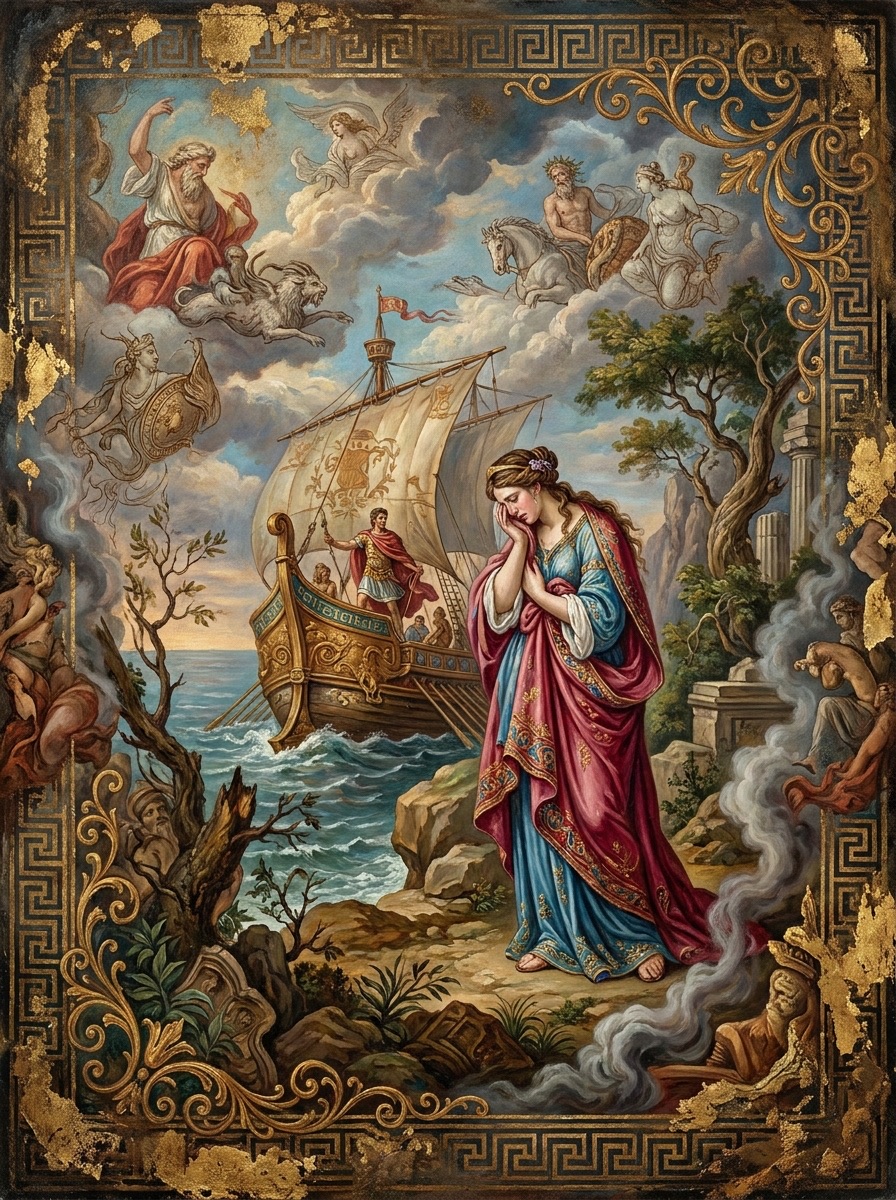
Ariadne, daughter of Minos, helps Theseus survive the Labyrinth and then leaves Crete with him. This story focuses on her choice, exile, abandonment, and later divine fate.
Article
Summary
Ariadne sees Theseus among the Athenian captives and chooses to help him, though that choice turns her against her father and her homeland. She gives him the thread that makes escape possible, flees Crete with the Athenians, and is later left on Naxos. There her story passes out of Theseus’s shadow and into the orbit of Dionysus.
The Princess Sees a Stranger
On Crete, King Minos’s palace rose high and splendid, with bright columns, courtyards, bronze vessels, and drifting incense. Yet to the young men and women from Athens, it did not seem like a palace at all. It looked more like the gate to a tomb.
They were brought before the king. Minos sat above them and studied the tribute. Theseus stood among the others without lowering his head. He was too calm for a man facing death, and unlike the rest, he showed no terror. He looked as though he had already chosen the dangerous thing he meant to do and was waiting only for the door to open.
Ariadne, Minos’s daughter, was standing nearby.
She saw the youth from Athens and felt something stir at once within her. There was no pleading in Theseus, but neither was there reckless pride. He seemed like a man who had already decided to face danger and was only waiting for the chance. Ariadne knew what the Labyrinth was. She knew too that no one ever came back from it. When she thought of this young man soon vanishing behind those endless stone walls, her mind and heart were thrown into confusion.
That night, when the palace had grown quiet, and the torches along the corridors made only soft crackling sounds, Ariadne found Theseus in secret.
“Do you truly mean to kill the Minotaur?” she asked in a low voice.
“That is why I came,” Theseus said.
“Killing it will not be enough,” Ariadne answered. “The Labyrinth is harder to defeat than the monster itself. Daedalus built it so that every passage folds into another. Once you go in, after a few turns the path behind you may as well have never existed. Even if you bring the beast down, you will die of hunger inside.”
Theseus looked at her but said nothing.
Ariadne drew a ball of thread from beneath her robe and placed a sharp sword in his hand. The thread was not large, but it felt heavy there, like a thin road that could pull a person back from death.
“Inside the maze,” she said, “tie one end at the entrance. As you go forward, let the thread run out bit by bit. After you kill the monster, follow it back. But you must promise me one thing.”
“What is that?”
“Take me away from Crete.”
Once she said it, Ariadne may already have known that there was no turning back. She was betraying her father’s house, her island, and everything she had known since childhood. Still she stood there and placed the thread in Theseus’s hand.
Theseus closed his fingers around it and swore to her, “If I come out alive, I will take you with me.”
The Thread She Gave
Ariadne gave Theseus the practical shape of hope: a sword for the monster and a ball of thread for the maze. The killing of the Minotaur belongs to Theseus’s own story. For Ariadne, the decisive moment was different. She chose to trust the stranger, to betray the silence of her father’s palace, and to tie her own future to the line she placed in his hands.
The Escape by Night
Ariadne was already waiting there.
The Athenian ship lay on the shore, its black sail stirring in the night wind. The sailors cut the moorings at once and sent the oars into the water. Some traditions say that, so the Cretans could not give chase immediately, Theseus also damaged the gear of several ships in the harbor, keeping them from sailing at once.
Ariadne looked back once toward the Cretan shore. The palace lights still glimmered in the distance, and her father had not yet learned that his daughter had left him. In that glance there was fear, and there was resolve. Then she stepped aboard and stood beside Theseus.
Once the ship was clear of land, the sea struck its sides in a steady rhythm. Crete slipped little by little into darkness. The young men and women sat in the hold, hardly able to believe they had escaped. Some hugged their knees and trembled; others prayed softly to the gods. Theseus stood at the prow, staring ahead across the water. Ariadne stood not far from him, with empty hands, for the ball of thread had already done its work.
They sailed on until they came to Naxos. There were hills and sandy beaches there, and the dawn wind moved through the grass. Everyone went ashore to rest, and exhaustion quickly overcame them. Ariadne, too, fell asleep. After a night of flight, she thought she would wake to see the ship and the young man who had sworn to take her away.
But then she heard oars in the distance.
When she opened her eyes, the ship was already gone. Only its sail could still be seen, fading out across the sea. Theseus had left. The old tales give different reasons for why he abandoned Ariadne on Naxos: some say he changed his heart; some say the gods would not allow him to take her; others say that Dionysus had already marked the princess for himself. Yet of all these versions, what people most remember is the moment Ariadne woke and found herself alone.
She stood on the empty shore, with neither the palace of Crete nor the ship of Athens in sight. The waves kept coming ashore and drawing back again. She called Theseus’s name, but the only answer was the wind.
A New Fate on the Island
Ariadne wept by the shore. For Theseus’s sake she had turned away from her father and opened a road for the people of Athens, only to be cast off on a strange island. As she looked out across the sea, it felt as though the thread she had once given away had turned back and wrapped itself around her own heart, tightening little by little.
Then another sound rose on the island.
It was not the beat of oars and not the cry of pursuers, but drums, pipes, and shouts of joy. From the hills came a company of attendants, carrying thyrsi and crowned with ivy. At their center walked Dionysus.
When Dionysus saw Ariadne, he came to her. For her, it was as though fate had suddenly opened another path out of the darkness. She had lost her home and the promise of Theseus, but she was not left forever on a deserted shore. Dionysus comforted her and took her as his wife. Later, people said that he lifted her crown high into the sky, where it became a wreath of stars. So, when someone looked up at night and saw that bright cluster, they remembered the princess who had been abandoned on the shore of Naxos and then gathered up by a god.
Meanwhile, Theseus sailed on toward Athens.
He had killed the Minotaur and saved the young men and women of his city, but he forgot one thing that weighed most heavily on his father’s heart. Before he left Athens, he had promised that if he returned safely, the black sail would be changed to white. Yet in the confusion aboard the ship, or because his thoughts were elsewhere, the black sail still hung from the mast.
Day after day, Aegeus stood on the high shore and watched the sea. At last he saw a ship returning from afar. It drew closer and closer, but its sail remained black. The old king believed his son had died in Crete, and grief overcame him. Before the ship had even reached the harbor, he threw himself into the sea.
So when Theseus returned to Athens, victory had already been touched by sorrow. The Minotaur was dead, the blood-debt to Crete was ended, and the children of Athens would no longer be carried off on the black-sailed ship. Yet Ariadne had been left on Naxos, and Aegeus had gone beneath the waves. What this story leaves behind is not only a hero’s triumph, but also the sorrow of loss and the cost carried on the wind over the sea.