Greek Mythology
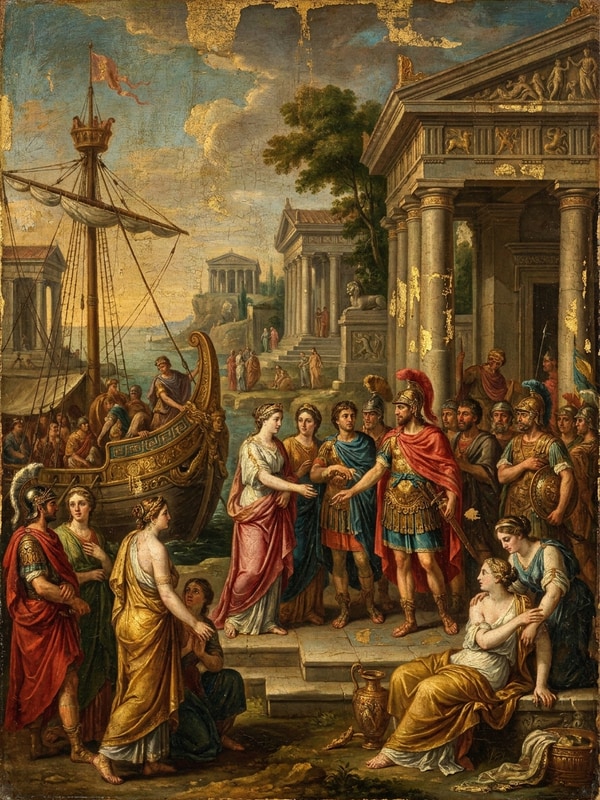
The Argonauts on Lemnos — Greek Mythology
When the Argo reached Lemnos, the island was inhabited only by women burdened with bloodguilt. At first they raised weapons against the newcomers; then they welcomed the heroes in. After a brief season of peace, the Argonauts were stirred by the purpose of their voyage and sailed away again.
Article
Summary
After leaving the Greek coast, the Argo ran before a favorable wind and came to Lemnos. The island looked strangely whole: walls, fields, and palace all stood in place, yet no grown men were to be seen. The women of Lemnos, it was said, had offended Aphrodite. Their husbands rejected them and turned instead to slave women brought from Thrace. Anger and humiliation gathered until, in one night, the women killed the men of the island. Only King Thoas survived, secretly saved by his daughter Hypsipyle. Afterward the women guarded the city, worked the fields, and held counsel by themselves. Hypsipyle became queen, though she had to hide the truth about her father. When the Argo approached the shore, the Lemnian women feared that enemies or pirates had come. They took up armor and spears at the gates, then sent a messenger and learned that the strangers were heroes bound for Colchis. Hypsipyle welcomed Jason into the city, but she did not tell him what had truly happened on the night of slaughter. She said instead that the men of Lemnos had abandoned their wives and children and gone away with Thracian women. Jason did not press her, and the Argonauts needed water, food, and rest. The gates opened; feasts were prepared; and the silent island filled again with firelight, cups, and voices. For a time the heroes lingered on Lemnos. Hypsipyle loved Jason, and the other women joined themselves to the Argonauts. The island seemed, briefly, to rise out of bloodguilt and fear. Yet the heroes had not sailed there to make homes. The Golden Fleece still lay far away, and Pelias still waited in Iolcus for the outcome of their quest. At last Heracles called the men back to the ship with stern words, reminding them not to leave their glory and their oath behind in warm houses. Jason said farewell to Hypsipyle, and the Argo went out to sea again. Lemnos kept the queen's secret and the memory of a short season of joy, along with the children and hope that would grow from those meetings.
The Island Without Men
After the Argo left Iolcus, her prow split the waves, and the oars fell stroke by stroke upon the water. The heroes crowded the long ship: some gazed toward the clouds far off, some cleaned their weapons, and some wondered how distant the Golden Fleece truly was.
Before long, an island rose ahead of them. It had hillsides, walls, and a harbor where a ship might safely come to shore. This was Lemnos.
As the ship drew near, the heroes sensed that something was wrong. No fishermen stood by the sea. No herdsmen drove cattle beside the fields. Near the city gates there was no sound of men calling to one another. The island was not deserted: the houses remained, and smoke still rose from hearths. Yet the voices that should have filled such a place seemed to have been carried away in a single night.
The Argonauts did not yet know that the island had just passed through a terrible slaughter.
The women of Lemnos had once offended Aphrodite, goddess of love and beauty. In anger, the goddess made an evil smell cling to them. Their husbands began to despise them and would not come near them. Then the men brought back slave women from Thrace and took those young strangers into their houses.
Day after day, shame pressed upon the hearts of the Lemnian women. They saw their husbands sitting beside foreign women; they saw their own beds left empty; they saw even their children neglected. At last their anger burned to its end.
One night the women took up knives and axes and broke into the houses. The men were still asleep. Some woke only in time to reach for their swords; some never even cried out. Husbands, fathers, brothers—even young boys did not escape. By dawn, blood had run through Lemnos, the earth before the doorways had darkened, and the sea wind blew through a city where only women stood in silence.
Only one man was left alive.
He was Thoas, the old king of Lemnos. His daughter Hypsipyle had taken part in the women’s council, but when her father’s turn came, she could not strike him down. She hid Thoas and prepared for him a chest—or, in another telling, a small boat—so that he might slip away from the shore by night. The sea carried the old man elsewhere, and Hypsipyle returned to the city and told the others that her father too was dead.
From then on, the women of Lemnos guarded the city themselves. They worked the fields themselves. They ruled the altars and the palace. Hypsipyle became their queen. She was young, yet she had to sit upon the throne and listen as the women discussed grain, watches, and the winds out at sea.
The Women on the Walls
When the Argo came into sight, confusion broke out in the city.
From far off, the women of Lemnos saw a great ship making for the shore, filled with armored men, their spears flashing in the sun. Fear seized them. They thought the kin of the slain men had come from Thrace to take vengeance, or that pirates had heard there were no men on the island and had come to plunder it.
The women hurried up onto the walls. Some put on armor left behind by their husbands; some took up long spears still stained with old blood. They were not used to standing in battle order, but in that moment none of them would give way. The gates were shut. On the towers, women drew their bows and fixed their eyes on the shore.
The Argonauts also saw the movement along the walls. They did not rush forward at once. The ship lay by the beach, and the heroes held their weapons while they studied this strange city. Jason stood at the prow, wearing a bright cloak, and looked toward the gate. He knew the expedition had only just begun, and he did not want to begin a war here through misunderstanding.
Inside the city, Hypsipyle gathered the women for counsel. The younger women were mostly afraid. They remembered what they had done, and they feared that men had returned to punish them. Some urged immediate battle and said no stranger should be allowed within the city. Others said they should first send someone to learn why the men had come.
Then an older woman spoke. She had seen more years and understood better than the young what the island now faced. She said that women alone might work the fields for a time, and looms might continue to sound, but without children the days would grow emptier and emptier. If these men from afar were not enemies, perhaps they should not be shut outside the gates.
Hypsipyle listened and sent a messenger out of the city. The messenger went down to the shore and told the Argonauts that the queen was willing to receive them. They might enter the city without hostility.
The heroes let their tension fall. Jason chose a few men to accompany him and walked at their head. When the gate opened, its hinges groaned heavily. The women of Lemnos stood on either side and watched these unfamiliar heroes pass. It had been a long time since they had seen men so near. Some lowered their eyes; some stole glances; others still kept their hands on the hilts of their knives.
Hypsipyle’s Lie
Jason was led to the palace. The throne there should have belonged to King Thoas; now his daughter Hypsipyle sat upon it.
She wore the robes of a queen and tried to keep her face calm. As she looked at Jason, she knew she could not tell him the truth. If these heroes learned that the women of the island had just killed their own husbands and fathers, perhaps they would loathe them, or fear them, or draw their swords.
So Hypsipyle told another story.
She said that the men of Lemnos had rejected their wives and sailed away with women taken from Thrace, abandoning their homes and children. The women, left behind, had been forced to defend the city, the fields, and the temples by themselves. She spoke with sorrow and with care, as if she had wiped the night of blood from memory and left only the pain of betrayal.
Jason heard her out and did not ask where the men had truly gone. The heroes had come a long way already and needed rest, food, and fresh water. Lemnos opened its storerooms, set out wine and bread, and the heroes entered the city without men.
Soon the air of fear loosened.
The women prepared feasts for their guests. Fires were lit in the houses, and bronze cups were filled with wine. The heroes took off their armor, reclined at table, and spoke of the hardships of sailing and the task that waited far away. The women of Lemnos listened to the names: Jason, Orpheus, Telamon, Peleus, the twin brothers Castor and Polydeuces. Those names entered the long-stifled city like a wind from the sea.
Hypsipyle kept Jason in the palace. She was young and beautiful, and after disaster she had borne the burden of rule alone. Jason, too, was moved by her. They spent their days receiving the city’s hospitality and their nights speaking together by lamplight. Hypsipyle hoped the heroes would stay, at least for a while. She had no husband, and the island had no future. When she looked at Jason, it was as though she saw a rope by which Lemnos might be drawn back into life.
The Argonauts scattered among the households. The women welcomed them, washed the salt of the sea from them, brought out fresh clothing, and set food before them. Laughter slowly returned to the city. The looms sounded again, wine jars were opened, and incense rose once more before the altars.
And so the ship of the expedition lay still in the harbor.
The Forgotten Ship
Day followed day, and the Argo rested quietly by the shore. Waves struck her hull; the mooring ropes swayed gently against the posts. The oars were stowed in the hold, the sail remained furled, and no one hurried to raise it.
The heroes had meant to go to distant Colchis and win the Golden Fleece. But the beds of Lemnos were soft, the wine was warm, and the women’s eyes made departure difficult. Some men began helping mend roofs. Some went out with the women to look over cattle and sheep in the fields. Some simply hung their spears upon the wall, as if the expedition might be set aside for a little while.
Only Heracles did not wholly sink into the island’s ease.
He watched his companions lingering in the city. He watched Jason delay giving the order to sail. His anger grew. Heracles had not come for pleasure. He had joined the Argo to take part in a hard voyage, to cross the sea with the greatest heroes and reach places where no ordinary man dared go. Yet they had scarcely begun, and already his companions behaved as though they had reached the end.
At last he could bear it no longer.
Heracles summoned the heroes back to the ship. He stood in the sea wind, broad-shouldered, his voice heavy with reproach. He reminded them that the Golden Fleece still lay far away, that Pelias still waited in Iolcus, and that the oath of the expedition had not been fulfilled. They had not come to Lemnos to make homes as guests. They could not leave their glory behind in warm houses.
His words struck them like cold water. The heroes lowered their heads and remembered why they had left their own lands. Jason too fell silent. Hypsipyle’s palace, the peace of the island, the women’s affection—all of it was real. Yet the prow of the Argo still pointed toward a farther sea.
He knew it was time to go.
The Morning of Departure
When news of their departure spread, Lemnos grew quiet again.
The women did not hold them back, but they could hardly bear to let them go. They prepared food for the voyage, filled skins with wine, and brought clothing and gifts down to the ship. Some stood weeping in doorways. Some walked all the way to the shore beside the heroes they had welcomed. Their brief laughter had not yet faded, and already farewell stood before them.
Hypsipyle accompanied Jason to the ship. She knew she could not keep him. She pressed down her sorrow and spoke to him still as a queen. She asked him to remember Lemnos, and the island that had opened its gates to him. Jason, too, said farewell and promised that he would not forget her kindness.
In later times people said that Hypsipyle bore Jason children, the most famous of whom was named Euneus. Through that child, a bloodline remained between Lemnos and the Argonauts. But on that morning of departure, all of this still belonged to the future. What lay before them was only parting in the sea wind.
The heroes boarded the ship once more. The rowers returned to their benches and set their hands around the familiar oars. The mooring ropes were loosed; the hull gave a slight shudder and moved away from land. Perhaps Orpheus’ lyre sounded again, rising above the water and the sighs.
The women of Lemnos stood upon the shore and watched the Argo draw farther and farther away. The sail swelled in the wind, white as the wing of a seabird. The heroes had not stayed long on the island, yet they had left the manless Lemnos with children and hope.
And the Argo sailed on. She carried the heroes out of the warm harbor and back onto the dangerous sea road, leaving behind her, in the sound of the waves, the secret of Lemnos and its brief feast of joy.