Greek Mythology
The Argonauts Arrive at Colchis — Greek Mythology
After their perilous voyage, the Argo at last enters the Phasis River in Colchis. Jason goes with his companions to the palace of King Aeetes and asks for the Golden Fleece, but the king answers with a trial that seems almost certain to kill him.
Article
Summary
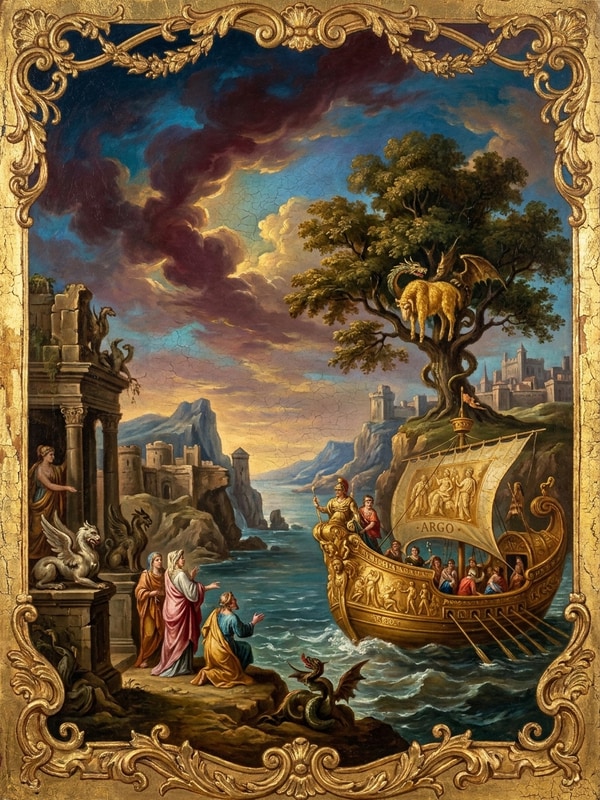
After a long voyage, the Argonauts see the Caucasus Mountains and the mouth of the Phasis River. They guide the ship inland, make sacrifice to the gods, and consider how they should approach Aeetes, king of Colchis, for the Golden Fleece hangs in a sacred grove there, guarded by a sleepless dragon. Jason does not want to begin with violence the moment they reach land. He takes Telamon, Augeas, and several sons of Phrixus into the city, hoping first to ask the king for the fleece with words. Colchis is splendid and strange to Greek eyes, and in the royal palace live Aeetes, Queen Idyia, his daughter Chalciope, and Medea. The sons of Phrixus are recognized by their kin, and for a while the palace is filled with tears and joy. But when Aeetes hears that these Greeks have come for the Golden Fleece, his face changes at once. He suspects that they have not come merely seeking a treasure, but are secretly looking toward his throne and his land. Jason masters his anger and promises that, if he is allowed to take the fleece, he and the Argonauts will fight for Aeetes or serve him in return. Aeetes then sets his condition: Jason must yoke the fire-breathing bulls with bronze hooves, plow the field of Ares, sow the dragon’s teeth, and kill the armed warriors who spring from the earth. Only then do the heroes understand that arriving in Colchis is not the end of their danger. The true peril has only just been placed before them.
The Mouth of the Phasis
The Argo had been long at sea.
The heroes had passed between the clashing rocks, heard the waves roar beneath the ship’s sides like wild beasts, and put in at strange shores where they buried companions who would sail no farther. Now the color of the sea began to pale ahead of them, and far off, through the mist, a shadow of mountains rose like a dark wall across the edge of the sky. That was the Caucasus. At its foot a great river poured into the sea, broad and muddy, with reeds crowding the mouth and waterbirds lifting from the shallows only to settle again.
Tiphys held the steering oar and called for the sailors to tighten the rigging. The rowers bent their backs and drove the ship stroke by stroke into the river mouth. The Argo moved up the Phasis, leaving the sound of the open sea behind; in its place came the slap of river water against the banks. Thick trees pressed close on either side, their branches hanging low over the current as though to hide the foreign ship from sight.
Jason stood at the prow and looked out over the unknown land. He knew that the thing they had come to find was here.
The Golden Fleece had once belonged to the divine ram that carried Phrixus away from Greece. When Phrixus reached Colchis, he sacrificed the ram to Zeus and hung its fleece in the sacred grove of Ares. There, the story said, a dragon that never slept lay coiled in guard, its eyes never closing. Jason had sailed from home to bring that fleece back to Iolcus, so that he might demand from Pelias the kingship that should have been his.
Yet now that he had come so far, he could not afford rashness.
The Argo came to rest in a bend of the river. The heroes fastened the cables to roots along the bank, then made sacrifice according to the old custom, praying that Hera, Athena, and the other gods who had brought them this far would continue to aid them. Smoke rose from the rough altar they had built, mingling with the damp smell of river mud. Some men wiped down their spears; others checked their shields; others stood in silence, looking toward the distant city.
Telamon, quick-tempered as ever, thought that since they had reached Colchis they ought to go at once with weapons in hand and seize the fleece. But Jason did not agree at once. He gathered his companions and said, “We have come a long way. If we rush ashore into another man’s land like robbers, every man here will take up arms against us. Let me first go to Aeetes and tell him why we have come. If he gives us the Golden Fleece willingly, the river need not run red. If he refuses, then we can decide what else must be done.”
The others were uneasy, but they knew there was sense in what he said.
So Jason chose a few men to go with him. Telamon was strong and brave, a man who did not give ground when trouble came. Augeas, it was said, belonged like Aeetes to the line of Helios, and his presence might make the king receive them with a little more courtesy. With them went several sons of Phrixus, grandsons of the Colchian royal house, whom the Argonauts had lately rescued after a shipwreck; they could guide the strangers through the land.
The rest of the heroes stayed by the river, guarding the Argo and the weapons.
The Road to the Royal City
Jason and his companions left the riverbank and followed the road that led toward the city.
Colchis was not like the harbor cities of Greece familiar to them. The air was wet, canals and streams cut through the land, and the fields stretched broad and open. In the distance they could see herds of cattle and horses. The people wore garments of unfamiliar cut, and when they heard the footsteps of strangers, they stopped their work and stared at the Greeks with their swords and spears.
The nearer the travelers came to the city, the smoother the road grew. Soon the palace of Aeetes stood before them. Its walls were high, and its doorposts and beams shone with the gleam of metal. Clear water ran through the courtyard, and trees cast shade over the stone steps. Men said that the palace had the richness of the bloodline of Helios, and anyone who looked upon it knew that its master was no ordinary king.
The sons of Phrixus walked ahead. They had been long from home, had drifted across the sea, and their clothes still carried the dust of travel. The gatekeepers recognized them and ran in astonishment into the palace. Before long the news reached the women’s chambers, and Chalciope was the first to hurry out.
She had been the wife of Phrixus and was the mother of these young men. She had believed her sons dead at sea; now, seeing them suddenly standing before the gate, she could not speak. She rushed forward and embraced them, and her weeping echoed through the palace colonnades. Queen Idyia also came out, and the maidservants gathered around in wonder and delight.
For a time, that reunion softened the hostility around Jason and his companions. They were invited inside; water was brought so the guests could wash the dust from their hands and feet, and food was set before them. Jason sat in the guest’s place, but his eyes quietly took in everything around him. He knew that the man who could decide their fate had not yet spoken.
Then Aeetes came.
The king of Colchis was imposing in body and sharp in gaze. He was a son of Helios, and there was something about him that made men careful not to take him lightly. Seeing his grandsons safely returned, he first asked how they had survived the sea and how they had come upon these Greeks. The sons of Phrixus told him what had happened: they had sailed from Colchis, a storm had broken their ship, and they had almost drowned, until the Argo came by and saved their lives.
At this, Aeetes nodded to Jason and the others, acknowledging the debt.
But his eyes did not soften.
The Request for the Golden Fleece
When the feast had been laid, Jason knew he could delay no longer. He rose and told Aeetes who he was: he came from Iolcus, the son of Aeson. Pelias had seized the throne that should have been restored, and had ordered him to sail all the way to Colchis and bring back the Golden Fleece. He had not come to plunder the city, Jason said, nor to harm the people of Colchis. He asked only that the king give him the fleece, so he might carry it home.
He spoke without servility and without arrogance. To reassure the king, Jason also promised that if Aeetes granted their request, the Argonauts would aid him in war, help him conquer his enemies, and repay the favor with service.
A silence fell over the hall.
The Golden Fleece was no ordinary treasure. It came from a divine ram and hung in the grove sacred to Ares; it was part of the glory of the Colchian royal house. To Jason it was the hope of returning home. To Aeetes it was like a flame burning beside his kingship, and anyone who reached for it seemed to be reaching with a hidden purpose.
Aeetes’ face darkened. The moment he heard the words “Golden Fleece,” suspicion rose in him. This king did not believe that a young man from far away had come only to fulfill another man’s command. He looked at the shipload of strong Greek warriors who had come to the Phasis and thought that, though they spoke of asking, they might mean to take his treasure first and his kingdom after it.
His voice grew cold. “If you had not saved my grandsons,” he said, “you would already be paying the price for such words. You call yourself a hero, and you say you are willing to serve me. Then first let me see what you can do.”
Telamon heard the contempt in the words, and his hand almost went to his sword hilt. Jason checked him with a glance and remained standing before the king, unmoving.
Then Aeetes named the terms.
In the field of Ares there were two bulls with bronze hooves. They were no common plow beasts: flames burst from their nostrils, and their breath burned like fire from a furnace, so that anyone who came near would be scorched. Jason must yoke them with his own hands and drive them to plow a hard field. When the plowing was done, he must sow dragon’s teeth in the earth. As soon as those teeth touched the soil, armed warriors in armor would spring up bearing spears. Jason must kill them all by himself.
“If you can do all this in a single day,” said Aeetes, “I will give you the Golden Fleece. If you cannot, speak of it no more.”
When he had finished, everyone in the palace understood that this was not a test of a guest’s courage. It was a sentence of death.
The fire of the bronze-hoofed bulls could burn a man’s flesh black, and the warriors grown from dragon’s teeth would rise at once with spears ready to kill. A young stranger, however good his sword and however steady his hand, could scarcely hope to come alive out of such a field.
Medea Sees Jason
Yet there was another person in the palace who heard all that was said.
She was Medea, daughter of Aeetes. She was young, but she already knew herbs and spells; she served the goddess Hecate and understood which roots gathered at night could ease pain, and which juices could draw a person down into sleep. In ordinary days she did not linger long before strange men. But on this day she saw Jason standing in the hall, and heard her father set a path of death before him, and suddenly her heart was thrown into confusion.
The hands of the gods were moving in the darkness as well. Hera and Athena did not want Jason to die uselessly in Colchis, so they went to Aphrodite for help. Aphrodite then sent little Eros to shoot his arrow into Medea. That arrow made no sound, yet it struck more fiercely than open flame. Medea looked at Jason, and something seemed to hit her in the breast. Her face went pale, then flushed red. She tried to turn her eyes away, but again and again she looked back.
Jason knew nothing of this. He saw only the king’s anger, the tense faces of his companions, and the many people in the palace waiting for him to show fear.
He did not refuse.
After a short silence he said, “I accept. If this is the condition for obtaining the Golden Fleece, then I will do it.”
The words sank heavily into the hearts of the men who had come with him. Telamon and Augeas both knew that such a promise was almost the same as handing over his life. But before Aeetes they could not show panic. They could only leave the feast with Jason and withdraw.
Aeetes watched them go, and his anger still burned within him. He had already resolved that even if Jason somehow overcame the bulls and the earthborn warriors, he would not easily allow these foreigners to carry off the Golden Fleece.
The Problem in the Night
When Jason and his companions left the palace, darkness had already fallen.
The palace walls that had gleamed in daylight now seemed lower beneath the dusk, and torches were being lit one by one throughout the city. In the distance the Phasis could no longer be seen clearly; only the sound of its broad current moving through the night reached them. Jason walked in silence. Not until they were away from the crowd did Telamon speak in a low voice.
“This is no fair bargain,” he said. “He means for you to die in that field.”
Jason knew it.
But he had come all the way to Colchis. He had stood before Aeetes and made his request. If he drew back now, every hardship the Argo had endured would come to nothing. The companions who had died, the storms at sea, the road between the clashing rocks—all would have been suffered in vain.
The sons of Phrixus were troubled as well. They knew this land, and they knew that the field of Ares and the two fire-breathing bulls were not merely frightening rumors. The bulls truly breathed flame from their nostrils; when their bronze hooves struck the ground, even stones trembled. As for the warriors who sprang from dragon’s teeth, no man’s strength could easily stand against them.
When the party returned to the riverbank, the Argonauts immediately gathered around. After they heard Aeetes’ conditions, some were furious, some fell silent, and some proposed seizing the Golden Fleece by night and fleeing at once. But the sacred grove where the fleece hung was guarded by a dragon, and the soldiers of Colchis were no feeble men. A reckless attempt would only trap the Argo in a ring of enemies.
Jason looked out into the dark river. The ship rocked gently; the current drew the cable taut, then let it slacken again. Far away, the royal city crouched in the night like a banked fire, waiting for morning to see him enter the field of death.
That night the Argonauts at last understood: they had reached Colchis, but they had not yet gained anything. The Golden Fleece still hung deep in the grove of Ares, with the sleepless dragon coiled beneath the tree. Aeetes had set his deadly trial. And inside the palace, Medea lay restless because of an unseen arrow.
So the end of the voyage had become a new peril. If Jason wanted to carry away the Golden Fleece, he first had to survive tomorrow on the soil of Colchis.