Greek Mythology
The Argo and the Gathering of the Heroes — Greek Mythology
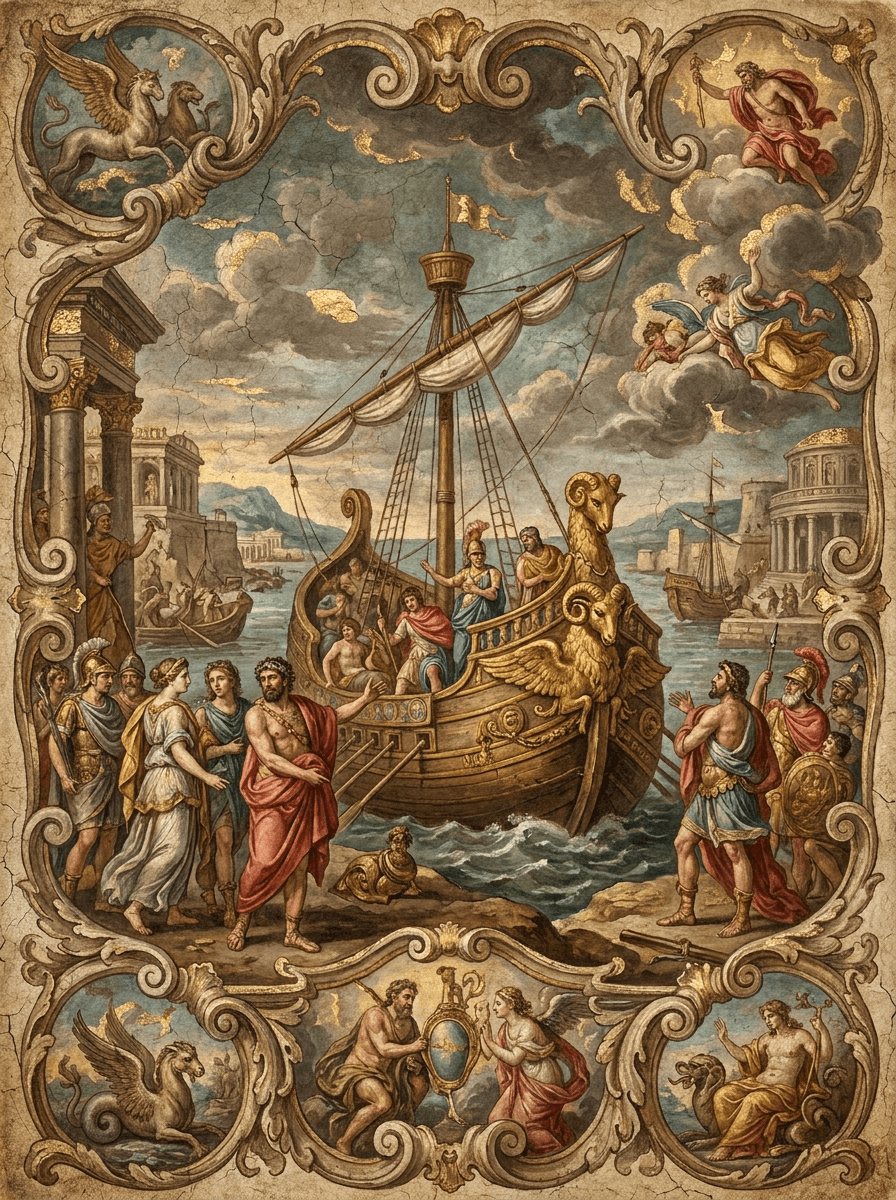
To recover the Golden Fleece, Jason is forced to summon heroes from across Greece, build the great ship Argo, and set out on the long voyage to Colchis. Warriors gather from every land; the oars bite the sea for the first time; and the expedition of the Argonauts begins.
Article
Summary
In the city of Iolcus, Pelias had seized the throne, yet he lived in fear of a prophecy: a man wearing only one sandal would one day bring him ruin. When Jason came to the city, he appeared exactly so—one foot shod, the other bare. Pelias dared not kill him in public, so he set him a deadly task. If Jason sailed to far-off Colchis and brought back the Golden Fleece, Pelias said, he would restore the throne to him.
The Man with One Sandal
Iolcus stood by the sea, with mountains beyond the city and plains below them, and from its harbor ships could sail toward distant lands. In those days Pelias ruled there. He sat on the throne, but his heart was never easy, for the throne had not come to him without dispute.
Long before, a prophecy had passed through the royal house of Iolcus: one day a man wearing only one sandal would stand before Pelias and bring danger upon him. Pelias remembered those words too well. At sacrifices, feasts, and crowded markets, his eyes would stray toward people’s feet, as though disaster itself might enter the city through one bare heel.
Then one day Jason returned.
He was a child of the royal line, but in his youth he had been sent away and entrusted to the centaur Chiron. Chiron lived among the wooded mountains. He knew medicine, hunting, music, and the training of boys: how to hold a spear, how to master a horse, how to tell one healing herb from another. When Jason grew to manhood and heard that his family had been wronged in Iolcus, he left the mountains and set out for the city.
On the road he came to a river running swift and strong. Beside it stood an old woman, her clothes blown tight against her by the wind, afraid, it seemed, to step into the current. Seeing her age, Jason bent down and let her climb upon his back. Then, feeling for the stones beneath the water, he carried her step by step toward the farther bank. The river beat hard against him; sand and silt swirled around his ankles. In midstream one of his sandals was torn away by the current, but he did not stop to chase it. He carried the old woman safely to shore.
The old woman was no mortal. She was Hera, and she remembered the young man.
So Jason entered Iolcus with an animal skin across his shoulders, a spear in one hand, one foot in a sandal, the other bare and muddy from the riverbank. People in the city stopped when they saw him. Pelias saw him too, and his heart sank, though he did not strike at once.
He called Jason before him and, pretending calm, asked, “If you knew that a certain man was destined to harm you, how would you deal with him?”
Jason did not know he was being trapped. He answered, “I would send him to fetch the Golden Fleece from Colchis.”
Those words were exactly what Pelias wanted to hear. Colchis lay at the far end of the Black Sea, beyond strange waters and wild coasts. And the Golden Fleece was no treasure kept in a house. It hung in a sacred grove, guarded by a terrible watcher. So Pelias said, “Since that is your advice, go yourself. Bring back the Golden Fleece, and I will return to you what is rightfully yours.”
Jason understood him. This was no ordinary errand; it was a sentence of death. Yet the words had been spoken, and before all those watching he could not draw back. So he resolved to summon the bravest men in Greece and sail with them across the sea.
The Timber That Could Speak
For such a journey, Jason first needed a ship worthy of it.
He called upon the shipwright Argus. Argus knew how to choose timber, how to smooth planks, how to strengthen the keel, and how to set the oar-holes in ordered rows. Wood was hauled down from the mountains to the shore. Axes rang against the trunks, shavings fell in heaps, and the smell of pine resin and fresh-cut wood mingled with the sea wind.
Athena, too, helped in secret. She guided the shape of the vessel, so that it would be no common fishing boat and no small craft fit only for coasting along the shore, but a ship broad and strong enough to carry many heroes over open water. Its hull was wide, its belly firm, and when the mast rose it stood like a tree planted in the sea. Most wondrous of all, a piece of oak from the sacred grove of Dodona was set into the prow. It came from the holy woodland of Zeus, and people said it could speak, warning those aboard of dangers ahead.
When the ship was finished, they named it after the shipwright: the Argo.
The name soon spread. Messengers went along the roads, through cities, valleys, and harbors, carrying Jason’s summons to famous warriors everywhere: whoever wished to board the Argo and sail to distant Colchis for the Golden Fleece should come to Iolcus.
It was no easy invitation. Everyone knew the voyage might have no return. Yet the danger itself stirred many hearts. Heroes of that age longed for their names to live on men’s tongues. A man might remain at home, tending horses, drinking wine, and dividing fields, and life would pass all the same. But to cross the sea with the Argo, to see places few mortals had seen, and to face enemies no ordinary man dared approach—that was another kind of fate.
Heroes from Every Land
The first to draw every eye was Heracles.
He was huge of body, with shoulders broad as doorposts, and he often carried his heavy club in his hand. The lion skin over his back swung as he walked, as though he had brought the power of the beast itself down to the harbor. Beside him came young Hylas, fair-faced and attentive, carrying his bow, arrows, and water-flask, following him almost like a younger brother.
The Dioscuri came as well: Castor and Polydeuces. One was famed for his mastery of horses, the other for boxing. They had come from Laconia, light in their step and bright in the eyes. When the boys along the quay saw them from afar, they whispered among themselves, for the brothers’ fame had already traveled widely.
Orpheus also boarded the ship. He was not renowned like other heroes for spear or sword. He brought his lyre, and when his fingers touched the strings, those around him fell silent. It was said that his song could still the swaying woods and make even stones willing to listen. Jason knew that a long voyage needed more than strong arms. It needed someone who could soothe men’s hearts and quiet quarrels before they grew.
There were Zetes and Calais, sons of the North Wind, with wind seeming to cling about their ankles and light wings rising from their shoulders. Argus, the shipwright, came too, so that if the vessel suffered damage he could repair it at once. The seers Mopsus and Idmon joined them, men who could read divine intention from the flight of birds, the smoke of sacrificial fire, and the voices of dreams. Idmon even knew that he might not return alive from the voyage, yet he took his place among them.
Meleager came; Peleus came; Telamon came; Ancaeus came; Augeas came. Many names gathered around the Argo like stars. Each man had his own homeland, parents, enemies, and glory. Now they left those things for a time upon the shore, taking only weapons, cloaks, wineskins, and a heart unwilling to turn back.
The harbor grew busier by the day. Some sharpened spear-points; some inspected oar-handles; some carried provisions, leather bags, water jars, and offerings aboard. Bronze clattered; the distant cries of horses drifted in; women stood beneath the eaves watching their kin prepare to depart. Jason moved among the men, marking who had arrived, who was still on the road, and assigning each his place in the ship.
To gather so many famous heroes in one vessel was itself no small matter. None lacked courage, and none lacked pride. Without a leader, they might begin quarrelling over seats, honor, and command before the voyage had even begun.
So the company discussed who should lead them. Heracles had no equal in strength, and many thought he ought to take the highest place. But Heracles refused. He said the expedition had been begun by Jason; the ship had been built for Jason’s task; the Golden Fleece, too, was Jason’s to recover. Hearing this, the heroes chose Jason as their leader.
Jason did not boast loudly. He knew that the men standing around him were the finest of their age, and if he wished to bring them through the voyage, command alone would not be enough. He promised that matters would be decided by common counsel, and that when danger came he would stand in the front. The heroes accepted his leadership.
His Mother and the Shore
Before setting sail, Jason went home to see his mother.
The house was not noisy like the harbor. It was dimmer within; familiar stone steps lay before the door, and ordinary tools hung along the wall. When Jason’s mother saw her son return in armor, she understood at once that he had not come for a short visit. He had come to say farewell.
She took his hands and asked if he could not stay. She knew Pelias’s mind, and she knew how far away Colchis was. To a mother, the Golden Fleece, a throne, and fame were all worth less than seeing her son alive before her. But Jason could not remain. If he stayed, he would admit that Pelias might keep forever what he had stolen. If he fled, his name would be stained with shame.
He tried to comfort her, saying that he would not go alone, that many heroes would share the ship, and that the gods would watch over a just cause. But such words could not truly quiet her grief. She embraced him and wept, holding him as though he were again the child she had once been forced to send away.
At the parting, Jason did not look back for long. He feared that one more glance would make it harder to leave. When he returned to the shore, the sun was already shining along the sides of the Argo. The ship had been drawn close to the water; the oars lay ordered along both sides like wings waiting to unfold.
The Flame Before the Altar
The heroes did not board at once. First they built an altar on the shore and sacrificed to the gods.
An ox was led down to the sea, white breath steaming from its nostrils. The offerings were made ready; barley grains were scattered beside the fire; wine poured from the cup and darkened the earth. Jason lifted his hands in prayer, calling on Zeus, Hera, Athena, and the gods who protect sailors to watch over the expedition: may the ship pass through wind and waves, may the companions remain of one mind, and may they return with the Golden Fleece.
The flame rose. Fat fell into the fire with a sharp hiss. Smoke climbed toward the sky, and the men looked up after it. The seers watched the cries of birds and the shape of the fire, seeking signs for the voyage ahead. The omens were not easy, but neither did they forbid departure. Such an expedition had never promised peace, and the heroes had long since prepared their hearts.
When the sacrifice was finished, the men began to board.
As Heracles sat down, the ship sank a little under his weight, and those nearby laughed. Orpheus placed his lyre beside him, careful to keep it from the spray. Castor and Polydeuces checked their places. The sons of the North Wind lifted their faces toward the sea, as though they already smelled the weather far ahead. Jason took one last look at the crowd on shore, then stepped up onto the prow.
The ship still lay in the shallows and had to be driven down together. The heroes stripped off their outer garments, stepped into the water, set their shoulders to the sides, and pushed against the hull. Wet sand gave way beneath their feet; small waves struck their calves. At first the Argo stayed heavy and stubborn. Then the keel slid, the timber groaned and scraped, and the ship moved slowly forward. With one more heave, it floated free.
The men sprang aboard and seized the oars.
Then Orpheus struck the strings of his lyre. The clear music spread across the water, rising above the cries and weeping from the shore. The rowers moved to the song. The first rank of oars dipped into the sea and opened white foam; the second followed, and the ship surged ahead, farther from land.
Those on shore waved. Some called out to husbands, some to sons, and some stood silent, watching. The sea wind scattered their voices. Jason stood aboard and saw the houses of Iolcus grow smaller, the shadowed mountains drawing back into the distance.
The Argo sailed on over the sea. The sacred timber in its prow faced forward, as if gazing down a road no one had yet fully traveled. The shadows of the heroes fell across the deck, and the oars beat the water stroke by stroke.
From that moment, they were no longer merely warriors from separate homelands. They were companions in the same ship. The Argo left Iolcus behind, carrying Jason’s hope, Pelias’s scheme, a mother’s tears, and the fame of many heroes toward far-off Colchis.