Greek Mythology
The Golden Apples of the Hesperides — Greek Mythology
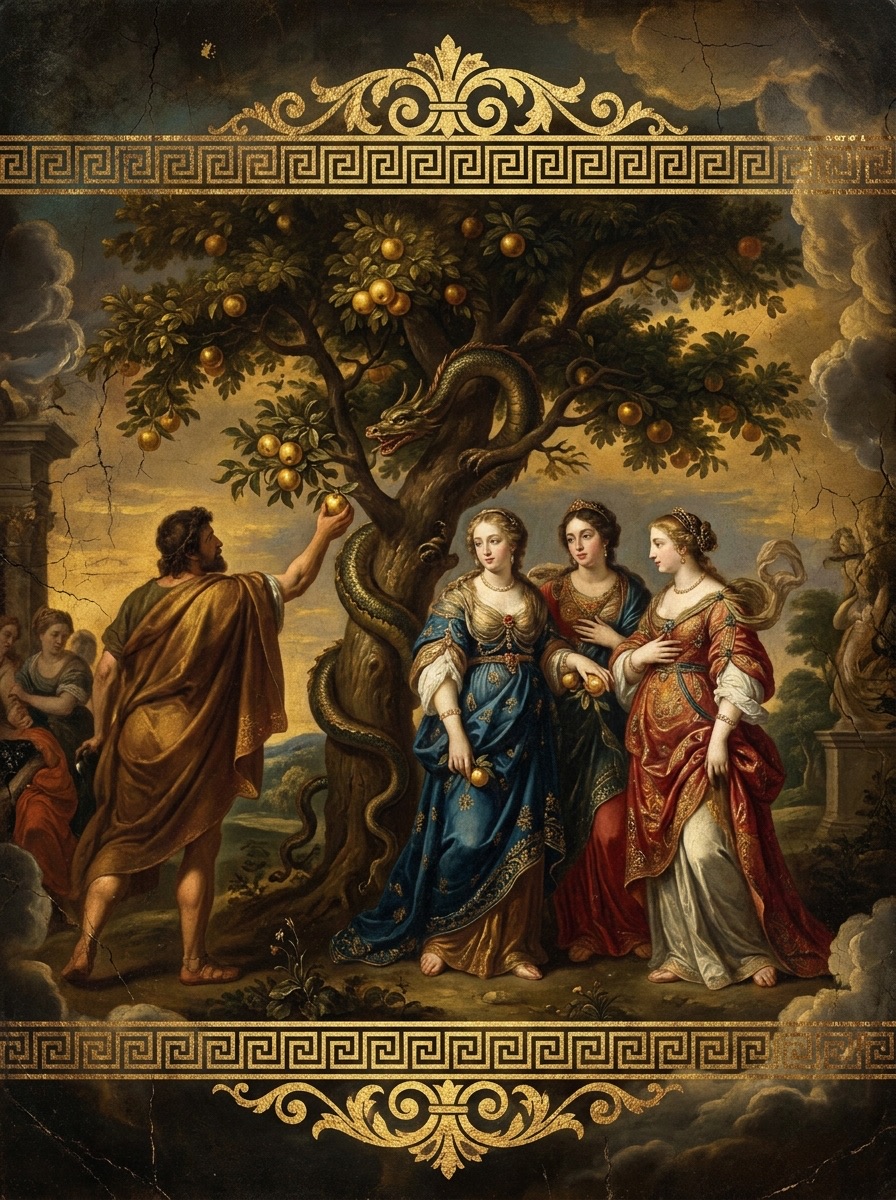
Eurystheus ordered Heracles to travel to the far west and bring back the golden apples from Hera’s sacred garden. Heracles searched, fought, and questioned his way across the world, until at last he obtained the apples through the hands of the Titan Atlas—and by a clever trick made Atlas take the sky back onto his shoulders.
Article
Summary
When Zeus and Hera were married, Gaia, the goddess of the earth, gave Hera a tree that bore golden apples. Hera planted it in a sacred garden at the far western edge of the world, where the Hesperides kept watch beside the sleepless dragon Ladon. Hoping to set Heracles an impossible task, Eurystheus commanded him to bring the apples back to Mycenae. Heracles did not know where the garden lay, so he searched north and west, asking shepherds, travelers, and goddesses by rivers and woods. Along the way he beat back violent men and hostile creatures who blocked his road. At last the water nymphs told him to seize Nereus, the Old Man of the Sea. Heracles caught him while he slept and held on through every change of shape, until Nereus yielded and told him to seek Atlas, the Titan who bore the sky. On the way, Heracles found Prometheus chained to the cliffs of the Caucasus. The eagle that came each day to tear at the Titan's liver was already diving from the air. Heracles shot it down with an arrow and ended that part of Prometheus' torment. In gratitude, Prometheus warned him not to pluck the apples with his own hands. He should ask Atlas to enter the garden while Heracles held the sky in his place. At the edge of the earth, Heracles found Atlas standing beneath the weight of heaven. He offered to bear the sky for a little while if Atlas would fetch the apples from the garden guarded by his daughters. Atlas agreed, and Heracles stepped under the crushing burden. After a long wait, Atlas returned carrying the golden apples, but he no longer wished to take back his punishment. He proposed to deliver the apples himself while Heracles kept holding the sky. Heracles did not answer with force. He pretended to agree and asked Atlas to take the sky back for a moment so he could pad his aching shoulders with the lion skin. As soon as Atlas resumed the burden, Heracles picked up the apples and left. He brought them to Eurystheus and completed the labor, but the apples were sacred to Hera and could not remain among mortals. Athena later carried them back to the garden of the Hesperides.
Hera’s Golden Tree
When Zeus and Hera were married, all the gods brought gifts. Gaia, the earth goddess, came with a precious wedding present: a thick-leaved tree that bore apples of gold. They were no ordinary fruit from any mortal orchard. When sunlight touched them, they gleamed among the green leaves like little balls of hidden fire.
Hera loved the tree dearly, and she planted it far away in the west, in a sacred garden near the edge of the sea. There twilight lingered for a long time, the water shone at the rim of the world, and night seemed to rise from beneath the shadow of the trees. The garden was watched by nymphs, goddesses of the evening lands, who often sang beneath the branches. But Hera did not trust song and flower-shade alone. She also set a dragon beside the tree.
The dragon’s name was Ladon. It coiled its body around the roots and branches and never closed its eyes. Some said it had many heads, and many mouths that spoke or cried in different voices. When the wind moved through the orchard, the leaves whispered overhead, and the dragon’s low growl rolled among them. Anyone who wished to approach the tree had to pass Ladon first.
By the time Heracles had already completed many bitter labors, Eurystheus still would not release him. Sitting in his palace, he heard tales of the golden apples in the western garden and devised a new command:
“Go, and bring me the golden apples of the Hesperides.”
It sounded like no more than plucking a few pieces of fruit. But Heracles did not even know where the garden lay. He knew only that it was far, far to the west, near the place where night came down upon the world. So he threw the lion skin over his shoulders, took up his club and bow, and once more left Greece behind, setting out on a road without signposts.
The Man Who Searched Everywhere for the Garden
Heracles first went north, then west. He crossed mountains, passed through river valleys, and asked shepherds, travelers, and goddesses who lived by streams and in the woods. Many had heard the name of the golden apples, but no one could tell him the road to the sacred garden.
Along the way he met violent men who blocked his path, and warlike creatures who challenged him. Some saw him traveling alone and rushed forward to provoke a fight; others, when he asked for directions, gave no answer and raised their weapons instead. Heracles had not come looking for enemies, but if anyone stood in his way, he did not retreat. He struck down attackers with his club, drove off beasts with his arrows, and went on.
At last he came near a great river and saw a company of water nymphs. They knew what Heracles was seeking, and they said to him, “If you want to learn the way, find Nereus, the Old Man of the Sea. He knows many hidden things. But he will not answer easily. You must seize him while he sleeps, and whatever shape he takes, you must not let go.”
Heracles remembered their words and went to the seashore to wait. Wave after wave rolled up the sand; white foam drew back and left wet shells shining behind it. After a long while, aged Nereus rose from the water and lay down on the shore to rest. Heracles crept close, then sprang upon him, locking both arms around him like bands of iron.
Nereus woke in alarm and began at once to change shape. First he became a lion and roared with open jaws. Then he became a slick serpent, twisting through Heracles’ arms. Next he turned to water, as if he might slip away between the hero’s fingers, and then to burning fire. Heracles clenched his teeth. Whatever appeared before him, he held fast and would not release his grip.
At last Nereus saw that he could not escape. He returned to the form of an old man and said breathlessly, “Enough, son of Zeus. The garden you seek is not easy to reach. Go farther west and find Atlas, who bears the sky. The golden apples are in the garden watched by his daughters.”
Heracles let the old sea god go, thanked him, and turned again toward the west.
Prometheus in Chains
The farther Heracles went, the lonelier the land became. He passed through mountains, deserts, and countries of foreign peoples. At times the sun whitened the rocks with heat; at times sea mist covered everything in the distance. After many days he came at last to the harsh cliffs of the Caucasus.
There he saw a vast figure chained to the rock with iron. A cold wind blew through the mountain pass, and the chains struck the stone with a sharp, cruel sound. The prisoner’s chest was bare; his face was worn by long suffering, yet he still possessed the dignity of a god.
It was Prometheus. Because he had brought fire to humankind, he had angered Zeus and been bound upon that mountain. Each day a savage eagle flew down to tear at his liver; each night the wound grew whole again, so that the torment could begin anew the next day.
Heracles saw the eagle already diving from the heights, its wings blotting out a patch of sunlight. At once he took down his bow, set an arrow to the string, and shot. The bowstring rang; the arrow crossed the air and struck the cruel bird. With a shriek the eagle fell from the cliff, and the wind scattered its feathers.
Prometheus looked at Heracles and spoke in a low but steady voice. “You have ended a torment that lasted long. I will tell you something in return: do not pluck the golden apples with your own hands. Find Atlas, and let him enter the garden for you. Hold the sky in his place for a little while, and he will be able to fetch the apples.”
Heracles listened and understood that his road had not yet reached its end. He went on toward the west, until the earth seemed about to stop beneath his feet and the sky appeared to press low upon the horizon.
Atlas, Bearer of the Sky
There Heracles saw Atlas.
The Titan stood at the edge of the earth, his feet planted as if rooted in stone, his shoulders and arms supporting the weight of the sky. Clouds moved about his neck, and the paths of the stars pressed upon his back. He could not turn freely, nor could he leave his place. He could only stand there through the long ages, bearing a burden whose end could not be seen.
Heracles came before him, looked up, and said, “Atlas, I have been commanded to bring back the golden apples from Hera’s sacred garden. I am told your daughters guard that place. If you will pick them for me, I will hold the sky for you for a little while.”
At these words, a light came into Atlas’ eyes that had not been there for a long time. He had stood in one place for so many years that even a brief walk seemed like a breath wrested from punishment. He agreed, but warned Heracles, “Hold firm. The sky is no common stone. Its weight will make your bones groan.”
Heracles took off the lion skin and stepped into Atlas’ place. He bent his knees and set his shoulders beneath the invisible, crushing heaven. Atlas slowly drew away his hands, and the weight of the sky came down upon Heracles.
In that instant Heracles felt as though the whole world had fallen onto him. Vapor brushed his hair, and the cold of the stars seemed to pass through his shoulders and back. His feet sank into the ground; the veins stood out along his arms. But he did not collapse.
Atlas stretched his body freely at last. Then he turned and strode away toward the sacred garden of the Hesperides.
The Golden Apples Are Brought Back
A long time passed. The western sky darkened and brightened again. Heracles still stood in the same place, gritting his teeth beneath the sky. He did not know how Atlas dealt with the dragon that guarded the tree, nor how the nymphs allowed him to approach it. He knew only that he could not let go. If he did, the vault of heaven would come crashing down upon the earth.
At last Atlas returned. In his hands he carried several golden apples. They shone in the dusk as though the last light of evening had been gathered into their skins.
When Heracles saw the apples, relief rose in his heart. But Atlas did not at once take back the sky. He stood there, weighing the apples in his hands, and said, “I have picked them for you. Let us do this instead: I will carry the apples myself to Eurystheus. You hold the sky for me a little longer.”
Heracles understood what lay beneath those words. Atlas did not wish to return to his old punishment. He meant to leave Heracles there forever, bearing the sky in his place.
Heracles did not burst into anger. He knew that as long as the sky weighed on his shoulders, he could not move freely or force the matter. So he pretended to agree. “Very well,” he said. “Only this weight is hurting my shoulders. Take it back for a moment while I fold my lion skin into a pad, or I may not be able to hold it much longer.”
Atlas thought this reasonable. He set the golden apples down, came forward, and once again took the sky upon his own shoulders. Heracles slipped out from beneath it, picked up his lion skin, then took the golden apples and his club.
Only then did Atlas understand that he had been deceived. He stood heavily in place, both hands upholding heaven, unable to pursue. Heracles looked at him and said, “You have borne the sky for a long time, and it is natural that you wish to rest. But this punishment is not mine.”
With that, he left the edge of the earth, carrying the golden apples with him.
The Apples Return to the Goddess
After a long journey, Heracles finally came back to Eurystheus and gave him the golden apples.
When Eurystheus saw the fruit brought from the sacred garden in the west, he could not say that Heracles had failed. Yet the apples were holy to Hera. They were not meant to remain long among mortals, and still less to become toys for a king’s pride. Later, Athena took the golden apples and returned them to the garden of the Hesperides.
And so the tree still grew in the far west. When twilight fell, the golden apples shone among the leaves, the songs of the nymphs echoed through the garden, and the tale of the dragon Ladon still kept watch beside the branches. Heracles had completed another hard labor, and went on bearing the destiny that was not yet finished.