Greek Mythology
Apollo and Python — Greek Mythology
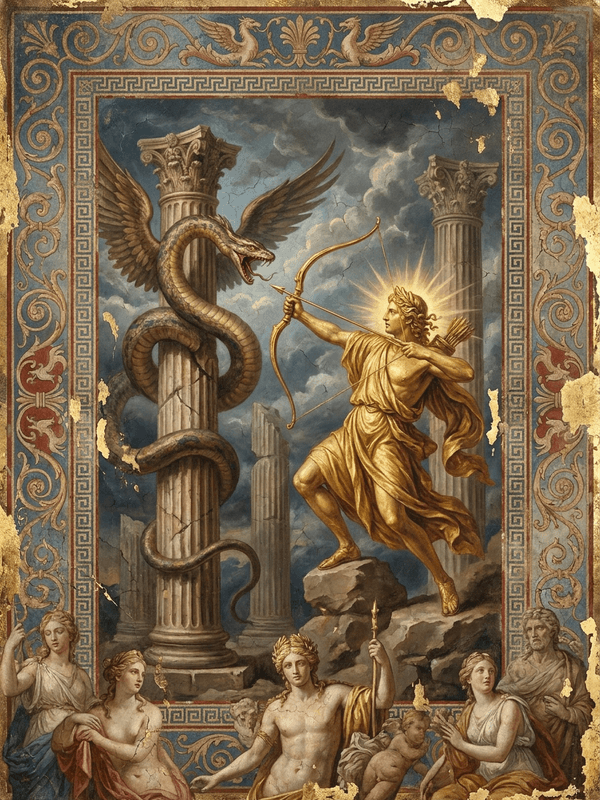
The young Apollo came with his silver bow to the foot of Mount Parnassus, slew the great serpent Python who brooded beside the sacred spring, and founded his own oracle there. From then on, Delphi became a place where mortals sought the will of the gods, while Python’s name lived on in Pytho and in the title of the Pythia.
Article
Summary
Young Apollo set out with his silver bow to find a sanctuary of his own and came to the springs and valley beneath Mount Parnassus. The place could have held an altar, but the great serpent Python brooded there, keeping shepherds and travelers away. Apollo did not turn back. He stood on the slope and sent arrow after arrow into the serpent until Python collapsed beside the spring, its poison thinned, and the valley heard water and birdsong again. From then on, Apollo founded his oracle at Delphi and brought distant sailors to serve as priests. Python was dead, but its name lived on in Pytho, in the Pythia, and in the memory of the holy place.
The Young God with the Silver Bow
After Leto bore Apollo in her wanderings, the islands and mountains of the Aegean remembered the radiance of the new god. He was not a child who lingered long in swaddling clothes. The stories say that once he had tasted the food of the gods, strength filled his body. He slung a quiver over his shoulder, took up his silver bow, and with light steps crossed shores, meadows, and high mountains.
In those days, many places among mortals already stood in awe of Zeus, Hera, Poseidon, and the other great gods. But Apollo too needed a sanctuary of his own. He wanted a place where people would come from far away, bringing offerings and asking what they should do in the days ahead: whether to sail, whether to found a city, where disaster had come from, and how the anger of the gods might be appeased.
He passed through many lands. Some were rich in water and pasture, but lay too close to the noise of crowded towns. Others rose in lofty cliffs, but were not fit for throngs of worshippers. Apollo went on, crossing valleys and rivers, until he came to the region of Mount Parnassus.
There the rocks shone pale, pines and laurels grew along the slopes, and clear springs ran out from cracks in the stone, their sound echoing through the deep ravine. At the mountain’s foot lay an open place, broad enough for an altar and a temple. Apollo saw it and settled the matter in his heart: this could become his dwelling.
But the place was not yet at peace.
The Great Serpent by the Sacred Spring
Near the valley and the spring there brooded a terrible serpent named Python. Some said it was born of the earth; others said it guarded the place beside an ancient goddess. Its body was vast, its scales clung to the damp stone, and when it coiled, it looked like a dark ravine come alive. It hid in caves and under the shadows of trees, and at the sound of footsteps it lifted its head, breathing out a hot, foul reek.
The shepherds nearby did not dare drive their flocks to the spring, and travelers were reluctant to pass through those woods at dusk. The water was clear, yet fear seemed to hem it in. Some said Python had once pursued Apollo’s mother, Leto; others said only that it guarded this ancient place and would not let a new god draw near. Whichever tale was told, Apollo found the same enemy before him when he came there: the serpent barred the way to the holy ground.
Apollo did not turn back. He stood on the mountainside, sunlight flashing on his hair and along the curve of his bow. He drew an arrow from his quiver, and the arrowhead glinted in the light. Python heard the movement and raised its head from the stones beside the spring. Its huge body scraped the rock face, sending dry branches and broken stones tumbling down.
It opened its jaws. Venomous breath rushed out, and the grass bent low as if scorched by a hot wind. Then it lunged at the young god, coiling its body again and again upon the ground, as though it meant to drag its enemy into the cave.
The Bowstring Rings Through the Valley
Apollo drew his bow to the full.
The first arrow flew and sank into Python’s heavy scales. The serpent recoiled, its tail striking the rocks with a dull crash that rolled through the valley. A second arrow came, then a third. Apollo’s steps never faltered. He moved along the slope, avoiding the serpent’s thrashing body, and sent his arrows toward its exposed throat, breast, and belly.
Python writhed in agony beside the spring. Its body crushed the earth, broke the shrubs, and stirred the clear water into mud. It tried to slip back into the darkness of its cave, but Apollo’s arrows were faster. It tried to rear up and strike, but the silver bow rang again nearby.
At last the great serpent could endure no more. Its immense body collapsed upon the sacred ground. Its tail twitched a few times, then slowly lay still. Only the sound of the spring remained in the valley. The poisonous breath thinned and drifted away, and at last the birds began to call again from the branches.
Apollo stood beside the dead Python and proclaimed his victory over the place. The story says he left the serpent’s body there to rot in the sun and wind; from this, the place received the name Pytho. Later people also said that the priestess called the Pythia took her title from that ancient name.
The Temple Beneath Mount Parnassus
After Python’s death, Apollo claimed the place for himself. He was no longer only the young god who wandered with a bow; he became the lord of that valley. In time, masons and worshippers would raise foundations at the foot of the mountain, build an altar, and place laurel branches, tripods, and gifts for the god within the sanctuary. People came from far away, following the winding mountain road with sheep, cattle, wine, and rich-smelling offerings, seeking Apollo’s counsel.
But a temple needs more than rocks and an altar. It also needs people to tend it. The story says that Apollo once saw a ship from Crete sailing over the sea. The men aboard had their own course and did not know that the god in the mountains was watching them. Apollo took the form of a great dolphin in the water, leapt beside the ship, and guided it away from its path. The sailors were seized with fear and confusion, unable to understand where this wondrous creature meant to lead them.
When the ship came to shore, Apollo revealed himself in divine form and told them not to be afraid. He commanded them to leave their former way and come to the foot of Mount Parnassus, where they would serve his newly founded sanctuary. The sailors obeyed the god’s order, traveled inland to the region of Delphi, and became Apollo’s priests. Thus the mountain temple gained men to perform sacrifices and to receive those who came asking for answers.
From then on, Delphi’s fame spread little by little. Cities sent envoys. Kings sent messengers. Ordinary people, faced with choices too difficult for them, climbed the mountain road with gifts in their hands. The priestess sat in the sacred place and delivered Apollo’s oracle. Sometimes the words were plain; sometimes they were like mountain shapes glimpsed through mist, needing to be weighed again and again. Yet all believed that the voice came from the god of the silver bow.
The Name Python Left Behind
The great serpent Python lay dead beside the spring. It could no longer coil around travelers or hold the valley with its venomous breath. Yet it did not vanish entirely from the story. Its name remained in Pytho, in the Pythia, and in the tales that remembered Apollo’s victory. In later times, people also held contests in memory of the god’s conquest of the serpent, joining them to Apollo’s sacred place.
The spring beneath Mount Parnassus went on flowing, and the laurel stirred in the wind. When those who sought counsel entered Delphi, they did not tread on ordinary ground. They walked into a sanctuary once held by a serpent and won by Apollo with his bow and arrows.
This is the story of Apollo and Python: the young god came to the valley, slew the ancient serpent, and turned fear into a legend beside the altar. From then on, Delphi belonged to Apollo. Python’s body decayed, but its name remained in the oracle and in the holy place.