Greek Mythology
Apollo and Hyacinthus — Greek Mythology
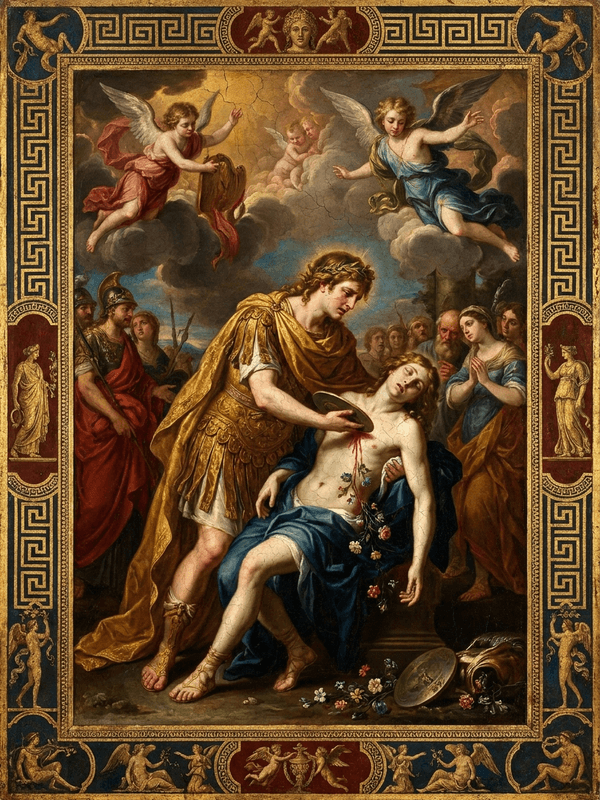
Apollo loved Hyacinthus, a youth of Sparta, and often joined him in the hills to hunt, race, and throw the discus. During one such game, the West Wind, jealous of Apollo, secretly turned the course of the air. The discus struck Hyacinthus and killed him, and Apollo changed the boy’s blood into a flower marked with a sign of mourning.
Article
Summary
Near Sparta, in Amyclae, lived the beautiful youth Hyacinthus. He came from a royal house, and even while still young he was known for his grace, strength, and quickness. Apollo, god of light, often left Delphi and Olympus to visit him in the hills, where they hunted, practiced with the javelin, and threw the discus together. But Apollo was not the only one who loved Hyacinthus. Zephyrus, the West Wind, loved the boy as well, yet Hyacinthus did not return his affection with the same warmth. When Zephyrus saw that Hyacinthus always wished to be near Apollo, bitterness slowly took root in him. One day Apollo and Hyacinthus were throwing the discus in an open meadow. Apollo sent the discus high into the air, and it flashed away through the sunlight. Hyacinthus ran eagerly after it, hoping to retrieve it first. Then Zephyrus blew in from the side with a cruel gust. The discus veered from its course and struck the boy hard on the head. Apollo rushed to Hyacinthus and held him, but no healing herb could keep life in the boy’s body. Where the blood fell upon the earth, Apollo would not let Hyacinthus vanish utterly. He caused a flower to rise from it, and on its petals he left the marks of grief. From that time on, the people of Amyclae remembered the youth, and remembered, too, the sorrow that even a god could not undo.
The Youth of Amyclae
In Amyclae of Laconia, the hills were not high, but the meadows opened wide. When spring came, wildflowers pushed up between the stones, and the leaves of the olive trees turned silver in the wind. The people there used to say that Hyacinthus, the young prince of the royal house, was as bright as morning.
Hyacinthus was still young, yet he could already follow the hunters into the hills. He knew how to hear the crack of a deer’s hoof among the dry branches, and how to hold a javelin steady in his hand. When he ran, the hair falling behind his shoulders streamed in the wind like dark water. Many loved to watch him in the training ground as he raced, cast the spear, or threw the discus. But the one who came most often to his side was no mortal. It was Apollo.
Apollo was the god of light, of the bow, of music, and of prophecy. He had his own holy places, his golden bow, his laurel crown, and crowds of seekers waiting at his altars for an oracle. Yet for Hyacinthus he often set all this aside and came into the hills and fields of Amyclae.
He did not sit upon a high divine throne, nor come surrounded by attendants. He bound up his long hair, took a hunting net in his hands, and chased wild creatures beside the boy. He slung his bow over his shoulder and walked with him through pine woods and beside springs. Sunlight shone on their arms, the hounds sniffed the earth ahead of them, birds startled from the branches, and arrows flew from the string.
Hyacinthus was not afraid of the god. He spoke with Apollo as he would speak with a familiar companion. Apollo, for his part, loved to see him laugh, to watch him run with all his strength, to see him lift the discus behind his shoulder, clench his teeth, and hurl it forward.
The West Wind over the Hillside
But another god often passed over those hills.
This was Zephyrus, the West Wind. When spring flowers opened, people felt his breath; when sails swelled at sea, his hand was there behind them. In ordinary times his wind was gentle. It stirred the treetops, opened shadows in the clouds, and cooled the brows of shepherds.
He too loved Hyacinthus.
At first Zephyrus only watched from a distance. He blew across the meadows of Amyclae, ruffled the hair on the boy’s forehead, and circled in the folds of his cloak. He hoped Hyacinthus would lift his face toward the sky and look to him as he looked to Apollo.
But Hyacinthus’s gaze always turned to Apollo.
When Apollo came, the boy went out with him. They hunted together, trained together, and rested together beside the spring. When Apollo set his lyre upon his knees and touched the strings, Hyacinthus listened quietly. When Apollo spoke of far-off sanctuaries and islands in the sea, Hyacinthus listened as though the whole world had opened before him.
Zephyrus paused among the treetops, and his heart grew more and more bitter. Sometimes his wind skimmed low over the grass; sometimes it suddenly plunged into the woods and shook the leaves into a clatter. Yet however he came and went, the boy never looked upon him as the one dearest to him.
Jealousy was like a thorn hidden in the breast. The longer it stayed, the deeper it drove itself in.
The Discus in the Sunlight
One day the weather was clear, and the sky was clean of clouds. Apollo and Hyacinthus came to a broad meadow. A few trees stood at its edge, and beneath them lay their cloaks and hunting gear. Far off, the hillside shone under the sun, and the warm smell of earth rose in the air.
They had brought no bows and no hounds that day. They meant only to try their skill with the discus.
The discus was heavy, its rim polished smooth. A mortal would have felt its weight in the hand, but Apollo held it as though it were a light stone. He stepped into the middle of the level ground, balanced the discus on his palm, and turned back to Hyacinthus with a smile.
“Watch closely.”
He turned, swept his arm back, planted his foot hard against the earth, and the discus flew from his hand.
At first it skimmed low, then suddenly climbed, drawing a dark, bright arc through the sunlight. It flew far and straight, as though it were cutting the very air apart. Hyacinthus, delighted, could not wait for it to settle. He ran forward, eager to be the first to pick it up.
Apollo was just about to call out for him to slow down, but the boy had already rushed ahead.
The discus struck hard ground in the distance and sprang up with a sharp sound. At that moment Zephyrus came.
He blew in from the side of the meadow, no longer gentle as he was in spring. He drove the wind low, whipping up dust and grass, and thrust it violently against the rebounding discus. The discus should have rolled onward with its own force. Instead it swerved, as though an unseen hand had struck it, and flew straight toward Hyacinthus.
The boy was still running forward. He raised his head and saw only a dark shape rushing toward his face.
In the next instant, the discus struck him hard on the head.
Hyacinthus fell in the meadow. Blood ran from his hair and spilled onto the dust and grass, red and terrible to see.
The Life That Could Not Be Held
Apollo’s face changed at once.
He ran to the boy, knelt beside him, and gathered him into his arms. A moment before, Hyacinthus had been racing in the sunlight; now his body had gone slack. His eyes were half open, as though he were still trying to see who was calling him. His lips moved, but no whole words came.
Apollo pressed his hand against the wound, but blood still seeped between his fingers. He brought healing herbs and laid them upon the boy’s head. He murmured words of divine power, words that could drive away sickness and pain. But this was no ordinary wound. The discus had struck the place where life itself remained. No art of healing, however great, could drag a dying youth back from the gates of the underworld.
Apollo held him tighter. His golden hair fell down beside Hyacinthus’s blood-stained face. For the first time, the god of light was helpless like a mortal. He could kill a great serpent, utter prophecies, and make music resound through temples, but he could not make the boy in his arms stand again.
“It was not your death that was due,” Apollo said softly. “It was my hand that threw the discus.”
Hyacinthus could no longer hear him.
His head sank in the crook of Apollo’s arm, and his breath weakened little by little. The wind over the meadow fell still, and even the leaves seemed afraid to make a sound. Zephyrus hid far away and did not blow again. Jealousy had done its dreadful work, and once the deed had fallen into the world, it could not be called back.
The boy was dead.
The Flower That Rose from Blood
For a long time Apollo did not let him go.
At last he looked down and saw Hyacinthus’s blood soaking into the earth. The soil was wet and red at first; then, as if some hidden power lifted it gently, a tender stem rose from the stain. Leaves unfolded, and from the blood a flower grew.
Its color was deep, like dark purple-red, like blood just beginning to dry. Its petals were soft, yet they carried lines of sorrow. Apollo bent over it and set upon the petals the marks of his grief, as though sigh after sigh had been written there. Later, when people saw the flower, they said it bore the traces of mourning.
Apollo would not allow the name of Hyacinthus to scatter on the wind. He made the flower carry the boy’s memory, and each year, in its proper season, it would rise again from the earth. The flower could not speak and could not run, yet it stirred gently in the sunlight, as though it still held the shadow of that day in the meadow.
In Amyclae, the people did not forget Hyacinthus. They remembered the youth who died too soon, and they remembered that a god had grieved for him; so they honored him there with rites. Those who came afterward could still hear his story: the boy whom Apollo loved, the boy whose life was taken by the jealousy of the West Wind. His blood did not vanish for nothing, but blossomed from the ground as a flower.
From then on, whenever that flower opened, people thought of the meadow where Hyacinthus fell, and of Apollo holding him in the silence of a grief he could not undo.