Greek Mythology
Apollo and Daphne — Greek Mythology
After Apollo slew the great serpent Python, he grew proud and mocked the bow of the little love-god Eros. Eros punished him with two different arrows: one drove Apollo into a wild love for Daphne, while the other made Daphne flee from love itself, until at last she was changed into a laurel tree.
Article
Summary
Apollo had just slain Python, the monstrous serpent of Delphi, and he carried his bow with a proud heart. When he saw the young god Eros holding bow and arrows of his own, he laughed at him and said such weapons were not fit for a child. Stung by the insult, Eros flew up to Mount Parnassus and drew out two arrows: a golden one that kindled love, and a dull, heavy leaden one that made love hateful.
The Proud Archer
Apollo was young and radiant, and the bow in his hand never missed its mark.
In those days, the country around Delphi was not yet the peaceful holy place it would later become. Deep in the valley lived a monstrous serpent called Python. It crawled out from damp caverns, trailing mud and a foul stench behind it, its scales rasping over stone with a dry, whispering sound. People and livestock alike feared it. Even those who went near the springs for water did not always return.
Apollo pursued the creature there. He drew his silver bow and shot arrow after arrow into the serpent’s body. The barbs sank through the thick scales. Python writhed among the rocks, smashing branches as it thrashed, until at last it collapsed upon the ground and its long body moved no more. Apollo stood beside it, the bowstring still trembling softly. He looked at his arrows and was well pleased with himself.
Not long afterward, he saw Eros carrying a bow and arrows too.
Eros still had the look of a child. A small quiver hung over his shoulder, and with the lightest beat of his wings he could flit from meadow grass to treetop. His bow did not have the solemn grandeur of Apollo’s, and his arrows were much finer and more delicate. When Apollo saw him, he could not help laughing.
“Child,” he said, “bows and arrows belong in the hands of those who can kill great beasts. What use have you for them? Go play with your torch, and do not try to imitate me with weapons.”
The words were lightly spoken, but they struck Eros like an arrow. The little god looked up at him. There was no fear in his eyes, only a cold and sharpened pride.
“Apollo,” said Eros, “your arrows may strike every living thing, but mine can strike you.”
With that, he beat his wings and left Apollo behind, flying up to the heights of Mount Parnassus. A cool wind moved over the summit, and cloud shadows drifted across the rocks. Eros opened his quiver and drew out two arrows.
One had a point of bright gold, keen and shining like metal just lifted from the fire. The other had a blunt, heavy head, dark in color, like dull lead. The golden arrow could make love flare suddenly in the heart; the leaden arrow made the heart turn away from love, so that even words of courtship sounded hateful.
Eros said no more. He bent his small bow and first shot the golden arrow at Apollo. It flew without a sound and sank into the god’s breast. Apollo did not bleed, but it was as though a hot wind had seized him, and from that moment his heart could find no rest.
Then Eros shot the leaden arrow at Daphne, the daughter of the river-god Peneus.
The Bride Who Wanted No Garland
Daphne lived by the river. She was a girl of marshes and woodland, often going into the forest at dawn, paying no mind when the wind tangled her hair. She loved to chase wild deer, to run along the slopes, to hear the hunting dogs barking through the thickets. Her hand was often wrapped around a javelin, and her dress was gathered high so she could pass easily through brambles and grass.
Many who saw her wished to marry her. Young men came with gifts to the river-god Peneus and begged the father for his consent. Peneus too hoped that one day his daughter would wear a bridal veil, bear children, and carry the family line onward. But whenever Daphne heard the word marriage, her brow tightened as if she had heard a trap snap shut behind her.
She threw her arms around her father’s neck and pleaded with him. “Father, let me be free like Artemis. Do not make me marry. I want to run in the woods. I want to keep to my bow and the mountain wind.”
Peneus looked at his daughter. He could not bear to force her, yet he knew her beauty would draw still more suitors. He sighed and said, “Your beauty itself will stand in the way of what you want.”
Daphne paid little heed to his words. She still went into the forest with a light step, like a deer touched by sunlight.
But Eros’s leaden arrow had already struck her. It left no wound, yet it made her heart harder than before. She hated proposals, hated love-songs, hated the gaze of anyone who pursued her. She wanted only the mountains, the streams, the shadows, and the wind rushing past her ears as she ran.
At the same time, Apollo was changed.
When he first saw Daphne, sunlight lay across her shoulders, and her loosened hair stirred like leaves in the wind. She wore no gold, made no effort to adorn herself, and carried hunting gear in her hands, her cheeks flushed from running. Apollo gazed at her, and the invisible golden arrow in his breast began to burn.
He longed to draw near to her, to hear her speak, to learn her name. The more lightly she moved toward the trees, the more urgently he felt he must follow.
The Chase by the River
Apollo called out to her.
“Wait, maiden! I am no enemy. Do not flee from me as a lamb flees the wolf, or a deer the lion. I am not chasing you to harm you.”
As soon as Daphne heard the voice behind her, she quickened her pace. She did not look back, but gathered up her dress and ran through shifting shade and grass.
Apollo followed, still calling, “Slow down! The thorns may tear your feet. The stones may trip you. If you are hurt, I shall suffer more than you.”
As he spoke, he came closer and closer. The wind swept across his brow, but he had no thought now for divine dignity. He declared who he was, hoping Daphne would stop.
“I am the son of Zeus. I am the god of Delphi. I know herbs, and archery, and song, and prophecy. Yet now there is no herb that can heal the wound in my heart.”
Spoken to someone else, such words might have inspired wonder, perhaps even desire. But in Daphne’s heart there was only Eros’s heavy leaden arrow. The more urgent Apollo’s voice became, the more frightened she felt. She wanted none of his divine names, none of his honors, none of his lyre, and none of his love.
The forest streamed past her eyes. Branches scratched her arms; grasses brushed her ankles. Her breath came harder and harder, and her hair flew loose down her back. Apollo followed close behind, like a hound gaining on a deer whose strength is almost spent. He could already see the hair at the nape of her neck, could see her shoulders rising and falling as she gasped for breath.
Daphne knew she could run no farther.
Ahead came the sound of water. It was the river of her father, Peneus, shining under the sun while reeds trembled along its bank. Daphne reached the riverside, where the earth beneath her feet was wet and soft. She looked back and saw Apollo almost upon her, his outstretched hand nearly touching her.
She had no strength left to flee.
So she cried out to the river: “Father, save me! If rivers truly have divine power, change this body that has made me hunted!”
The Leaves of the Laurel
The moment she spoke, the change began at her feet.
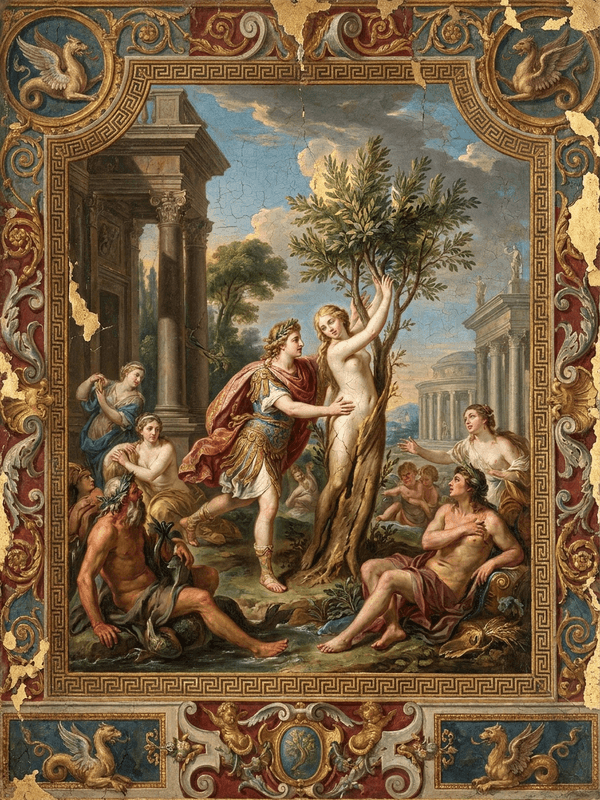
Daphne felt her legs grow suddenly heavy. Her toes seemed to sink into the earth and root there, impossible to pull free. Cool bark climbed upward from her ankles, binding her calves and covering her waist. She tried to lift her hands, but her arms stretched toward the sky and became supple branches. Her hair spread out and turned into thick leaves, trembling softly in the wind. Her heart still beat within her breast, but bark closed around it and sealed it inside.
When Apollo reached her, what he caught was no maiden’s hand, but the branch of a newly formed tree.
He stopped.
The tree before him still bore something of Daphne’s shape: a slender trunk, fragrant boughs, narrow and resilient leaves dark green beneath the sun. Apollo laid his hand upon the bark, as if he could still feel the faint life within. He bowed his head and heard the leaves whispering, but Daphne would never answer him again.
At last he understood. She had chosen to lose her human body rather than become his wife.
Apollo stood grieving by the river. After a long while, he broke off a branch of laurel, wove it into a crown, and placed it on his own head. To the tree he said, “Since you cannot be my wife, you shall be my tree. My hair, my lyre, and my quiver shall be adorned with your leaves. Victors too shall wear you. Your leaves shall not easily wither, but remain green through the passing years.”
The wind moved along the riverbank, and the laurel leaves made a small, broken sound—like refusal, and like an answer given only because there was nothing else left to say.
From that time onward, the laurel was bound to Apollo. Poets, singers, and victors wore laurel on their brows. And whenever people saw that green crown of leaves, they remembered the chase beside the river: a proud god wounded by love, a maiden who would not yield running toward her father’s waters, and her form left forever between bark and branch.