Greek Mythology
Aphrodite and Adonis — Greek Mythology
After offending Aphrodite, Myrrha was changed into a myrrh tree and gave birth to Adonis from within its trunk. Aphrodite fell in love with the beautiful youth, hid him away, and shared him with Persephone, but Adonis loved the hunt more than comfort and died under a wild boar’s tusk, leaving behind a flower that blooms only briefly from his blood.
Article
Summary
Myrrha offended Aphrodite and fled into the wild. In her shame she begged the gods for release, and her body was changed into a myrrh tree, though she still carried a child inside its trunk. When the nymphs split the tree open, Adonis was born from the scent of resin. Aphrodite saw how beautiful the child was and hid him in a casket, giving him to Persephone to guard. Persephone grew fond of him as well, and the dispute ended only when the gods ruled that Adonis must spend part of the year with each goddess, shared between spring and the underworld. As Adonis grew, he loved bows, hounds, and the hills more than Aphrodite’s fragrant halls. She warned him again and again not to chase lions, bears, or boars, for wounded beasts turn savage. But when the hounds broke into a furious cry, he forgot her warning and followed the hunt into the woods. He struck a boar but failed to kill it. The wounded beast wheeled back and drove its tusk into his groin, and Adonis fell bleeding on the ground. Aphrodite reached him too late; she could only gather him up and pour nectar over the blood. From that crimson patch rose a pale flower that blooms and falls at once, like Adonis himself.
The Child in the Myrrh Tree
In the lands around Cyprus, people once told a bitter story. There was a woman named Myrrha, whom some called Smyrna. She was nobly born, but because she had offended Aphrodite, a forbidden passion took root in her heart. Night hid the palace doors, and it hid the deed she committed; when the truth came to light, she could no longer remain beneath her father’s roof. With her hair loose and wild, she fled into the far wilderness.
She crossed hard, dry ground until her strength was nearly gone. Then she prayed to the gods. She did not dare remain human, yet she did not wish to die at once. She asked only to be freed from the shame of mortal life. So her feet sank into the earth, her skin hardened into bark, her hair became branches and leaves, and tears slowly seeped from the trunk, turning into fragrant myrrh. From then on she spoke no more, but stood silent in the wind.
Yet inside the trunk a life was still hidden. When the time of birth came, the bark swelled, like a suffering body struggling without a voice. The nymphs of the woods heard the sound and gathered around the tree, laying their hands on the splitting wood. At last the trunk opened, and a baby boy was born from the myrrh tree. The scent of resin clung to him; his cry was small, yet clear as a mountain spring.
The child was named Adonis.
The Casket Given to the Queen Below
When Aphrodite first saw Adonis, he was still only a child. Yet even that little face showed a rare beauty, and the goddess could not bear to leave him casually among mortals. She brought a casket, placed the child inside it, and hid him away as though he were her most precious treasure. Then she entrusted the casket to Persephone, queen of the underworld, telling her only to guard it for her and not to open it.
The realm below lay deep beneath the earth. No bright daylight entered there—only shadow, black rivers, and the silence of the dead. Persephone took the casket, meaning at first merely to keep it safe for Aphrodite. But faint sounds came from within, and she could not resist lifting the lid. Inside she saw the child lying there. He looked up at her quietly, like a small light suddenly kindled in darkness.
Persephone too came to love him.
When Aphrodite returned to claim the casket, the queen of the dead refused to give him back. One goddess said the child was hers: she had hidden him and entrusted him to Persephone’s care. The other said that since he had come to the underworld and had been kept and cherished there, he should not be taken away again. The two goddesses quarreled over him, and neither would yield.
At last the gods gave judgment. Traditions differed from place to place, but they remembered the same result: Adonis could not belong to only one goddess. For part of the year he would stay with Aphrodite, and for part of the year he would remain with Persephone. So the child born from a tree was drawn partly toward springtime and love, and partly held fast by the cold world beneath the earth.
The Youth in the Wild
Adonis grew to manhood. He was not merely beautiful; he had the quickness and brightness of youth. When he crossed the grass, the hounds bounded around him. When he passed along forest paths, leaves brushed his shoulders. He loved bows, spears, hunting nets, and mountain winds; he loved the crack of dry branches under the hooves of fleeing beasts. The more the morning mist still clung to the hills, the more eager he was to go out.
Aphrodite loved him, and so she often left her fragrant altars and splendid halls to follow him into the wild country. She did not mind wet grass brushing her robe, nor stones pressing against her feet. She would sit in the shade and watch Adonis test his arrowheads and loose the leather straps from the hounds. The goddess’s chariot, which ought to have flown through the heavens, now waited at the edge of the pines for a young hunter to return from the trees.
But Aphrodite’s heart was never at ease. She knew that the wilderness held more than gentle deer and hares. Lions could spring from rocky caves; boars could whet their tusks behind the brush; a wounded beast was more dangerous than one untouched. She took Adonis by the hand and said to him:
“Do not chase creatures born for savagery. Deer will flee, hares will flee, birds will only fly away. But lions, bears, and boars, once wounded, turn back and charge. You are young and swift; you need not test your life against their rage.”
As she spoke, she did not sound like a goddess commanding a mortal. She sounded like someone pleading with the beloved child of her heart. Adonis listened and nodded his promise. Perhaps he truly meant to ease her fear. Yet once the cry rose in the hills and the hounds began to bay, his heart was carried away by the hunt again.
The Boar Turns Back
One day Aphrodite was away for a time. Adonis took the hounds and entered the forest. Sunlight shone on the treetops, while below the branches the ground lay mottled with shade. Suddenly the pack caught a scent. With noses low to the earth, they darted forward; then all at once they broke into furious barking.
A great wild boar was hidden in the thicket. The bristles along its back stood up like hard spikes; mud clung around its mouth, and its tusks were curved and sharp. The hounds drove it from its lair. When Adonis saw it, his blood leapt. He forgot Aphrodite’s warning, gripped his long spear, and rushed toward the dark shape.
His spear struck the boar, but did not kill it at once. Mad with pain, the beast wheeled around. The hounds scattered; branches snapped; earth flew under its hooves. Before Adonis could draw back, the boar was upon him and drove its tusk deep into his groin.
The youth fell to the ground. Blood poured from the wound, reddening the grass and soil. His hand still clutched the spear shaft, but he could no longer hold it firmly. The hounds whined around him, and the wind moving through the trees carried the smell of blood far away.
The Flower Born from Blood
Far off, Aphrodite heard the dreadful sound. She turned her chariot back in haste; the wind rushed against the wheels as swans or white doves drew it through the air. Before she reached the woods, she saw the red stain on the ground. She did not wait for the chariot to come fully to rest. She leapt down and ran to Adonis.
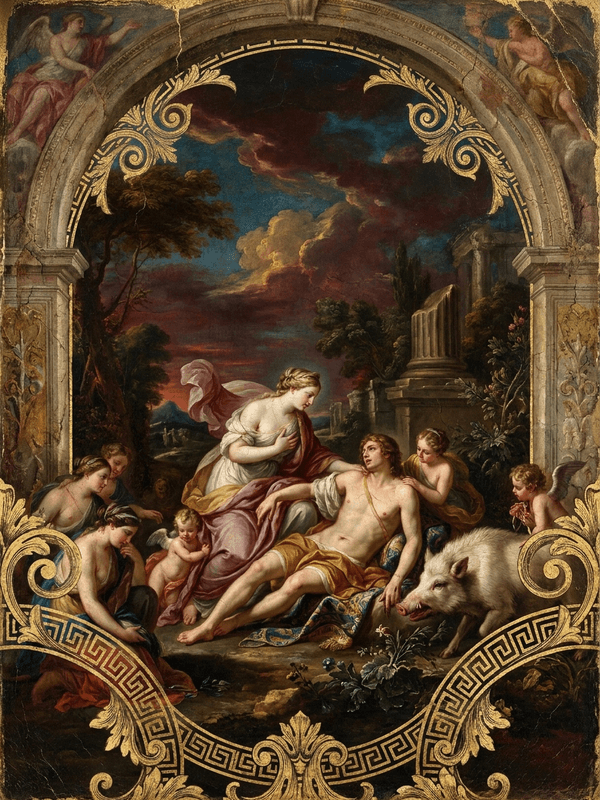
His breath was nearly gone. The goddess knelt in the dirt and gathered his head into her arms. Blood stained her robe, and the fragrance in her hair was covered by the dust of the forest. She called his name, but Adonis could not lift his face and answer as he once had. His young features were still there, but his lips were growing cold.
Aphrodite looked upon the blood in grief. She could not let him vanish into the earth like an ordinary quarry. So she sprinkled nectar over the bloodstained ground and let blood and soil mingle. Before long, a delicate flower sprang up there, its petals touched with faint red, like the color blood leaves behind when washed thin by water.
The flower bloomed quickly, and just as quickly withered. When the wind blew, its petals trembled, and soon they scattered among the grass. In later days, whenever people saw that short-lived flower, they remembered Adonis: born from a myrrh tree, hidden away by the goddess of love, cherished by the queen below; once running through the forests, and at last struck down beneath the tusk of a boar.
Aphrodite lost the youth she loved, and only this wind-frail flower remained. Whenever it opens in spring and soon falls away, people say that the blood of Adonis is waking softly on the earth, only to return again, very quickly, into silence.