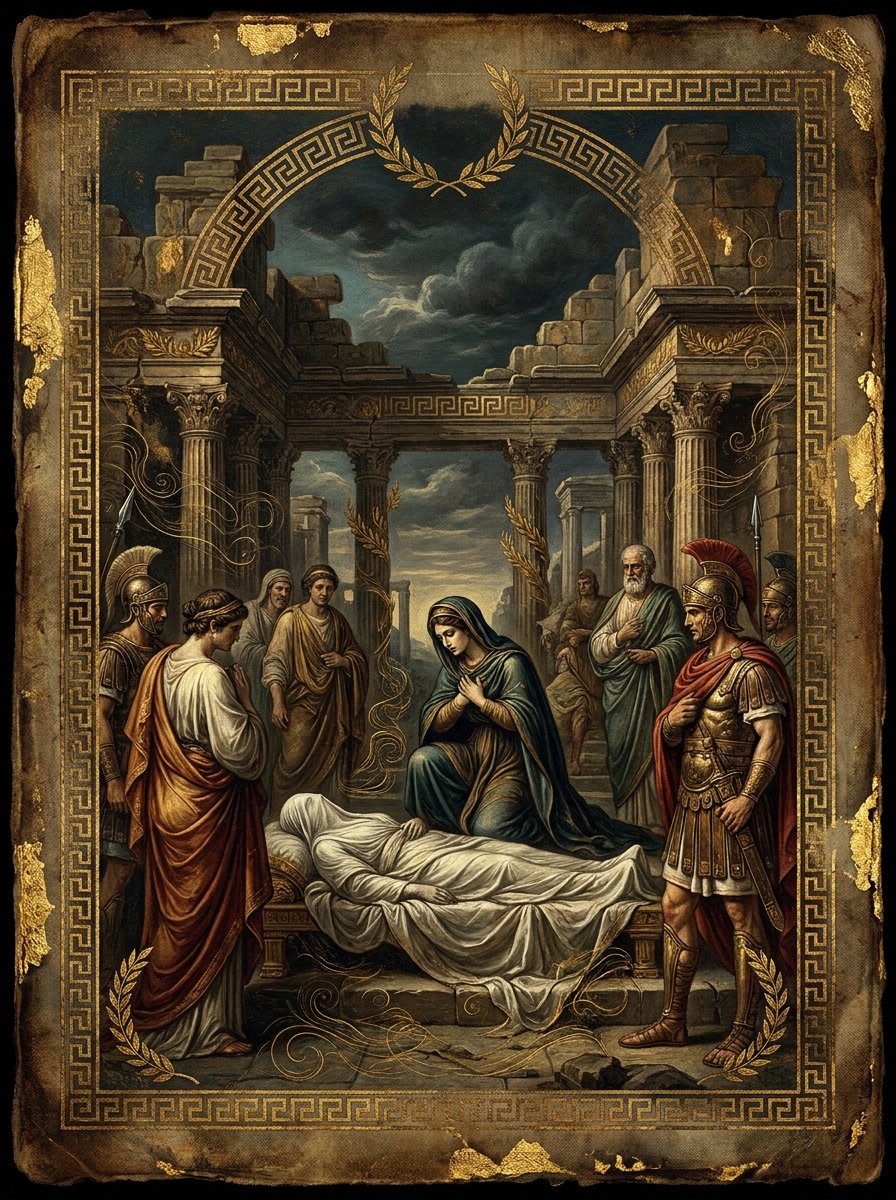
Greek Mythology
Antigone — Greek Mythology
After the civil war in Thebes, Creon forbids the burial of Polynices, who attacked the city. Antigone risks death to cover her brother with earth. She is sealed in a stone tomb, and by the time Creon repents, he finds only the deaths of his son and wife.
Article
Summary
After Oedipus left Thebes, his two sons, Eteocles and Polynices, turned against each other over the throne. Polynices returned with an army to attack his own city, and seven captains stood before the seven gates. In the end, the two brothers met at the gate and killed each other. Creon took control of Thebes. He gave honorable burial to Eteocles, who had defended the city, but ordered Polynices’ body to be left outside the walls. No one was allowed to bury him; anyone who disobeyed would be put to death. When Antigone heard the decree, she could not bear to leave her brother exposed to dust, birds, and beasts, and she asked her sister Ismene to go with her. Ismene feared the king’s command and would not help. Antigone went alone to the body, lifted dry earth in her hands, and sprinkled it over her brother. When the guards caught her and brought her before Creon, she did not beg for mercy. She admitted that she had done what had to be done. Creon, furious—and hardened all the more because she was betrothed to his son Haemon—condemned her to death. Later the seer Tiresias warned Creon that the gods would not accept the sacrifices of Thebes, because the dead had been denied burial. Creon was frightened at last. He hurried to bury Polynices and then to release Antigone. But he came too late. Antigone had hanged herself in the stone tomb, and Haemon died beside her. When Queen Eurydice heard of her son’s death, she too took her own life. Creon returned to the palace with nothing left but grief that could no longer be undone.
Two Bodies Before the Gate
The walls of Thebes had only just drawn breath after war.
Not long before, Polynices had returned with a foreign army to attack the city of his birth. He and his brother Eteocles were both sons of Oedipus, and both had once hoped to sit on the throne of Thebes. They had agreed to rule by turns, but when Polynices’ time came, Eteocles refused to yield. Polynices left in anger, gathered warriors from Argos, and came back to Thebes with seven captains beneath the walls.
For days the dust rolled outside the gates. Chariot wheels cut through the open ground; shield struck shield. At all seven gates men fought, and their cries carried from morning into night. The Thebans held the city, but at the last gate the worst thing still came to pass.
Eteocles and Polynices met each other.
Each recognized the other, and neither stepped back. Spears were lifted, shields came together, and hatred overpowered blood. In the end each drove his weapon into his brother’s body. The earth before the gate drank their blood. Thebes had won, but both sons of the house of Oedipus lay dead.
When the fighting ended, the people of Thebes opened the gates. They brought in the dead, washed wounds, and kindled funeral fires. But the two brothers did not receive the same fate.
Eteocles was buried as the prince who had defended the city. Men lifted his body, mourners lamented him, and earth was laid over him, so that he might pass to the place where the dead belong.
Polynices was left outside the walls. His armor was stripped away, and his body lay on the bare ground. No mound rose beside him, no libation was poured, and no kinsman could openly weep for him. Wind moved over the plain, dust settled on his face, and already birds were circling low in the distance.
The New King’s Command
The man who now held power in Thebes was Creon.
He was the brother of Jocasta, the wife of Oedipus, and an elder of the royal house. With both princes dead, the city could not remain without a ruler, and so Creon took the throne. He believed that Thebes, newly escaped from disaster, had to learn at once who had been loyal to the city and who had betrayed it. The two, he thought, must never be confused.
So he summoned the elders and stood before the palace to proclaim his command.
Eteocles, who had defended his native city, would receive honor and burial. Polynices, who had returned with an army to burn temples and attack the tombs of his ancestors, was an enemy of the state. No one was to mourn him, bury his body, or cast even a handful of earth upon him. Whoever disobeyed the royal command would be stoned or put to death.
The order spread through the city, and many bowed their heads in silence. The war had only just ended; every household had its dead, and no one wished to invite another calamity. Guards were sent outside the walls to watch Polynices’ body day and night, keeping his kin away.
But when the decree reached the inner chambers of the palace, one person could not keep silent.
She was Antigone, daughter of Oedipus, sister of Polynices and Eteocles.
Suffering had already worn deep paths through her life. When her father Oedipus discovered that, unknowingly, he had killed his father and married his mother, he blinded himself and left Thebes. Antigone had gone with him in exile, guiding him along dusty roads and hearing him call upon the gods in strange lands. Later, after he died at Colonus, she returned to Thebes, hoping at least to preserve the family that remained. Now both her brothers had died on the same day, and one of them was to be thrown to birds and beasts.
She found her sister Ismene. The two stood near the palace doors while the sky was still dark and watch-fires burned along the walls.
Antigone spoke in a low voice. “Have you heard Creon’s command? He has buried one brother with honor, but left the other exposed in the fields. He forbids anyone to cast even a handful of earth over Polynices.”
Ismene turned pale. She had heard, and she knew what it meant.
Antigone went on. “I am going to bury him. Will you come with me?”
The Sisters Divide
Ismene looked at her sister as though a cold wind had struck her.
She remembered the fate of their house: their father’s ruin, their mother’s death, their brothers’ quarrel, and now the harsh command of the new king. It was not that she did not love Polynices. She was afraid. They were only two women, with no weapons and no power. How could they stand against a king?
“Sister,” Ismene said, “we have already lost too much. You know how our father died, how our mother died, how our brothers killed each other. If we defy the king’s command now, we too will die. We were not born able to fight men, and still less to fight those who hold power.”
Antigone heard her, and her heart grew colder, but she did not yield.
“You may think that way,” she said. “I cannot. I will not leave our brother lying there like an animal. If I must die, I am willing. Better to honor the dead than to live after betraying what must be done.”
Ismene seized her and begged her not to go. At least, she pleaded, let the matter be endured in silence.
Antigone shook her head. “If you will not help me, then do not help. But do not stand in my way. Live, if you choose, by the road you think safe. I am going to bury our brother.”
When she turned away, Ismene remained where she was, tears already falling, yet still too afraid to follow.
Dust Upon the Dead
There were guards beside the body outside the city.
By day the sun beat down on the waste ground, and the stench around the corpse grew stronger. The guards kept their distance, afraid of defilement and disgust. They had been ordered to watch, but none of them wished to draw near the dead man. Wind came across the plain, lifting fine sand, and the grass shivered in the cracks between stones.
The first time, the guards discovered a thin layer of dust over the body.
It was no grave, and no full funeral rite had been performed. Someone had merely followed the ancient custom and scattered earth over the dead. But that was enough. Someone had defied the king.
The guards were terrified. They quarreled among themselves. No one would admit to having fallen asleep; no one wanted to go to the palace with the news. At last one of them was pushed forward and went trembling to Creon.
When Creon heard, he was enraged. He suspected the guards of taking bribes, and suspected men in the city of resisting the new king. He threatened them: if they did not find the culprit, they themselves would be punished. So the guards returned to the body, crouched out of the wind, and kept their eyes wide open.
Before long, a violent gust swept dust across the ground. When it had passed a little, they saw a figure approaching the corpse.
It was not a strong warrior or an armed servant. It was Antigone.
She came to her brother’s side. Seeing that the earlier dust had been blown away and the body lay exposed again, she cried out in grief. She did not run, nor did she spend long looking around in fear. She bent down, lifted dry earth in her hands, and gently scattered it over Polynices. Then, in the only way she could, she offered mourning. Dust clung to her hands; the wind pulled at her dress. Yet her movements were steady, as if she were doing something she had resolved upon long ago.
The guards rushed out and seized her. Some thought she would defend herself; others thought she would weep and beg. But Antigone only stood and looked at them. She did not deny what she had done.
So they brought her into the palace.
Before Creon
Creon sat on the throne, his face dark. The guards pushed Antigone before him and hurried to explain that they had caught her at the place itself, as though speaking quickly might free them from suspicion.
When Creon saw that it was Antigone, he was first astonished, then angrier still.
“Did you know my command?” he asked.
“I knew it,” Antigone answered. “The whole city heard it.”
“And still you dared to disobey?”
Antigone raised her head and looked at him. “Yes. I did not think that the command of one man could stand above the laws the gods have given to the dead. The dead must be covered with earth, and kin must perform the rites. Such laws were not born today, and they do not vanish because a king has spoken today.”
For a moment the hall was silent.
What Creon could least endure was her calm. If she had begged for mercy, he could have imagined himself merciful. If she had lied, he could have questioned her as a criminal. But she neither begged nor hid. She seemed to say that from first to last she had done no wrong.
Creon gave a cold laugh. If he allowed her to escape punishment, he thought, his command would become an empty sound. “Since she is so proud,” he said, “she must learn that royal decrees are not to be trampled underfoot.”
Then Ismene too was brought in. Creon suspected her of sharing the deed. When Ismene saw her sister bound in the hall, she could bear it no longer and said that she too was guilty and would die with her.
Antigone would not accept it.
“You did not put out your hand,” she said. “You did not go with me. Do not now take half of what is mine. You chose life; then live.”
Ismene wept. “How can I live without you?”
Antigone’s voice softened, but she remained firm. “I have given myself to the dead. You stay among the living.”
Creon listened to the sisters’ dispute and was not moved. He ordered them imprisoned. Later he spared Ismene, but resolved that Antigone must die.
Yet Antigone had another bond that drove the matter deep into the royal house: she was betrothed to Haemon, Creon’s son.
Haemon’s Counsel
When Haemon came before his father, he did not begin with anger.
He was young, but not reckless. He knew that his father had only just taken the throne, and that Thebes needed order. So first he said that he honored his father and wished to follow his guidance.
Creon was pleased. A son, he said, should stand on his father’s side and not be led by a woman. If a city did not obey its ruler, it would fall into disorder. Antigone had defied the command and must be punished.
Only then did Haemon speak carefully.
“Father,” he said, “I hear what people in the city are saying in secret. No one dares say it to your face, but they are mourning for Antigone. They say she has done nothing shameful, only refused to let her brother be torn by birds and beasts. Do not cling only to your own thought. A tree that stands rigid in a flood is torn up by the roots; a sail that will not slacken can overturn the ship.”
These words were meant as counsel, not defiance. But Creon heard only that his son was speaking for Antigone, even lecturing his father.
He flared up. “Am I to be ruled by the people of the city? Am I to learn from this girl how to be king?”
Haemon too was stung to anger. He answered that a city was not one man’s private possession. If a ruler listened only to his own voice, then what he ruled was nothing but empty ground.
The words between father and son grew sharper. Creon declared that Antigone must die—and die before Haemon’s eyes.
Haemon’s face changed. “You will not kill her before my eyes,” he said. “And you will not easily see me again.”
With that he turned and left the palace.
Creon did not follow. He thought it only a young man’s anger. But anger can sometimes carry a person to a place from which there is no return.
A Stone Tomb for the Living
Creon did not wish to have Antigone publicly stoned. She was, after all, a woman of royal blood, and she was betrothed to his son. So he devised a punishment that seemed to leave his own hands unstained: she would be sealed in a stone cave in the wilderness, with a little food, and there she would wait for death.
In that way he could say that the city had not killed her by its own hand. If the gods truly wished to save her, let the gods save her themselves.
Antigone was led out of the palace. She passed through the streets of Thebes, where many watched from behind their doors. Some pitied her, but no one dared speak. She did not raise her head in a warrior’s boast, nor did she fall to the ground like a suppliant begging for life. She knew she was still young. There should have been a wedding for her, torches, songs, children. Instead she was not going toward a bridal chamber, but toward a tomb for the living.
On the road she thought of her father Oedipus, of her mother Jocasta, of her two brothers. She seemed like the last small lamp of a ruined house, being carried by the wind into darkness.
The stone cave lay in a desolate place. Its mouth was cold and hard; within there was no bed, only rock walls and shadow. The soldiers thrust her inside, then carried stones to block the entrance. The light outside narrowed little by little, until only a pale line remained in the cracks.
Antigone sat alone in the cave. She had not reached her wedding day, nor the embrace of her family. She had done what she believed had to be done, and now she was cut off here from the living.
Inside Thebes, Creon still believed the matter was finished.
The Seer’s Warning
At that time the blind seer Tiresias came to the palace.
He was very old, and a boy guided his steps. Though he could not see the sunlight, he could hear what others could not hear. Creon had honored him in the past, for the seer’s words had saved Thebes more than once.
Tiresias told Creon that dreadful signs had appeared at the altars. The fire would not burn clearly; the sacrificial flesh gave out strange sounds; birds tore at one another in the air, their beaks stained with human blood and carrion. The gods would not accept the offerings of Thebes, because the body of Polynices still lay outside unburied, and the pollution of the dead had touched the city.
He urged Creon to take back his command, bury the dead man, and release Antigone.
At first Creon would not listen. As he had suspected the guards before, he now suspected the seer of being bribed. These prophecies, he said, were only for the sake of money.
When Tiresias heard this, his voice grew stern. He told Creon that before long his own house would repay corpse for corpse. The city would fall into lamentation because of his stubbornness, and many would hate him.
Then the seer let the boy lead him away.
The elders in the palace were afraid. They urged Creon not to stand firm any longer. Tiresias’ words had never been easy to dismiss, and the thought of an unburied body had already troubled the hearts of men.
At last Creon wavered. Pride had been hard as iron, but fear made it soften in the fire. He finally gave the order: they would go outside the city and bury Polynices, then hurry to the stone cave and release Antigone.
He thought there was still time.
Repentance Too Late
Creon first went to the body of Polynices.
The guards were still there, and birds rose startled in the distance. Creon no longer spoke of punishment or royal decrees. He ordered the body to be washed, the remains gathered, the funeral pyre built, the proper libations and prayers offered. Flame rose, and smoke went up toward the sky. Polynices at last received burial, and earth at last covered him.
When this was done, Creon hastened to the stone cave where Antigone had been sealed.
Before he reached the entrance, he heard weeping from within.
It was not Antigone’s voice. It was Haemon’s. The young man had already come there. Finding the stones moved aside, he had rushed into the cave and seen Antigone dead. She had ended her life with her own girdle, her body hanging beside the cold stone wall.
Haemon held her, his grief like a blade through him. His wedding had never come; in its place he had found the body of his bride.
Creon stood at the mouth of the cave and saw his son in the darkness, and his heart sank. He came nearer, called to Haemon, and begged him to come out.
Haemon lifted his head. There was no tenderness of son for father in his eyes, only despair and rage. He drew his sword and sprang at Creon. Creon drew back. Haemon did not pursue him. He turned the blade against himself, drove it into his own body, and fell beside Antigone.
His blood flowed near her. They did not meet upon a marriage bed; they died together in a stone tomb.
Creon held his son’s body and began to weep. But one more blow was waiting for him in the palace.
The Last Cry in the Palace
The news was carried back to Thebes.
When Queen Eurydice heard that her son Haemon was dead, she was silent at first. She did not cry out before the crowd. She turned and went into the palace, while her attendants followed at a fearful distance.
Soon a cry rose from within. Eurydice too was dead. Before she died, she cursed Creon for destroying their son, and for leaving their house no tomorrow to hope for.
When Creon returned to the palace carrying Haemon’s body, he heard that his wife was dead as well. He stood before the doors as though he had grown old in a single moment. A short while before, he had pressed the whole city beneath his command and believed he had protected Thebes. Now all he saw was one body after another being carried from his own house.
Eteocles was dead. Polynices was dead. Antigone was dead. Haemon was dead. Eurydice too was dead.
Creon understood at last that some things cannot be crushed beneath a royal order. The dead need burial; kin need mourning. If the living tear these away, disaster turns back upon their own homes.
The walls of Thebes still stood, and the palace still remained, but Creon had no victory left. Supported by others, he went through the palace doors. Behind him remained the name of Antigone: the woman who, under a king’s forbidden decree, guarded her brother’s burial with a handful of dust.