Greek Mythology
Alcmaeon and the Necklace — Greek Mythology
Alcmaeon killed his mother to obey his father’s dying command, but the Furies would not let him rest, and he wandered from land to land seeking cleansing. Harmonia’s necklace and robe dragged him into fresh ruin, and in the end they brought about his death as well.
Article
Summary
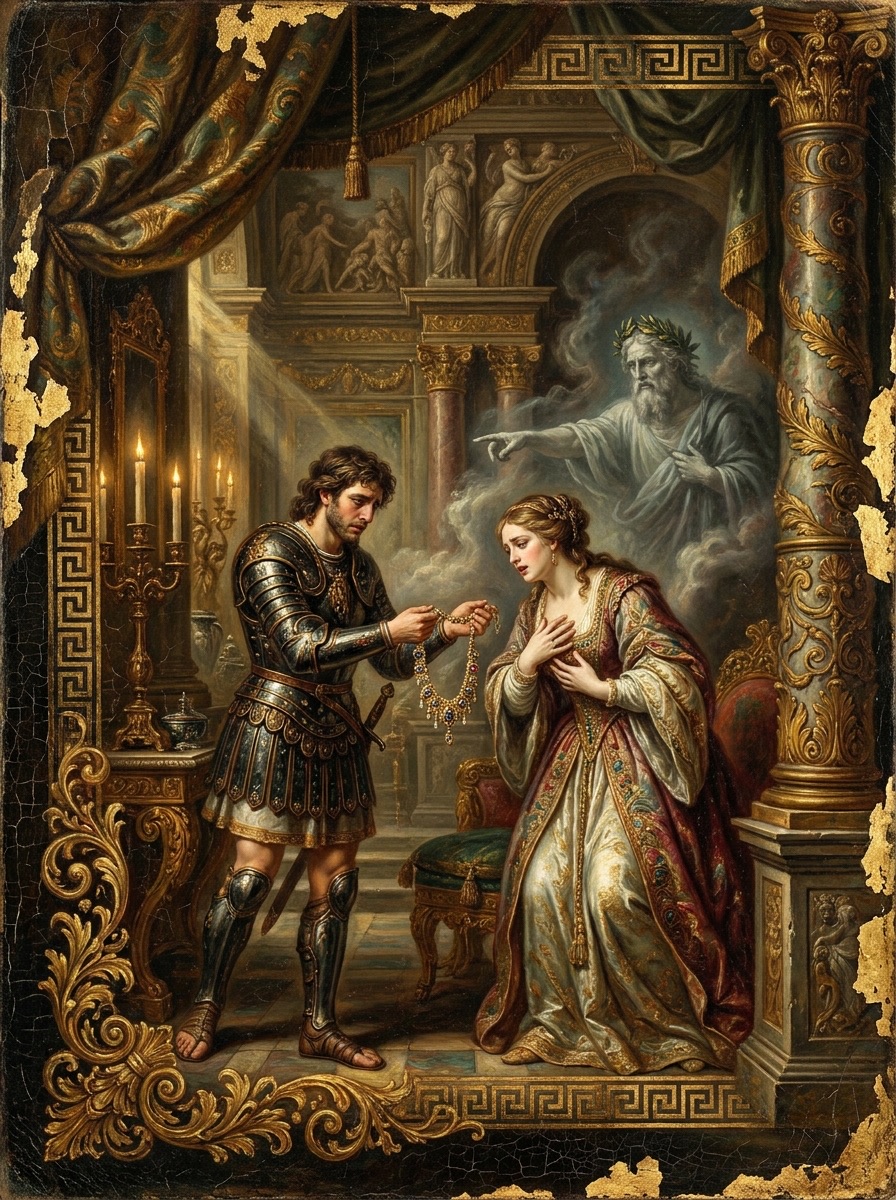
Amphiaraus knew he would die if he joined the war against Thebes, and at first he refused to go. But Polynices won over Eriphyle with Harmonia’s necklace, and she persuaded her husband to take the field. Before he left, Amphiaraus charged his son Alcmaeon to avenge him when he grew up. The first assault on Thebes failed, but when the sons of the fallen heroes prepared a second expedition, Eriphyle was again tempted by a treasure and urged Alcmaeon to march. Remembering his father’s command, Alcmaeon killed his mother and then led the later heroes to victory at Thebes. Yet the blood of his mother left him unclean. The Furies pursued him until he sought purification from Phegeus at Psophis, where he married the king’s daughter and left the necklace and robe behind. Later, when the land failed, an oracle sent him to the fresh soil newly formed at the mouth of the Achelous, where he was cleansed again and wed Callirrhoe, the river god’s daughter. Callirrhoe then wanted the necklace and robe for herself. Alcmaeon returned to Psophis to recover them, pretending that he meant to dedicate them to Apollo. But Phegeus learned the truth, and his sons lay in wait and killed Alcmaeon. Callirrhoe prayed to Zeus that her sons might grow at once so they could avenge their father, and they later carried the fatal treasures to Delphi.
A Father's Last Charge
In Argos, Amphiaraus was famed as a seer. He could read the flight of birds and hear the voice of the gods, and he could also see his own doom. One year Polynices came to Argos and gathered heroes for a march on Thebes, hoping to win back the throne that should have been his. Many were ready to follow him, but Amphiaraus held back.
He knew this road did not lead to victory. The chariots would reach the walls of Cadmus’ city, bronze shields would ring under the hail of stones, spears would break before the gates, and he himself would never return alive.
But there was an old compact in his house. Long ago, when he had quarrelled with Adrastus, the two men had agreed that if such a dispute ever arose again, Eriphyle, Amphiaraus’ wife, would decide it. Polynices learned of this and brought out a dazzling prize: Harmonia’s necklace.
The necklace was ancient. It had once belonged to Harmonia, queen of Thebes, and its gold and gems shone so richly that it seemed to cast light upon the one who wore it. Yet beauty clung to it like a hidden fire, and wherever it went, peace soon departed.
Eriphyle saw it and could not resist. She accepted the gift and ruled that Amphiaraus must join the expedition.
Amphiaraus understood that the matter could not be undone. He did not cry out in front of the others. Instead, he called his two sons to him. The elder was Alcmaeon; the younger, Amphilochus. They were still too young to ride to war. Their father looked at them and spoke words that were heavy with fate:
“Your mother has sent me to my death for the sake of a treasure. When you are grown, avenge me. Then go against Thebes again, so that what your father began may have its ending.”
After that he put on his armor, climbed into his chariot, and rode away with the Seven against Thebes.
The Expedition Bought by a Necklace
How the first assault on Thebes ended, Alcmaeon later heard from others.
The fighting before the gates was terrible. One hero after another fell. As Amphiaraus drove away from the field, Periclymenus was hard on his heels, and his spear was almost at the seer’s back. Then Zeus opened the earth. A cleft yawned before the wheels, and Amphiaraus, chariot and all, disappeared into the ground. He was not slain by the enemy, but he vanished from the world of men.
Adrastus alone made his way back to Argos. The Seven were nearly destroyed, yet the walls of Thebes still stood on the plain.
No body of his father came home, only the command that had been left in his sons’ ears. Alcmaeon grew up year by year, and with him that command grew heavier. But murder of a mother is no common revenge. Eriphyle had borne him in her arms and kept his house when he was a child. A hand may harden if anger drives it, but it trembles when it remembers a mother’s face.
Many years passed. The sons of the heroes who had fallen at Thebes came to manhood and were called the Epigoni, the Later Heroes. Their fathers had died before the city walls, and now the sons meant to complete what the fathers had failed to finish.
This time Alcmaeon too was pressed forward. An oracle had said that the Later Heroes could not prevail unless he led them. Yet he still hesitated, because his father’s last command had not ended with revenge: Eriphyle still had to be punished first.
Then the treasure entered the house once more.
Tersander, son of Polynices, wanted Alcmaeon to join the war, and he brought out a robe that, like the necklace, had come from the house of Harmonia. Eriphyle had already brought death upon her husband for the sake of the necklace; now the robe lured her again. She urged her son to march on Thebes.
At last Alcmaeon’s hesitation broke. His father had not merely died by chance; his mother had knowingly reached for the same ruin twice. That night the house held no war cry, only the shadows of a home turned dark. Alcmaeon lifted his hand against her, and blood fell on the floor.
Eriphyle died. Half of his father’s charge was fulfilled. But from that moment on, Alcmaeon’s own hands could never again be clean.
The Later Heroes Take Thebes
After the killing, Alcmaeon still had to go to war.
The Later Heroes gathered in Argos. Chariots were harnessed again, shields hung at the sides, and spear after spear was stacked in readiness. They did not rush as their fathers had done into the blind mouth of fate, but advanced with old hatred and divine warnings behind them. Alcmaeon stood among them like a man already driven forward by the blood debt of his own house.
They reached Thebes. The city still had its high walls, and from the gatehouses the shouts of defenders still rose. In battle Alcmaeon met Laodamas, king of Thebes. Spears met, shields rang, and his arm went numb from the shock. In the end, Alcmaeon killed him.
With their leader gone, the Thebans knew the city could no longer be held. They followed the advice of the seer Tiresias and, under cover of night, gathered their children and their household goods and fled. By the time Alcmaeon and the Later Heroes entered the city, many houses were already empty, the hearths cold, the streets strewn with abandoned things and the signs of a hurried departure.
So Thebes at last was taken. The sons won back for their fathers the victory that had been denied them.
Yet Alcmaeon found no peace. Blood shed in battle could be counted as war, but a mother’s blood cried out from within the house. The Furies came after him. They did not always show themselves, but he heard them in his ears as if in footsteps; they robbed him of sleep; and wherever he went, the ground seemed to refuse him.
Alcmaeon began to wander.
Hands That Could Not Be Washed Clean
He first came to Psophis and asked King Phegeus to cleanse him.
The ancients believed that a grave pollution could be washed away, at least for a time, if the proper person performed the proper rites. Phegeus received him, purified him of the stain of matricide with sacrifice and sacred water, and gave him his daughter Arsinoe in marriage. Alcmaeon left Harmonia’s necklace and robe with his new wife, as though he were shutting the old horror away in a new house.
He thought his life might finally grow quiet. But before long the land around Psophis failed. The fields yielded no grain, and the trees bore little fruit. Men said the blame still clung to Alcmaeon; the guilt had never truly left him. It stood in the furrows with him and followed him into other people’s homes like an unseen poison.
So Alcmaeon was forced to wander again. He sought an oracle, and the answer he received was strange: he must live upon land that had come into being only after the day he killed his mother. The old earth, it seemed, had seen his crime and would not receive him. Only a newly born land, unstained by that blood, could shelter him.
The riddle led him to the banks of the Achelous. The river curved through mud and reeds, carrying silt year after year and building new ground at its mouth. That land had arisen only after his mother’s death; it had not yet been touched by the stain of his crime.
The river god Achelous received him and cleansed him once more. Alcmaeon settled on the newborn land, and the Furies’ pursuit at last seemed to fall back.
Later, the river god gave him his daughter Callirrhoe in marriage. Young and beautiful, she lived by the river on that fresh land like a flower newly fed by the stream. Alcmaeon believed that perhaps he could finally stop running and no longer hear the voices behind him.
A New Wife's Demand
But the necklace and the robe had not vanished from the story.
Callirrhoe learned that Alcmaeon had once possessed Harmonia’s treasures, and she wanted them for herself. She asked her husband for the necklace and the robe. Alcmaeon was troubled. The treasures were no longer with him; he had left them in Psophis with his former wife, Arsinoe. To recover them would mean returning to Phegeus’ house and facing the life he had left behind.
Callirrhoe pressed him again and again. In the end he set out.
When he returned to Psophis, he did not say that he wanted the treasure for his new wife. He told Phegeus that he was still haunted by pain and must dedicate the necklace and robe to Apollo at Delphi if he was ever to be freed from his misery.
Phegeus believed him. Perhaps he remembered the man he had once purified; perhaps he thought that an offering to a god could only be proper. At any rate, he gave the treasures back.
Alcmaeon took them and prepared to leave. But lies do not travel far before they are caught. Someone among the servants or attendants revealed the truth: the treasures were not meant for Delphi at all, but for Callirrhoe by the Achelous.
Phegeus was enraged. He felt deceived by his son-in-law and shamed through his daughter. That necklace had already brought death to Amphiaraus and then led to Eriphyle’s murder, and now it was being taken from his house to another woman.
He ordered his sons to lie in wait on the road.
Alcmaeon passed by with the necklace and robe and did not know that death had already been waiting for him. The path was narrow among the trees; his horses trod the dust; the leaves threw broken shadows across the road. Suddenly Phegeus’ sons sprang out with spear and blade. Alcmaeon had no chance to escape and fell beside the road.
This time he did not sink into the earth, and no river god reached out to save him. The treasures of Harmonia were still there, but the man who carried them was dead.
The Treasure's Last Journey
After Alcmaeon’s death, Phegeus’ sons took the necklace and robe and carried them home. Arsinoe heard that they had killed her husband and bitterly rebuked her father and brothers. Though Alcmaeon had abandoned her, she did not wish to see him die in such a way.
Phegeus’ household would not listen. They shut her in a chest and sent her away, even claiming that she herself had brought about Alcmaeon’s death. In the anger of the house, a woman lost her voice, another victim dragged off beside the treasure.
By the Achelous, Callirrhoe learned that her husband had been slain. She held her young sons and thought only of vengeance. They were still too small to bear weapons, so she prayed to Zeus that they might grow at once and avenge their father.
Zeus granted her request. In a single night the boys became full-grown young men. They left the river, caught up with Phegeus’ sons, and killed them; then they went to Psophis and slew Phegeus and his wife.
Thus the blood debt set loose by the necklace and robe passed through one generation after another and dragged many lives down with it.
In the end, Alcmaeon’s sons carried Harmonia’s necklace and robe to Delphi and dedicated them to Apollo. The treasures were taken out of mortal bedrooms and chests and set before the god, no longer to hang upon a woman’s neck or lie hidden in a king’s storehouse.
So Alcmaeon’s life came to its close. He avenged his father and captured Thebes, yet was driven into exile by his mother’s death. He found cleansing, only to lie again to gain the treasures his new wife desired. And when he returned to the old house that had already ruined him once before, he died in an ambush laid by his own kin. The beautiful necklace handed down from Harmonia never lost its gleam, but the houses through which it passed left behind them blood and mourning.