Greek Mythology
The Ages of Humankind — Greek Mythology
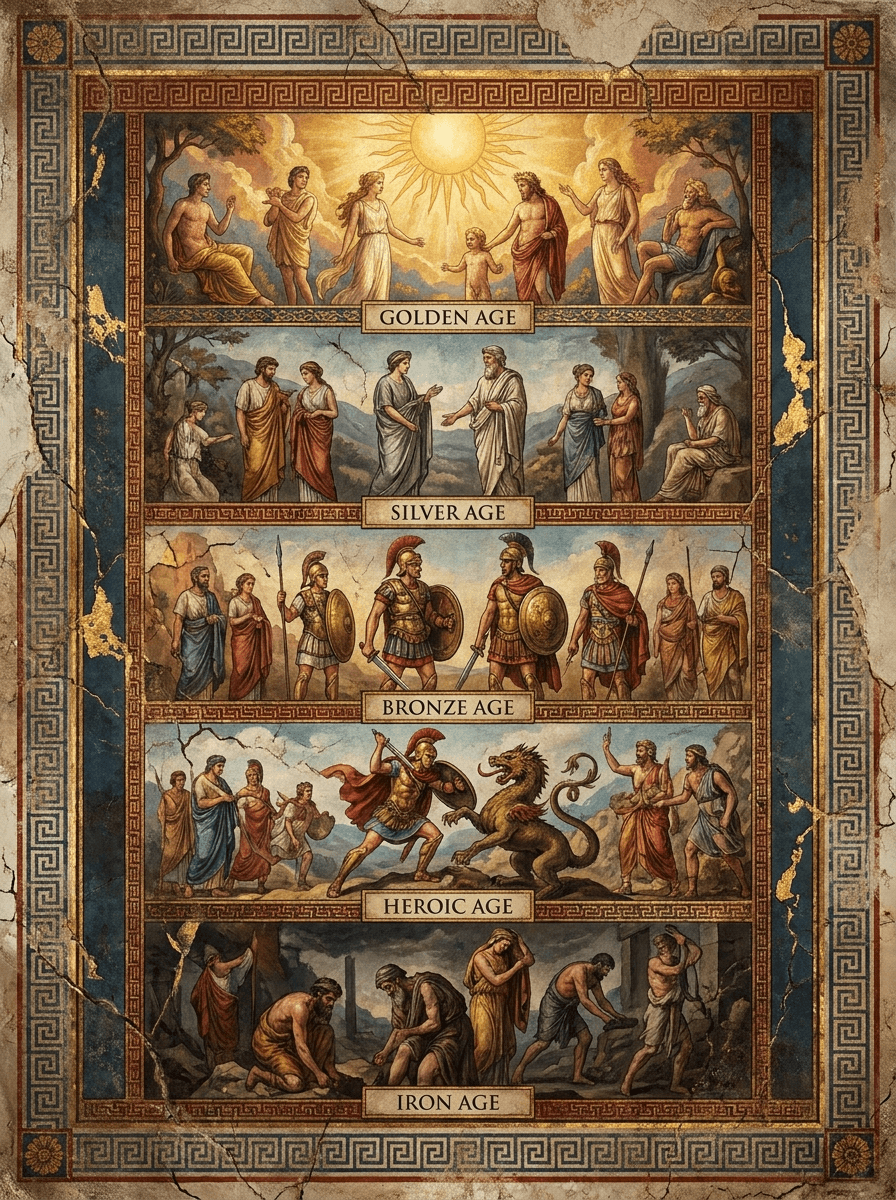
In the ages ruled first by Kronos and then by Zeus, humankind appeared upon the earth generation after generation: gold, silver, bronze, heroes, and at last the age of iron. Each race lived differently and met a different end, until there remained the world of mortals as we know it—hard-working, mixed with good and evil, still struggling to live amid sorrow.
Article
Summary
The earliest humans lived in the days when Kronos ruled. They dwelt in peace like the gods: the fields bore fruit of themselves, no hunger or sickness tormented them, and when old age came, they passed away as gently as if they had fallen asleep. Afterward they vanished from the visible earth, yet did not disappear entirely; they became kindly spirits who watched over mortal lives. The silver race was duller and more willful than the people of gold. They remained beside their mothers for an unnaturally long childhood, and when they finally grew up, they failed to honor the gods or keep proper order among themselves. Zeus was displeased by their arrogance and removed them from the earth; after death they became spirits beneath the ground, remembered still, but far less honored than the guardians of the golden age. Then came the bronze race. They were huge, strong, and harsh, with bronze shining coldly in their houses, tools, and weapons. They loved conflict and used hard weapons against one another until their own violence consumed them. In the end they dwindled away and sank into the dim house of Hades. After bronze, Zeus made a nobler race of heroes. They were not free from error, but many carried divine blood and won names that later singers remembered in quests, sieges, and wars: the Golden Fleece, Thebes, and Troy all belonged to their age. Many died in battle or on the road home, while some were settled by Zeus in a distant blessed land. Last came the age of iron. People had to live by the work of their own hands, plowing, harvesting, guarding stores of grain, and enduring poverty, deceit, quarrels over inheritance, and unjust judgments. Yet this age was not made only of misery: weddings, harvest songs, friendship, and hospitality still remained. Good and evil stood mixed together, and shame and justice might one day leave the earth, but human beings still had to rise each day and choose how to live.
The People of Gold
Long ago, before Zeus held power in the heavens, Kronos sat high above and ruled over the gods and the world. In those days, the first race of humankind appeared upon the earth.
They did not grow up amid famine and war. In the morning, mist rose from the fields, the grass lay wet with dew, and ripe fruit hung from the branches. People did not have to bend their backs and scrape desperately at hard soil, nor sow seed and then spend their days fearing wind and rain. The earth, like a generous mother, brought forth grain, grapes, olives, and every kind of fruit, and laid them before them.
Before their houses, cattle and sheep grazed slowly. Streams ran between the stones. People sat in the sunlight and talked, shared their food, and slept quietly at night. No one was driven by poverty to theft or violence; no one lay curled in bed, racked by pain. When the years came upon them, they did not reach out with sudden, icy hands. When a person’s days were full, he only grew drowsy, as if after a day’s labor he had closed his eyes beside the hearth, and passed peacefully into sleep.
This was the golden race.
Later, fate led them away from the earth that eyes can see. They did not scatter like smoke. Ancient tradition says they became gentle guardian spirits, hidden between cloud and air, moving to and fro, watching over those who came after them. They looked upon the upright, and they also saw when a wicked hand reached for what it should not take. If someone did good, they helped in secret; if someone oppressed the weak, they remembered the offense.
The Golden Age passed, and the earth stood empty for a time. Yet the story of humankind did not end there.
The Silver Race That Would Not Grow Up
Afterward, the gods made a second race of humans. They were not as peaceful or radiant as the people of the Golden Age. They were called the silver race.
Their childhood lasted strangely long. Children remained beside their mothers, living indoors, fed and cared for, for a very great span of time before they could truly grow up. A child might spend a hundred years at home, his body slowly increasing in height while his mind stayed like that of a little one who had not yet met the world. They grew used to being sheltered, used to having food placed within reach, used to having others yield when they cried and complained.
When at last they stepped outside their houses and became adults, the rest of their lives was already short. In those few remaining years, they let loose all the stubbornness in their hearts. Brother quarreled with brother; neighbor nursed hatred against neighbor. They did not understand restraint, and they would not bow their heads. A strip of land beside a boundary stone, a single ox in the cattle shed—anything could stir up rage. Some lifted their hands to strike; others deceived in secret. The altars grew cold, and the smoke once offered to the gods no longer rose as it should.
Zeus saw all this, and he was displeased.
By then Zeus had taken his throne in heaven. Looking down, he saw that the people on earth did not honor the gods and did not keep the proper customs, so he resolved that the silver race should vanish from the earth. When their lives ended, they did not receive the bright honor granted to the golden people, yet neither were they cast entirely into nameless darkness. Tradition says they became spirits dwelling beneath the earth, still remembered by later generations, though far below the guardians left from the Golden Age.
The silver race passed away. Once more the mortal world changed its face.
Bronze Hands and Bronze Blades
Next Zeus made a third race of humans. These were the people of bronze.
From the beginning, there was something harsh and unyielding about them. Bronze vessels stood in their houses; warriors gripped bronze spears in their hands and wore bronze swords at their waists. Even when fields had to be broken open, they used tools of bronze. Iron had not yet come into common use among mortals, and the gleam of bronze under the sun looked cold, like pieces of fire hardened in place.
The people of the bronze race were tall and terribly strong. They were not content with the fruit of the fields, nor willing to sit quietly and divide the harvest the earth provided. The smell of blood often drifted outside their houses, and meat hissed over the flames. They loved hard things, and they loved using hard things to break the bones of others.
Soon, fighting became their daily life.
One man forged a long spear; another made a thicker shield. One tribe built gates sheathed in bronze; another drove wagons forward to smash them down. At evening, when the plains should have echoed with the sound of flocks returning to their folds, there often came instead the roar of killing, the cries of grief, and the crash of weapon against weapon. Young men fell in the dust, still clutching broken spear shafts; victors stepped over bodies and piled the captured bronze upon their carts.
They were strong, but they were not immortal.
However powerful their arms, however broad their chests, death came to meet them in the end. The bronze race grew fewer and fewer through its own violence, until at last they left the sunlit earth and sank into the dim house of Hades. There were no battlefields there for them to love, no bronze-bright halls—only cold shadows and silent dead.
So the third race of humankind also passed away.
The Heroes Go to War
After the people of bronze had perished, Zeus did not at once fill the earth with a worse race. He made another generation, nobler than the last. Later people called them the race of heroes, or the race of demigods.
They were not carefree like the people of gold, nor did they know only violence like the people of bronze. They were born among cities and palaces, amid oaths, marriages, rivalries, and far journeys. They could err; they could rage; they could draw swords for the sake of honor, and weep for friendship and kin. Many carried divine blood in their veins, yet mortal fate still clung to them.
The names of this generation were often sung by poets in later days.
Some sailed to distant lands in search of the fabled Golden Fleece. Some fought beneath the walls of Thebes, where seven leaders drove their chariots and shields toward the gates. Others, for a queen who had been taken away, boarded black ships and crossed the sea to Troy. Sea wind swelled the sails, and by night campfires shone in rows along the shore. The heroes put on armor and went into battle, their spearpoints aimed at their enemies—and at their own destinies.
Many of them died in war. Some fell beneath city walls; some were pierced by spears; some returned victorious only to die at their own doors. The heroic race did not escape death, but not all of their endings sank into darkness. Tradition says Zeus settled some of them in a distant blessed land, at the edge of the earth, where the sea wind is gentle. There they lived with fewer sorrows than ordinary mortals know; the fields bore fruit many times in a year, and sweet air blew in from the sea.
Yet the age of heroes did not remain long upon the earth. Rain washed away the tracks of chariot wheels, dust covered the bloodstains on city gates, and though the songs still traveled from mouth to mouth, the living had already become another race.
The Days of Iron
Last came the race of iron.
This generation stood closest to the ancient singers, and closest as well to the world we recognize. Iron was taken from the earth, reddened in fire, and beaten again and again beneath the hammer. Sickles, axes, swords, and plowshares all bore the color of iron. People had to live by the work of their own hands. In spring they turned the soil; in summer they weeded; in autumn they harvested; in winter they guarded their scant stores and counted out the days. When the sun rose, a person had to go to the fields. When night came and he returned, his shoulders and back ached, and cracked calluses marked his palms.
This generation did not know only misery from morning until night. They too held weddings, poured wine before new houses, lifted newborn children in their arms, and sang at harvest time. When friends met, they still passed the cup; when a stranger entered the door, he might still be given a piece of bread and a place beside the hearth.
But in the age of iron, trouble always came walking beside joy.
A father worried for his son, while the son complained that his father was old. Brothers quarreled over inheritance; neighbors argued over boundary lines. In the marketplace, some spoke words as sweet as honey while their hands slipped toward another man’s purse. In judgment, some accepted gifts and sent the honest home empty-handed. The poor feared for tomorrow’s bread; the rich feared that others would come to seize what they had. By day there was labor, and by night there was not always sleep.
The old poet said that in such an age, Shame and Justice would gradually leave the world. Like goddesses clothed in white, weary of quarrels and deceit in the dust, they would turn away and climb toward the heights. If that day truly came, humans would have nothing left but the harm they did one another, and disaster would grow heavier and heavier.
Yet the iron race did not immediately perish in the story. People still lived upon the earth. At dawn, a farmer lifted his plow and walked toward the field; a woman set a water jar on her shoulder and went to the well; children chased one another before the door until adults called them back inside. Smoke still rose at times from the altar, and old people still told of the peace of the Golden Age, of the childish willfulness of the silver race, the savagery of the bronze, and the journeys and deaths of heroes.
So the ages of humankind fell one after another. The first people lived lightly, almost like gods; later generations tasted more and more of toil, conflict, and loss. By the age of iron, humans could no longer expect the earth to give them everything of itself, nor hope to live without sickness or deceit. Yet they still had to rise in the morning light, labor through wind and rain, and choose between good and evil. What this story leaves behind is the reason mortal life is so hard—and why hope has not yet entirely departed from it.