Greek Mythology
Agamemnon Tests the Greeks — Greek Mythology
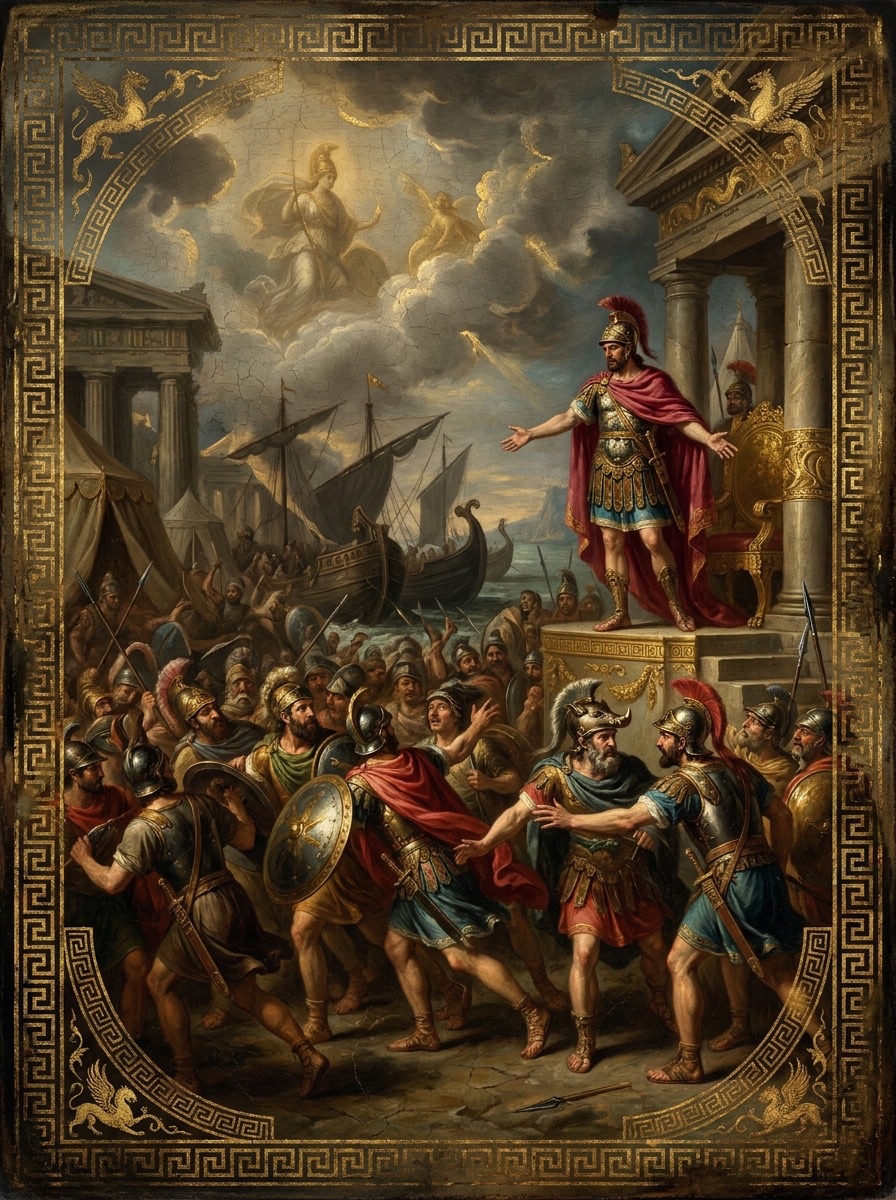
Zeus sends a deceptive dream into Agamemnon’s tent, urging him to attack Troy. But Agamemnon first tests the Greeks by speaking of withdrawal, and nearly sends the whole army rushing back to the ships, until Odysseus restores order among the troops.
Article
Summary
Outside the walls of Troy, the Greek army has been at war for a long time. The soldiers long for home, and the chiefs are burdened with their own doubts. In the night, Zeus sends a dream to Agamemnon, telling him that if he attacks at once, Troy will fall. Agamemnon wakes and trusts the dream, yet he does not immediately order battle. At dawn, he first gathers the leaders and tells them what the dream has said. Then he announces that he will test the soldiers: in the assembly he will urge them to sail home, while the chiefs must hold the men back and keep them from truly dispersing. But once the words are spoken, the weary soldiers surge like a sea toward the ships, pulling out the props, loosening the cables, and longing to drag the black hulls down into the water. Hera sees the Greeks about to leave and fears that Troy will escape its doom. She sends Athena down to stop them. Athena finds Odysseus, and Odysseus takes Agamemnon’s scepter and runs through the ranks of ships. He speaks gently to the chiefs, but harshly rebukes the shouting common soldiers, driving them back to the assembly. There the ugly, loud-mouthed Thersites rises and insults Agamemnon, calling him greedy for treasure and women, and urging the men to go home. Odysseus rebukes him before everyone and strikes him across the back with the scepter. Thersites sits down in tears, while the soldiers burst into laughter, and the scattered spirit of the army slowly steadies again. Then Odysseus and Nestor persuade the men to remain and fight, and the Greek army reforms its ranks, ready once more to move against Troy.
The False Dream in the Night
Outside the city of Troy, the camp of the Greeks stretched along the shore. The black ships stood close together, prow to the sea and stern toward the rampart. When the dust of day had settled, the soldiers lay down beside their tents, near the ships, or close to the ash of dying fires. Some slept with shields in their arms; others rested their heads on folded cloaks. Far off, the walls of Troy still stood, and the war had dragged on far too long.
That night, many men slept, but the gods in heaven had not forgotten the battlefield.
Zeus sat upon Olympus, turning over in his mind how he might bring suffering upon Agamemnon and make the Greeks pay a heavier price. He summoned the Dream and said to him, “Go to Agamemnon’s tent. Stand by his head and tell him what I say. Tell him that the gods have agreed to let him take Troy, and that now is the hour to gather the long-haired Achaeans and storm the city.”
The Dream flew at once down from Olympus. Night lay heavy over the sea, and among the ships only a few sparks still glimmered. He passed through the camp and came to Agamemnon’s tent. Agamemnon was sleeping within, with his royal scepter and weapons close beside him. The Dream took the shape of old Nestor, stood by his head, and spoke in a familiar voice.
“Are you still asleep, son of Atreus?” the figure in the dream said. “A man who commands so many soldiers should not sleep through the night. Zeus has pity on you and bids you arm the Greeks in haste. Troy can no longer escape. The gods on Olympus are all agreed. If you march at once, you will take the city.”
When he had spoken, the Dream departed. But Agamemnon still lay wrapped in sleep. He believed the message to be a true sign from Zeus and thought that on the next day he would seize Priam’s high city. He did not know that the dream was a snare, one that would drive the Greeks toward greater disorder.
Counsel in the King’s Tent
At daybreak, a wind rose by the sea, and through the camp came the sounds of horses neighing and weapons striking against one another. Agamemnon woke and sat up, the dream still clear in his mind. He put on a soft tunic, fastened a broad cloak over it, drew sandals onto his feet, and took up the ancestral scepter.
That scepter had a long history. It had passed from the gods into the hands of heroes, and from them into the house of Atreus. When Agamemnon held it, it was as though he held command over the whole army.
He did not summon all the troops at once. First he called together the Greek leaders. Old Nestor, Odysseus, Diomedes, the two Ajaxes, and the other kings came before his tent. Agamemnon told them the words he had heard in the dream, saying that Zeus urged him to attack Troy without delay.
But after this, he proposed another plan.
“I mean first to test the spirit of the army,” Agamemnon said. “In the assembly I will advise the soldiers to board the ships and go home. You must stand among them, each among his own men, and keep them from truly embarking. If they are still willing to remain, then we will set the army in order and fight.”
The chiefs listened, knowing well that the Greeks had grown tired of the long siege. Every day the sea wind blew over the sails, while home lay far away. Many men missed their fields, their wives, their children, and the vines before their doors. To test such an army with the word “home” was dangerous.
Yet old Nestor did not stop him. He said that if some other man claimed to have received such a dream, perhaps it could not be trusted; but the one who reported it was commander of the whole army, and the men ought to obey. So the leaders went out from the tent and ordered the assembly to be called.
The Assembly by the Sea
The soldiers poured out from the ships and tents like swarms of bees leaving cracks in the rock, buzzing as they gathered at the meeting place. There were so many of them that the sand rang beneath their feet. Each people clustered around its own leader, shields resting against knees and spears standing upright by shoulders. Heralds moved through the crowd, shouting for silence.
Unseen, Athena helped still the uproar little by little. Then Agamemnon rose, holding the scepter in his hand.
He began to speak, and his voice carried across the assembly. “Friends, warriors of Greece, Zeus once promised me that I would take Troy. Now it seems he has deceived me. We have fought here for many years and still have not captured this city. Our soldiers are more numerous than the Trojans, but they have allies to help them, and their walls are strong. If we go on like this, we will only suffer in vain. Come, then, listen to me. Let us sail home to our own land. It seems broad-streeted Troy is not ours to take.”
When these words fell, the crowd was silent for a moment. Then, like a great wind striking the sea, the whole mass of men suddenly moved.
They did not hesitate as Agamemnon had expected. They did not wait for the chiefs to explain. The soldiers, long worn down by war, heard the word “home,” and their hearts flew at once across the water. Some shouted for joy; others ran toward the ships, and dust rose beneath their feet. The camp fell into confusion as if fire had been set to it.
They rushed to the ships, pulled away the wooden props that held the hulls, cleared the trenches beneath them, and loosened the cables. Some had already set their shoulders to the sterns, ready to drag the black ships into the sea. Rowers shouted as they searched for oars. Soldiers gathered their belongings, flinging helmets, shields, and bundles aboard. Along the shore a cloud of dust rose, as though all the years of siege were about to vanish in that single moment.
Agamemnon’s test had nearly become a true retreat.
Odysseus Runs to the Ships
From heaven Hera saw what was happening and was filled with alarm. She had long stood on the side of the Greeks. If the army sailed away now, Troy would be saved, and the matter of Paris carrying off Helen would go unpunished. At once she said to Athena, “Will you stand there and watch? The Greeks are already fleeing to the ships. Go quickly. Stop them. Do not let them push the ships into the sea.”
Athena swept down from Olympus like a gust of wind and came to the camp by the shore. There she found Odysseus. At that moment Odysseus had not touched his own ship. Uneasy in his heart, he stood aside and watched the men streaming past.
The goddess stood beside him, and only he could hear her words. “Son of Laertes, will you let the Greeks run away? If they go home like this, the Trojans will boast of victory, and Helen will remain within the city. Go quickly and stop them.”
Odysseus understood at once that a goddess was urging him on. He handed his cloak to his attendant Eurybates, turned, and went to Agamemnon. From Agamemnon’s hand he took the royal scepter, then ran through the crowd toward the ships.
When he met chiefs and famous warriors, he spoke to them gently. “Friend, you should not run away like a coward. Sit down yourself, and make your men sit down as well. Agamemnon was only testing the army. You did not hear what he said in the council of leaders. If we provoke the commander, worse trouble may come.”
But when he came upon common soldiers shouting and pressing toward the ships, he took another tone. He struck their backs and shoulders with the scepter and cried, “Sit down! Listen to men better than you. You are neither the bravest in battle nor the wisest in counsel. Not everyone can be king. There must be one command.”
As he spoke, he drove them back toward the assembly. In his hand the royal scepter was not merely wood; it was Agamemnon’s authority. The men who had just been desperate to board the ships were checked, pulled back, and pushed into order. Dust still flew, but the movement of the crowd slowly turned. From the ships the soldiers returned to the meeting place, like water drawing back after the tide has rushed out and then settling again into the low ground.
The Shouting of Thersites
When the men had seated themselves again, resentment still stirred among them. Then a man named Thersites sprang up to speak.
He was no famous chief, nor any warrior whom men honored. People said he was ugly, crooked in the legs, hunched at the shoulders, with thin hair scattered over his head. But above all he loved to speak wildly in assembly, especially when he could mock the kings. His heart was full of bitter words, and whenever he found an opening, he was eager to let them fly before everyone.
He raised his voice and railed against Agamemnon. “Son of Atreus, what do you still lack? Your tents are already filled with bronze and with many chosen women. Whenever we take a city, the best spoils are brought first to you. Do you want more gold? Do you want some other man’s daughter? You brought us here to suffer, while you take the largest share of the plunder. Greeks, let us sail home instead and leave him here alone to enjoy his glory!”
His words fell like stones into water, stirring the men again. They had already been driven back and forth, and many were angry. Some nodded secretly when they heard him; others thought he had gone too far. Agamemnon sat nearby, his face dark.
Odysseus stepped forward and fixed his eyes on Thersites.
“Thersites,” he said, “you may be loud of tongue, but do not make sport of kings again. No man here loves insulting his commanders more than you. You speak of going home only to stir up disorder. If I hear you babbling like this again, may I be punished by all the army; I will strip the clothes from your body and send you weeping back to the ships.”
With that, he raised the scepter in his hand and struck Thersites hard across the back. A red welt soon swelled where the blow had fallen. Thersites crouched in pain, tears forced from his eyes. He sat down again, his mouth still twisted, but he did not dare speak further.
The soldiers saw him in that state. For a moment they stared; then they burst out laughing. One man wiped his eyes and said, “Odysseus has done many good things—given counsel, led men in war—but this was not the least of them. He has shut the mouth of that noisy fellow.”
The laughter spread, and the anger that had filled the crowd loosened with it. The assembly grew quiet once more.
The Army That Stayed
Odysseus still held the scepter and stood before the men. He no longer chased them as he had done at the ships, but spoke plainly, reminding them that when they left Greece they had not come in order to give up halfway. At Aulis, when they first gathered, they had seen a divine sign foretelling that Troy would one day fall. They had endured many hardships already; if they returned empty-handed now, they would only be mocked.
He spoke of home, too, and did not deny their longing. Who did not wish to return? Who did not wish to see wife and children again? Even a man delayed by contrary winds for a single month at the shore grows restless; after so many years outside Troy, weariness was natural. Yet having come this far, they should endure a little longer and see whether the prophecy would be fulfilled.
Old Nestor then rose. He was aged, but his voice still had strength. He urged Agamemnon to arrange the army by tribes and clans, so that the brave and the cowardly alike would be revealed, and every company would know its place. Then, if any man refused to fight, he could no longer hide in the crowd.
Agamemnon accepted this counsel. Before everyone, he also admitted that his quarrel with Achilles had been one of his mistakes, but now the chief need of the whole army was unity in battle. He ordered the men to eat, prepare sacrifice, and then arm themselves for war.
When the assembly broke up, the soldiers no longer ran toward the ships. Some went back to their tents for helmets; some sharpened spearheads; others brought horses to the chariots. Once again the camp rang with the sound of bronze armor. The black ships remained where they were on the shore. Their cables were not loosed, and their hulls were not dragged into the sea.
Agamemnon had meant to test the army’s heart with a single word—“home”—and had nearly sent the whole host onto the sea. But Odysseus ran among the ships and turned the men back, until they sat once more in assembly. That day, the Greeks did not withdraw. They pressed their longing for home down into their hearts, took up shield and spear, and faced the city of Troy again.