Greek Mythology
The Bag of Winds, the Laestrygonians, and Circe — Greek Mythology
Just as Odysseus drew nearer to home, Aeolus, lord of the winds, shut the contrary gales inside an ox-hide bag and gave it to him. But his companions’ greed drove the fleet back out to sea. Later they entered the harbor of the Laestrygonians and were almost wiped out; only one ship escaped to the island of Circe.
Article
Summary
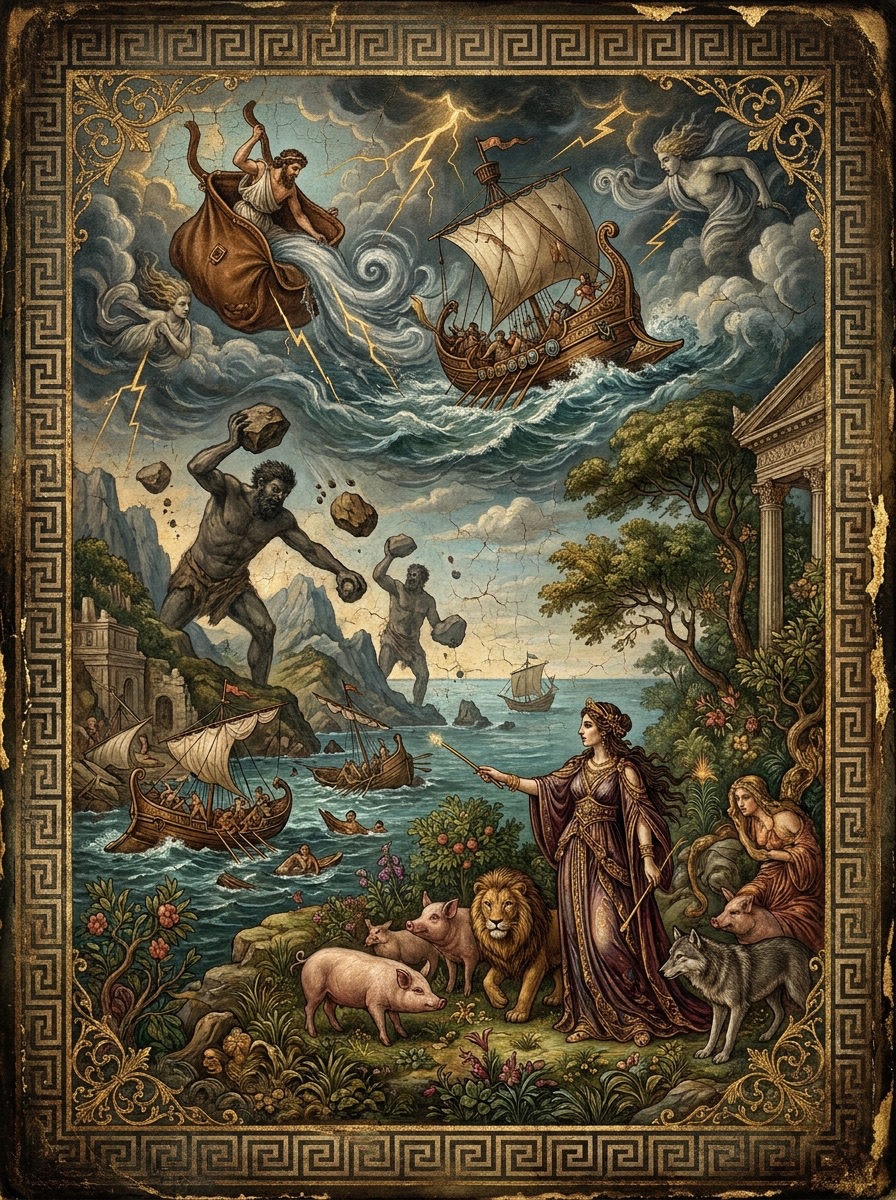
After leaving the shore of the Cyclops, Odysseus and the surviving ships reach the island of Aeolus. The wind king welcomes him, listens to the story of Troy and the sea, and then seals all the storm winds inside a bull’s hide, leaving only a fair breeze to carry the fleet toward Ithaca. But Odysseus falls asleep on the ship, and his companions, thinking the bag holds gold and silver, quietly untie the silver cord. The winds burst out at once, drive the fleet back from home, and carry them to Aeolus’s island again. Aeolus decides that the gods do not wish to help this wanderer any further, and refuses to aid them a second time. They drift six more days before coming to the harbor of the Laestrygonians. Odysseus keeps his own ship outside the narrow inlet as a precaution, but the scouting party sent inland is seized and eaten by the giant inhabitants. Then the harbor becomes a slaughter: stones and spears smash the eleven ships inside, and only Odysseus’s ship escapes. The survivors reach Aeaea, where Eurylochus leads a party into the woods and comes upon Circe. She welcomes them with food and drink, then mixes a potion into their wine and turns them into pigs. Eurylochus runs back to the shore, and Odysseus goes alone to help the men, meeting Hermes on the way and receiving a divine herb that can withstand the spell. Odysseus forces Circe to swear that she will not harm him, and the goddess lifts the enchantment, restoring his companions to human form. The exhausted sailors then live for a year in Circe’s halls in comfort and safety, until home begins to matter again and they ask Odysseus to learn from the goddess what road lies ahead.
The Island of the Lord of Winds
After Odysseus left the shore of the Cyclops, his thoughts turned constantly toward Ithaca.
Twelve ships still remained to him. Their masts creaked in the sea wind; their sails swelled, then sagged again. The men who had followed him all the way from Troy had seen too much death. They no longer sang loudly as they had when they first sailed to war. They bent over the oars in silence and listened to the hulls cutting through the sea.
In time they came to a strange island. It seemed to be ringed all around with a wall of bronze. Its shores were steep, and the waves broke against them in white foam. There lived Aeolus, the lord of the winds. He was no king in the ordinary mortal sense, but a host beloved by the gods, keeper of the winds and their going.
Aeolus received Odysseus warmly. He seated the strangers at his table and listened while Odysseus told how the city of Troy had fallen, how the Wooden Horse had brought ruin inside its walls, and what sufferings they had endured at sea. Odysseus spoke for many days, and the lord of the winds listened for many days.
When a month had passed, Odysseus at last asked leave to go.
“I have been away from home too long,” he said. “My wife, my son, and my father are in Ithaca. If you will help me, I will remember this kindness all my life.”
Aeolus did not refuse him. He took the hide of a nine-year-old ox and shut inside it all the fierce winds that would hinder the voyage home, as though he were penning a pack of roaring beasts. Then he tied the mouth of the bag with a shining silver cord and set it with his own hands aboard Odysseus’ ship. Only the West Wind he let loose, to blow gently into the sails and carry the fleet toward Ithaca.
Odysseus guarded the ox-hide bag and did not dare leave it for a moment. The winds churned inside; the hide bulged, and the silver cord held fast. The sailors saw it, and suspicion slowly began to grow in their hearts.
“What did he get from the lord of the winds?” one whispered.
“Perhaps gold,” said another.
“Perhaps silver. We have suffered with him, and he keeps the treasure for himself.”
Odysseus did not hear them. For nine days and nine nights he did not close his eyes. He held the rudder himself and kept his gaze fixed on the edge of the sea. On the tenth day Ithaca came dimly into sight. The shadow of its hills rose like a dark cloud, and it seemed that the smoke of home was already rising in the distance.
He was utterly worn out. Just as they were almost home, he sat in the stern, his head nodded lower and lower, and at last he fell asleep.
The Bag Opened
As soon as Odysseus sank into sleep, his companions gathered around the ox-hide bag.
One man reached out first and touched the mouth of it. The wind inside struck and heaved like a living thing. He stepped back, then clenched his jaw and said, “Since we are nearly home, what harm can there be in one look?”
The moment the silver cord was loosened, all the winds burst out.
They leapt upon the sea like beasts from a black cavern. The sails were wrenched violently; the masts bent until they seemed about to snap. The calm water rose at once into towering waves. The fleet was lifted high on the swell and then hurled down again. Ithaca, which had been before their eyes only moments earlier, vanished behind cloud, mist, and sea-spray.
When Odysseus woke, the winds had already swept them far away.
He saw his homeland disappear before him, and his chest felt as though a stone had been laid upon it. For a moment he even wished to throw himself into the sea and bring his torment to an end. But then he saw the men aboard the ship stumbling in terror, and heard the planks striking the waves. He clenched his teeth, wrapped his cloak about him, and sat down again in the ship.
The gale drove them back to the island of Aeolus.
When Odysseus went ashore, he came once more to the doors of the lord of the winds. He brought only a few companions with him. His face was worn with exhaustion and shame.
Aeolus was astonished to see him return.
“How have you come back here?” the lord of the winds asked. “Did I not give you a fair wind and send you home?”
Odysseus told him what had happened. He made no excuses for his companions; he only begged Aeolus to help him once more.
But Aeolus’ face changed.
“Leave my island,” he said. “I cannot help a man hated by the gods. If the immortals do not wish you to reach home, I dare not send you on your way again.”
The palace doors did not open to them. Odysseus could only lead his men back to the ships. They did not dare speak loudly, nor did they dare meet his eyes. The oars fell into the sea once more, stroke by stroke, cutting through the gray waves.
The Narrow Harbor
They drifted again across the sea for six days and six nights. On the seventh day a harbor appeared ahead.
It seemed a good place to anchor. High cliffs enclosed the water on either side, and between them was only one narrow entrance. Inside the bay the water lay still as a dark mirror; the sound of the outer waves was shut out by the rocks. When Odysseus’ companions saw the calm water, they breathed more easily and rowed eleven ships into the harbor, mooring them along the shore.
Odysseus, however, kept a thought for danger. He left his own ship outside the harbor, near a jutting rock by the sea, and fastened it only with a long cable. If peril came, at least he would be able to put out at once.
He sent two men ashore to scout, with a herald to accompany them.
The three climbed the road inland and saw a tall girl drawing water. She was the daughter of the king of the Laestrygonians. When they asked who ruled the land, she said little, but pointed toward a great house in the city.
They entered the house and found there a woman huge as a mountain. She was the wife of King Antiphates. The moment she saw the strangers, she called her husband.
When Antiphates came, he did not ask where they were from, nor why they had come ashore. He seized one of the men as if he were a small animal, killed him on the spot, and prepared to make a meal of him.
The other two were nearly mad with terror. They turned and fled through the doorway, racing back the way they had come.
But it was already too late.
The Laestrygonians heard the shouting and poured out from every side. They were enormous in stature. Standing on the cliffs, they lifted heavy stones and hurled them down into the harbor. When the boulders fell, the sea leapt up toward the sky, planks split apart, and masts snapped. Sailors ran wildly over the decks. Some were crushed by stones, some pierced with spears, and some fell into the water.
The quiet harbor became a slaughtering ground.
Odysseus stood outside the harbor and watched eleven ships destroyed one after another. He had no time to weep and no time to cry out. He drew his sword, cut the cable, and shouted to the men aboard to row.
“Row! Row hard!”
The oars struck the water together, and the survivors pulled with all their strength. Stones crashed behind them, and the waves they raised rocked the ship from side to side. When at last they escaped through the narrow entrance, behind them there remained only shattered timber, bloodied water, and cries of death.
Of twelve ships, only one was left.
Smoke on Aeaea
After they escaped the harbor of the Laestrygonians, no one on the ship spoke.
Men who had lost brothers and friends sat beside the oars, their hands still gripping the handles, as though they had forgotten how to breathe. Odysseus too was silent. He knew he had not been able to save those men, and he knew that this single ship could not endure another such disaster.
They sailed on and came to an island called Aeaea. It was thick with trees, and along the shore there was a beach where a ship could be drawn up. The men hauled the vessel ashore and sat by the sea, spending two days and two nights in weeping and rest. On the third day Odysseus took his spear and sword and climbed to a height, hoping to see whether anyone lived on the island.
From the hilltop he looked out and saw, far off in the depths of the forest, a thread of smoke rising.
It did not scatter wildly like smoke from a brushfire. It rose slowly from a roof into the sky. Someone lived there.
Odysseus returned to the ship, and on the way he killed a great stag. It had come out of the forest to drink, and he struck it with his spear. He dragged it back to the shore so his companions could eat meat. After they had eaten, a little courage returned to them.
The next day he divided the survivors into two groups. One he would lead himself; the other he placed under Eurylochus. Lots were drawn, and Eurylochus set out with twenty-two companions to find the source of the smoke.
They went into the forest, and along the path lions and wolves suddenly appeared.
The beasts did not spring upon them. Instead they wagged their tails and circled around the men like tame dogs at their master’s gate. The sailors were even more afraid. They would rather have met roaring beasts than such uncanny gentleness.
In the woods stood a house of stone. The ground outside it was smooth and open, and from within came a woman’s song as she worked at her loom. The voice was clear and lovely, floating out with the rhythm of the shuttle as it passed to and fro.
In that house lived the goddess Circe. She could sing, she could weave beautiful cloth, and she knew the power of many terrible herbs.
The Drug in the Cup
Circe heard men outside and came to welcome them.
She did not look like a savage monster. She smiled and invited the strangers in, set out chairs for them, and brought cheese, barley meal, honey, and wine. The sailors were hungry and thirsty from long wandering, and when they saw how gentle their hostess seemed, they went in one by one.
Only Eurylochus stayed outside.
A chill had entered his heart. Something about the house seemed wrong. He did not drink the wine and did not sit down, but hid outside and watched.
Circe had mixed a drug into the wine. The sailors lifted the cups and drank. Before they understood what was happening, she took up her wand and touched each of them in turn. In an instant coarse bristles grew over their bodies, their noses thrust forward into snouts, grunts came from their mouths, and their limbs dropped to the floor.
They had become pigs.
Yet their minds remained clear, and they still remembered who they were. Only they could no longer speak with human voices, and they no longer had human hands. Circe drove them into a sty and threw them acorns and wild fruit.
When Eurylochus saw all this, he turned and ran. He fled back to the shore, pale-faced, his lips trembling, unable for a long time to speak a complete sentence.
Odysseus seized him by the shoulders and asked what had happened.
At last Eurylochus told him. He urged Odysseus to launch the ship at once.
“They are beyond rescue,” he said. “If we go too, the same thing will happen to us. While this one ship is still left, let us escape.”
When Odysseus had heard him, he took up his sword and slung his bow and arrows over his shoulder.
“You stay here,” he said. “I will go.”
Eurylochus was so frantic he almost fell to his knees, begging him not to go to his death. But Odysseus was already walking toward the forest.
Hermes’ White Flower and Black Root
Odysseus had gone only part of the way when a young man suddenly came toward him.
He looked like a mortal youth, but his voice was bright and calm. It was Hermes, messenger of the gods. Hermes knew where Odysseus was going, and stopped him, saying, “If you enter like this, you too will be shut in the sty with your companions.”
Odysseus tightened his grip on the hilt of his sword.
Hermes pulled a plant from the ground and gave it to him. Its root was black, but its flower was white. It was difficult for mortals to pluck, but a god could take it with ease. Hermes said the herb would protect him against Circe’s drug.
Then he taught Odysseus what he must do.
“She will give you wine. Drink it. The drug will not harm you. When she touches you with her wand, draw your sword and rush upon her. She will be afraid and ask you to stay. Then make her swear a great oath that she will not secretly harm you. Until she swears, do not trust her.”
Odysseus took the divine herb, thanked Hermes, and continued toward the stone house.
When Circe saw him at her door, she greeted him with the same smile she had shown before. She invited him to sit and handed him a cup of prepared wine.
Odysseus took the cup and drank it down.
Circe waited a little while, thinking the drug must now be at work. Then she lifted her wand, touched him, and said, “Go to the sty and lie there with your companions.”
But Odysseus did not change.
He drew his sword in a flash and sprang at her. The blade came close to her breast, and Circe, startled, drew back in fear. Only then did she understand that the man before her was no ordinary wanderer.
Her voice softened. She asked him to lower his sword, and invited him to remain.
Odysseus did not trust her at once. As Hermes had instructed him, he made her swear the great oath the gods may not break, promising that she would do him no further harm. Circe had no choice but to swear.
Only after the oath was spoken did Odysseus put away his sword.
The Companions Who Came Out of the Sty
Circe set her maidservants to work. They spread blankets, brought clear water, and laid out a rich meal. But Odysseus sat in the house and could not eat a bite.
Circe saw what troubled him and asked why he was still unhappy.
Odysseus said, “My companions are still in the sty. How can I eat and drink in peace unless they return?”
When Circe heard this, she took another kind of drug and went to the pigsty. The pigs saw Odysseus and crowded around him, grunting, but their eyes looked as though men were weeping inside them.
Circe opened the gate and rubbed the salve upon them. The coarse bristles fell away, the snouts withdrew, and their limbs became human hands and feet once more. One by one the sailors stood up, younger than before and taller too. But as soon as they had regained their human shape, they threw their arms around Odysseus and wept.
The house rang with their crying, and even Circe was moved by the sight.
She told Odysseus that he might bring the rest of the men from the shore. Odysseus returned to the ship and told the company that their lost companions had been saved. He ordered them to haul the ship to safety and carry their possessions into Circe’s house.
When the men heard that those who had vanished were still alive, at first they could not believe it. Then they followed him into the forest. Only Eurylochus was still afraid. He said that Odysseus was leading them into danger again, and reminded them of the Cyclops’ cave, where so many had died in just such a way.
At this, anger surged up in Odysseus, and he nearly drew his sword to kill him. But he restrained himself. The other companions also urged Eurylochus to come. In the end, Eurylochus did not dare remain alone by the ship and followed with the rest.
They came to Circe’s halls. The men who had been turned into pigs were already seated there, safe and unharmed. When the newly arrived sailors saw them, grief and joy overcame them together, and another wave of weeping filled the house.
Circe let them wash away the salt of the sea and their long weariness, and gave them food and wine. For the first time in many days, they slept beneath a roof, with no need to fear the night waves or keep watch beside oar and cable.
The Longing for Home After a Year
Day followed day.
On Circe’s island there was food in abundance, warm beds, clear water, and song. Odysseus and his companions were so exhausted that they stayed. One month passed, and then another. The sea wind moved through the trees; the ship rested on the shore; the oars dried in the air.
They lived on Aeaea for a full year.
But no one can forget home forever. At last the men remembered Ithaca. They remembered their fields, their parents, their wives and children, and anxiety stirred again in their hearts. They gathered around Odysseus and urged him, saying, “We have rested long enough. If fate still allows us to return alive, you must ask the goddess about the road home.”
When Odysseus heard them, the words struck him awake.
That night he spoke to Circe of home and asked her, in keeping with the kindness she had shown, to send them onward. Circe did not hold him back. She told Odysseus that if he wished to reach Ithaca, he could not yet sail straight across the sea. First he must go to a colder and darker place, a road few living men had taken, and there question the spirit of the blind seer Tiresias.
At these words Odysseus’ heart sank. His companions too fell once more into fear. Yet they had learned by now that wanderers do not come home by longing alone.
So in Circe’s halls, a year of ease came to its end. The wind still blew beyond the island, and the ship still waited by the shore. Odysseus knew that he must lead the men who remained to him onto the next dark stretch of the road.