Greek Mythology
Adrastus Shelters the Exiled Heroes — Greek Mythology
Polynices reaches Argos as an exile and finds shelter with King Adrastus. A quarrel at the palace gate, a strange oracle, and a marriage alliance draw the first leaders of the expedition together.
Article
Summary
Polynices arrives in Argos already stripped of Thebes, but this story begins with what happens after exile: Adrastus receives him, recognizes the oracle of the lion and the boar in Polynices and Tydeus, and binds both men to his house by marriage. From that shelter grows the plan to recover Thebes, the mission of Tydeus, the resistance of Amphiaraus, and the first shape of the Seven.
The Exile at Argos
Polynices had already been driven from Thebes by the broken bargain with Eteocles. He came to Argos not as a king, but as a man needing shelter and allies. What mattered now was not the quarrel in Thebes itself, but the house that would receive him and turn his grievance into a cause for war.
The Quarrel at the Palace Gate
That night the weather outside Argos was harsh. The clouds hung low, the night wind moved through the streets, and the ring on the gate gave a faint metallic sound. Polynices came to Adrastus’s palace and sought shelter beneath the portico. He wore a cloak, carried his weapons, and was still covered with the dust of the road.
Before long another young man arrived at the gate. His name was Tydeus. He came from Calydon in Aetolia, and he too had been driven from home. The exact reason varied from story to story, but all agreed that blood on his hands made it impossible for him to remain safely in his native land. He was not a giant of a man, but he was fierce and explosive, like a fire no one could contain.
So the two exiles came to the same doorway in the dark. At first they fought only over a place to rest. But after a few sharp words, neither would yield. Polynices was already bitter because his brother had taken his throne, and Tydeus was not a man to step back from a quarrel. They drew their weapons and fought before the king’s palace.
Shield struck shield; spear scraped spear with a harsh cry. The night watch ran to wake the king. Adrastus came out in his cloak and saw two strangers fighting in the dark: one had the bearing of a prince, though his eyes burned with the anger of an exile; the other moved with such quick violence that he seemed like a beast springing from the wilderness.
Adrastus did not at once order them seized. He called out to them and told his guards to bring torches. In the firelight he studied their armor and faces, and then he remembered something he had long kept in mind.
The Oracle of the Lion and the Boar
Adrastus had once asked the gods about the marriages of his two daughters. The answer he received was strange and dark: he was to give his daughters to a lion and a boar.
Anyone hearing such a prophecy would be baffled. A king could hardly hand his daughter over to wild animals, and yet a divine oracle was not a thing to dismiss. Adrastus had carried the words with him ever since, not knowing when they would be fulfilled.
Now, looking at the two men before his gate, he suddenly understood.
Tydeus, with his fierce strength and stubborn temper, was like a boar that would not retreat even when wounded. Polynices, noble and proud despite his exile, was like a lion driven from its pride but not yet broken. They had fought in the dark before his house exactly as the oracle had foretold: the boar and the lion had come to his door.
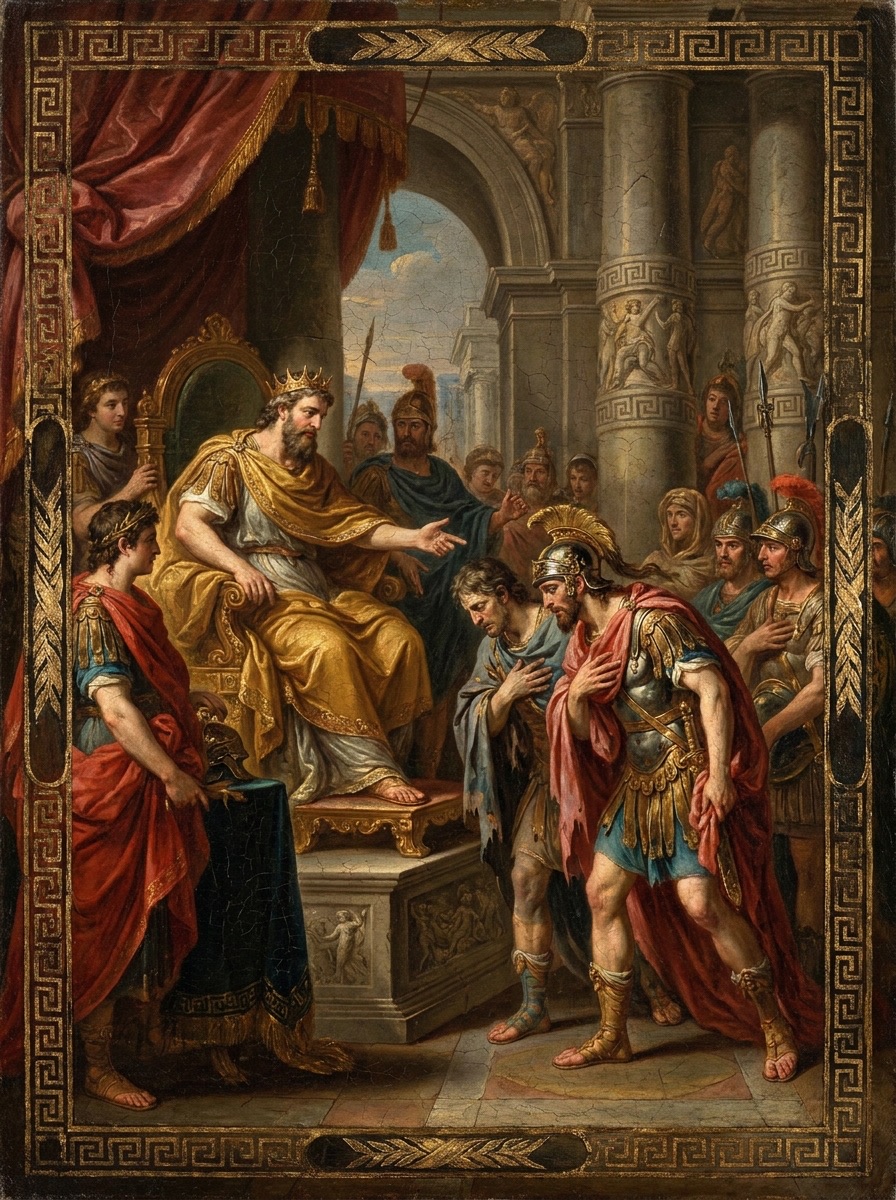
Adrastus therefore ordered the weapons put away and invited the two men inside. He did not treat them as nameless intruders, but as guests owed the rites of hospitality. Servants brought water for them to wash the dust from the road away, then set out food and wine so they might sit in the bright hall.
When their anger had cooled, Adrastus asked each man to tell his story. Polynices spoke of how he had been driven from Thebes by his brother Eteocles; Tydeus explained why he had left Calydon. The king listened, and the more he heard, the more certain he became that the oracle had not spoken by chance.
Not long after, Adrastus gave his elder daughter Argia in marriage to Polynices, and his other daughter Deipyle to Tydeus. The two exiles changed from enemies at the gate into brothers by marriage at his table.
The Request After the Wedding Feast
At the wedding feast, the men of Argos raised their cups in blessing. The hall was full of music, the smell of roast meat, and the laughter of newly married men. Yet Polynices’s heart was not at rest.
He had a wife now and the protection of a king. He had even found new kin. But he had not forgotten the gates of Thebes. He remembered the throne that should have been his and the cold way Eteocles had driven him out. So after the guests had gone and the night had grown deep, he approached Adrastus and asked him to help recover what was his by right.
Adrastus had made him his son-in-law, and could not now treat his grievance as the trouble of a stranger. He agreed to help, though not at once with armies and battle lines. The capture of Thebes was no small matter. It was a strong and ancient city, with high walls, gates, and soldiers loyal to Eteocles. If words might settle the matter first, better that than leaving so many men to die before the walls.
So Adrastus sent Tydeus to Thebes as envoy. Tydeus was Polynices’s new kinsman and a man of proven courage. He set out in that role and came to the city that had shut its gates against Polynices.
Tydeus Enters Thebes
Tydeus entered Thebes alone. In the city he demanded that Eteocles honor the brothers’ agreement and return the kingship to Polynices. The Thebans would not listen, and Eteocles would not yield.
Words came to nothing, but Tydeus did not bow his head. In some versions he challenged the Theban men and proved himself in contests of strength, whether in wrestling or in weapons practice. An outsider who won against so many in the city stirred both shame and anger among the Thebans.
Eteocles did not let him leave in peace. After Tydeus had set out on the road home, the Thebans sent an ambush after him. Night, or the shadow of the hills, hid the path; spears flashed out from the dark, and many men closed in on a single foreigner.
But Tydeus was not the man to be frightened. Like a beast driven into a corner, he turned and fought. Weapons clanged in the narrow place, and one ambusher after another went down. At last he left only one man alive, sending him back to Thebes with news of what had happened.
The survivor brought back no hope of peace, only a deeper fear and a harder hatred. Thebes knew that Argos would not easily let the matter rest; and Argos knew that Thebes had answered its envoy with murder.
The Seer Who Would Not Go
Adrastus began to gather heroes.
In the palace of Argos, chariots were inspected, horses brought out, and smiths hammered spearheads and axle fittings. The news spread far and wide, and men came to the king’s side for honor, kinship, or alliance. Yet one man troubled Adrastus more than any other: Amphiaraus.
Amphiaraus was not only a warrior but also a seer who could foresee good and ill. He knew this expedition against Thebes would end in disaster. Many who went would fall before the gates, and only a few would return alive. He refused to take part and urged Adrastus not to begin the war at all.
Between Adrastus and Amphiaraus there had long been old enmity. They had once agreed that if they ever quarrelled again, Amphiaraus’s wife Eriphyle would decide the matter. Eriphyle was Adrastus’s sister and Amphiaraus’s wife, caught between brother and husband.
Polynices knew of this agreement. So he brought out a costly object: the Necklace of Harmonia. It was bound up with the old fate of Thebes, brilliant enough to tempt even a cautious heart. Eriphyle took the necklace and judged that Amphiaraus must go to war.
Amphiaraus understood that he was being driven toward death. He did not try to escape again. He called his sons to him and left them grave words. Then he put on his armor, took up his weapons, and joined the expedition.
The Seven Leaders Gather
Besides Adrastus, Polynices, Tydeus, and Amphiaraus, a number of other formidable leaders came to Argos.
Capaneus was huge in stature and arrogant in spirit, never willing to temper his words. He believed his strength could scale any wall. Hippomedon was another famed Argive warrior, a man who lifted his shield like a moving rampart. Parthenopaeus was young and handsome, but he would not have men remember only his face; he too sought a name won in battle.
Together with Adrastus, these men formed the company later known as the Seven Against Thebes. Different poets have given slightly different lists, but the heart of the tale never changes: Adrastus shelters the exiles, and from his house the great expedition against Thebes takes shape.
Before the march, Argos bustled with preparation. Grooms combed the horses’ manes, soldiers tightened leather straps across their chests, wheels were greased, and shields leaned against the walls, catching the light of dawn. Polynices stood among them and looked toward the road to Thebes. He was no longer the lone exile who had once come to the palace gate. Behind him now stood chariots, allies, and the strength of all Argos.
Adrastus had welcomed two strangers who fought in the dark, and in doing so he drew his own house, his army, and his fate into the old feud of Thebes. At last the seven leaders had gathered, spears were raised, and hooves began to beat the earth. Polynices’s plea for his rightful throne had become a campaign that could no longer easily be stopped.