Greek Mythology
Achilles Rearmed — Greek Mythology
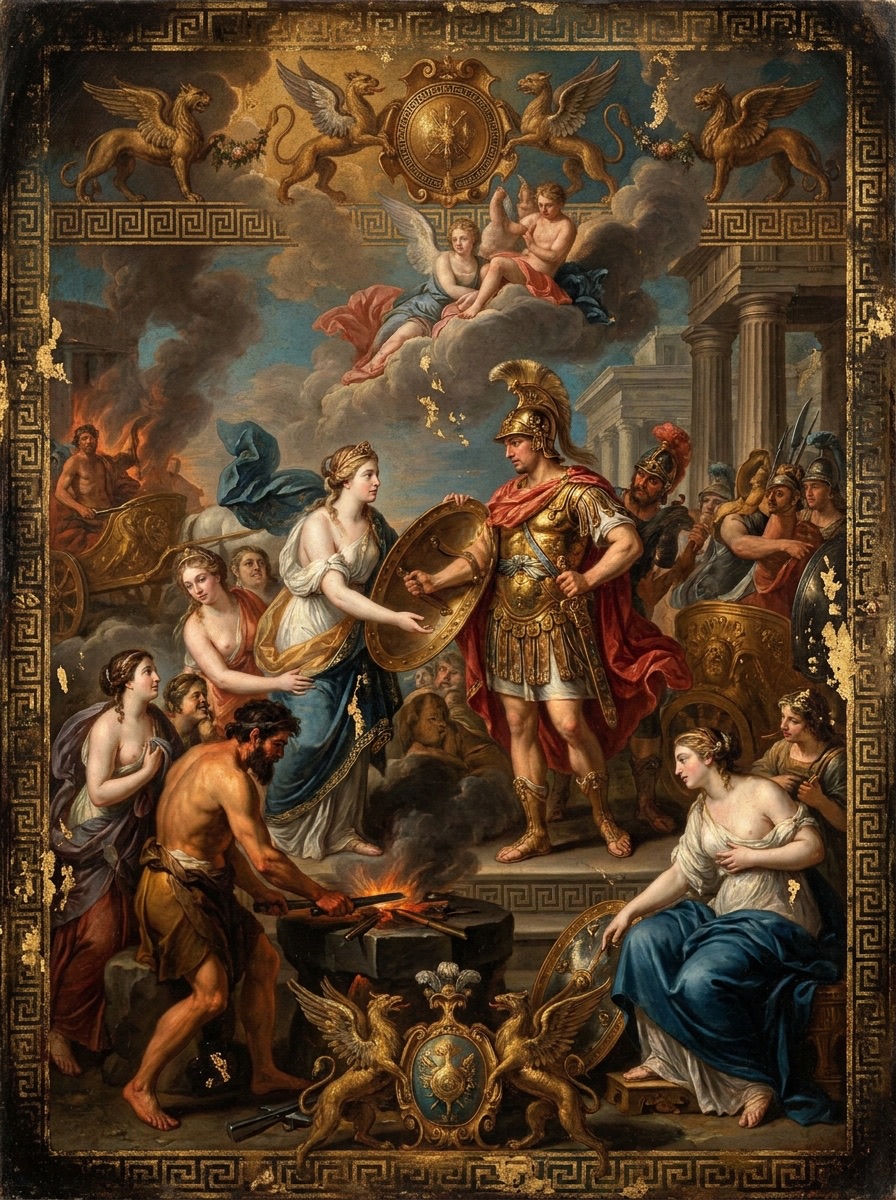
After Patroclus is killed in battle, Achilles is overcome with grief and at last lays aside his anger, preparing to return to the field. His mother, the sea-goddess Thetis, obtains new armor from Hephaestus, and Achilles arms himself once more as he advances upon the Trojans.
Article
Summary
Patroclus goes into battle wearing Achilles’ old armor, but he is killed by Hector. When the news reaches the Greek camp, Achilles falls to the ground, gathers black ash in his hands, and pours it over his head. His cry carries to the shore and down into the sea, where his mother Thetis hears it. Thetis rises from the water and holds her son, knowing that if he returns to battle, his own fate will soon be near. But Achilles thinks only of avenging his friend. He has no armor, for his old armor has been taken by Hector, so Thetis goes herself to Hephaestus, god of fire, and asks him to forge new weapons for Achilles. All night Hephaestus works beside his blazing furnaces. He makes a strong breastplate, a helmet, greaves, and a wondrous great shield. Upon the shield are cities, fields, weddings, disputes, harvests, vineyards, cattle, dancing places, and stars, as though the whole human world has been hammered into metal. The next day Thetis brings the new armor to her son. Achilles reconciles with Agamemnon, though he refuses to eat and urges the army toward battle. Athena secretly places divine food within his breast, so that hunger will not bring him down. When he puts on the new armor, all the Greeks see its dazzling light. Achilles mounts his chariot and reproaches his immortal horses for letting Patroclus die. Suddenly Xanthus, one of the horses, speaks, saying that the blame lies not with the horses but with the gods and fate, and foretelling that Achilles’ own death will also come. Achilles does not turn back. He draws the reins tight and rushes toward the battlefield with his new weapons.
Beside the Body of Patroclus
There was no song of victory in the Greek camp that day.
When Patroclus was carried back, the blood had already dried around his wounds. He had gone out from the ships wearing Achilles’ armor, hoping to save the Greeks as they were driven back in defeat. But that armor had fallen at last into Hector’s hands, and Patroclus himself had been recovered only as a stripped and naked corpse, snatched by his comrades from the fighting and brought back beside the ships.
Antilochus ran to find Achilles. He could not bring himself to speak at once. He stood before him, and his tears came first. Achilles saw his face, and his heart sank before the words were said.
“Tell me,” Achilles said. “Has something happened to Patroclus?”
Choking with grief, Antilochus answered that Patroclus was dead, that Hector had taken his armor, and that the Greeks had barely managed to defend the body.
When Achilles heard this, it was as though a thunderbolt had struck him. With both hands he gathered the black ash from the ground and poured it over his hair and face, until even his clothes were soiled with dust. He fell full length upon the earth, tore at his hair, and cried aloud. The captive women in his tent heard him and gathered around, wailing too; they wept not only for Patroclus, but for the fathers, husbands, and brothers they themselves had lost in the fire of war.
Achilles’ cry passed over the ships, over the sand, and out to the edge of the sea. Deep under the water, his mother Thetis heard it. She was a goddess of the sea, dwelling beneath the silver foam. She knew the weight of her son’s destiny, yet when that cry reached her, she rose from the water with the sea-nymphs beside her and came to the ships of the Greeks.
Thetis sat down beside Achilles, took his head in her arms, and asked, “My child, why do you weep so bitterly? Has the thing you most dreaded come to pass?”
Achilles said, “Mother, Patroclus is dead. Hector killed him and took my armor. I no longer wish to live unless I can kill Hector with my own hands and avenge my friend.”
Thetis’ heart grew heavier when she heard him. She had long known the two paths before Achilles: if he remained at home, he would live long, but without great fame; if he stayed at Troy, his glory would travel far, but his life would be short. Now that Patroclus was dead, Achilles’ heart had been thrust back toward the battlefield, and no one could draw it away.
Softly she said, “If you kill Hector, your own death will not be far behind.”
“Then let it come,” Achilles answered. “My friend died on the field while I sat beside the ships and could not save him. I refused to fight because Agamemnon dishonored me. Now none of that matters. I will return, even if fate is waiting for me there.”
Thetis knew there was no use in further pleading. “You cannot go into battle at once,” she said. “Your armor is now on Hector’s body. Wait. When the sun rises tomorrow, I will bring you new weapons.”
Then she left the camp and went back toward the depths of the sea.
The Cry by the Shore
But the fighting had not ended that day.
The Trojans crowded around the body of Patroclus, again and again trying to seize it. The Greek heroes defended it with all their strength and would not let Hector come near. Dust rose thickly; weapons clashed; the shouts of men mingled with the neighing of horses.
Achilles had no armor and could not rush straight into the battle. Hera saw how hard the Greeks were being pressed and sent Iris to urge him out. Iris stood beside him and said, “Go and show yourself quickly. If only the Trojans see you, they will be afraid, and the Greeks will be able to drag Patroclus’ body back.”
Achilles came out from the camp and stood by the trench. He wore no armor, but Athena cast the radiance of the divine shield about his shoulders and kindled above his head a light like fire. In the dusk, the Trojans saw him standing there and heard him shout three times, his voice rolling like thunder from a mountain valley.
The battlefield broke into confusion. Horses reared in terror, chariots crashed together, and many Trojans shrank back despite themselves. In that opening the Greeks dragged Patroclus’ body back to the ships.
When night fell, the Greeks gathered around the dead man and wept. Achilles laid his hand on Patroclus’ cold breast and said he would not first hold funeral rites for his friend until he had brought back Hector’s head and armor. He said, too, that before the funeral pyre he would cut the hair of Trojans and offer it to his dead companion. Grief burned within him, and by now it could no longer be separated from rage.
The Fire-God’s Furnace
After Thetis left her son, she came to the dwelling of Hephaestus.
Hephaestus, god of fire, lived in his heavenly workshop. There were bronze walls and golden doors, and the furnaces burned day and night. The bellows worked by themselves, blowing the flame now red, now white; beside the anvils lay bronze, tin, gold, and silver. Though Hephaestus’ steps were uneven, his arms held astonishing strength, and he could shape hard metal into works that even the gods admired.
When he saw Thetis, he at once set aside his work. Long ago, when his mother Hera had cast him down from heaven, Thetis had taken him in, hidden him in a cave beneath the sea, and cared for him for many years. Hephaestus had never forgotten that kindness.
“Noble goddess,” he said, “you have come here for a reason. Whatever lies within my power, I will not refuse you.”
Thetis told him what had befallen Achilles: how her son had quarreled with Agamemnon over honor and refused to fight; how now his dearest friend, Patroclus, was dead; how Hector had taken the old armor; and how Achilles wished to return to the battlefield but had no weapons.
Hephaestus listened and said, “Take heart. I will gladly forge armor for him. Only this I cannot do: I cannot drive death away from his side. If death comes, even the finest armor cannot hold back fate.”
With that he turned back to the furnace and cast bronze, tin, gold, and silver into the fire. The bellows blew together, and the light flared over the walls as though many red serpents were crawling there. Hephaestus lifted his great hammer, stood before the anvil, and struck again and again. Under the blows, the metal rang out clear and bright.
The World upon the Shield
The first thing he made was a great shield.
It was no ordinary shield. Hephaestus made it thick and strong, then worked many scenes across its face. Around the outer rim flowed the stream of Ocean, as though the waters at the world’s edge enclosed all things within. Upon the shield were sky, earth, sea, sun, moon, and stars; Orion, the Pleiades, and the Great Bear shone there as well.
Two cities appeared upon the shield.
In one city, a wedding was being celebrated. Torches lit the streets; a bride passed by among her companions; young men sang and danced, while mothers stood in doorways watching the festivity. Elsewhere in the same city, people gathered in the marketplace to argue over a killing. Two men disputed the blood-price. Elders sat upon smooth polished stones, each holding a staff and speaking in turn, while gold lay nearby for the one who gave the fairest judgment.
The other city was surrounded by an army. Two hostile forces lay in ambush by a river, waiting for the townspeople to drive out their cattle and sheep. Suddenly the ambushers sprang up; battle broke out; spears and swords met; the dead were dragged away, while the living still fought over the bodies. The peril of war was carved onto that small shield face, yet it seemed almost to move.
Hephaestus also shaped fields. Farmers drove oxen, turning the soil row by row; where the plowshare passed, the black earth opened. There was a harvest too: hired men swung their sickles through the grain, children carried sheaves, and the master stood nearby rejoicing in his heart. In a vineyard, purple grapes hung heavy from the vines; boys and girls walked by with baskets, and among them a child played the lyre and sang in a clear voice.
There were cattle on the shield as well. Golden-horned bulls moved from pasture toward the river, when lions leapt upon one of them and seized it. Herdsmen and hounds gave chase, though they dared not come too close. There were sheepfolds, shepherds’ huts, a dancing floor, and young men and maidens moving hand in hand in a circle. The girls wore fine linen; the boys wore golden knives; as they turned, they seemed like a potter’s wheel spinning swiftly beneath the craftsman’s hands.
The whole human world—joy and conflict, labor and death—had been hammered by Hephaestus into that shield. It was a weapon, and yet it was also like a silent world.
When the shield was finished, he made the breastplate. It shone like firelight and was strong enough to turn aside a spear. He forged a heavy helmet and set a golden crest upon it, then made greaves that fitted the legs perfectly. When all the weapons were laid together, the workshop blazed with such radiance that even the furnace flames seemed dimmer.
Thetis took the new armor and, under cover of night, left the heavenly workshop. Like an eagle she flew back to the ships of the Greeks.
The New Armor on the Ground
At dawn, while the sea mist had not yet fully lifted, Thetis came to Achilles’ side.
The body of Patroclus still lay there. Achilles had not slept all night, fearing that flies would settle on his friend’s wounds. Thetis comforted him and said she would preserve the body, keeping decay and worms from harming it. Then she set down the armor Hephaestus had made.
As the armor touched the ground, it gave a clear ringing sound. The Greeks nearby saw its light and instinctively drew back. Only Achilles stepped forward, and a flame came into his eyes. He ran his hand over the face of the shield, then lifted the helmet and breastplate, as though he had recovered some lost part of himself.
He did not put the armor on at once. First he summoned the Greeks to assembly.
In these past days the Greeks had suffered terribly. Achilles, enraged because Agamemnon had taken Briseis from him, had refused to enter battle. Now Patroclus was dead, and the quarrel at last seemed far too small. Achilles stood before the gathered men and said that his anger and Agamemnon’s had cost many lives. There must be no more delay; he would go at once into battle.
Agamemnon rose too and admitted that he had done wrong that day. He said madness had clouded his heart, and he was willing to bring the gifts he had promised before and return Briseis to Achilles.
Odysseus, however, urged them not to go into battle on empty stomachs. He knew soldiers were not made of iron. If they ate nothing in the morning, their arms would weaken by noon. He told Agamemnon to have the gifts brought out, and he told the men to eat before they fought.
Achilles listened impatiently. His heart was fixed only on Patroclus, only on Hector. He said he had no appetite; food and wine were hateful to him. He wanted only to rush against the Trojans.
In the end, the others followed Odysseus’ counsel. The gifts were brought into the assembly: bronze vessels, gold, horses, women, and Briseis. When Briseis saw the body of Patroclus, she threw herself upon it and wept. She said that Patroclus had once been gentle with her, had comforted her and told her not to be afraid, even saying that he would see her married to Achilles. Now the man who had given her a little hope had died far from home.
As Achilles heard her weeping, his own tears fell too. He thought of Patroclus, and then of his father Peleus, far away in his homeland. Everyone carried a grief of their own, but the battlefield would not wait for them to finish mourning.
The Warrior Who Would Not Eat
The Greeks went back to their huts to eat, but Achilles sat apart and did not move. His friends urged him to drink a little wine and take some bread, but he shook his head and refused.
It was as though a cold stone lay inside his heart. Patroclus had not yet been burned on the pyre; Hector still lived; the Trojans still stood outside the city. To eat now, he felt, would be to forget his friend’s blood.
Zeus looked down from heaven and saw that if Achilles continued this way, hunger would waste him before the fighting even began. At his command, Athena came to Achilles’ side, unseen by the others. She placed divine food and ambrosia within his breast, so that his body would not grow weak.
Then Achilles rose and began to arm himself.
First he fastened the greaves around his lower legs, their silver clasps flashing in the sunlight. Next he put on the breastplate, which settled over his shoulders and back like a wall of fire guarding his body. He slung his sword at his shoulder and lifted the great shield. When the shield rose, its light spread around him like the moon rising over the camp. Last of all he put on the helmet, and the golden crest above it stirred like flame in the wind.
He tested the spear his father had left him. It came from an ash tree on Mount Pelion, heavy and hard, too great for ordinary heroes to lift; only Achilles could wield it in his hand. Its point gleamed coldly, as though already eager for blood.
When the Greek soldiers saw him armed again, awe and fear came over them. This man who had once sat beside the ships and refused to fight now stood before them like a storm that had just taken human shape.
The Immortal Horse Speaks
Achilles went to his chariot. Automedon had already harnessed the immortal horses. One was named Xanthus, the other Balius, and they had once been given as divine gifts to Peleus. Their manes hung down, and their hooves struck the ground uneasily, as though they knew where their master was about to go.
Achilles looked at them and suddenly remembered that Patroclus too had ridden into battle in this chariot. He said to the horses, “Xanthus, Balius, this time you must bring me back alive. Do not leave my friend on the battlefield as you did before.”
Then a strange thing happened. Hera gave Xanthus the power of speech. The horse lowered his head until his mane fell beside the yoke, and he answered in a human voice:
“Mighty Achilles, this time we will do all we can to bring you back. But the day of your death is near. It was not we who killed Patroclus; a great god and fate brought him down. You too will die at the hands of a god and a man.”
As soon as he had spoken, the Furies stopped the horse’s voice. Xanthus could speak no more, but only stamped restlessly before the chariot.
Achilles heard him and did not falter. He had already heard such words from his mother. Death was waiting ahead—he knew that. But Hector was ahead as well, and so was the blood of Patroclus.
He tightened his grip on the reins and said, “I know I must die. You need not tell me. But before that day comes, I will make the Trojans remember this one.”
Then he mounted the chariot. The wheels rolled heavily over the sand. The new shield shone beside him; the spear slanted toward the sky; the immortal horses sprang forward with all their strength. The ranks of the Greeks surged after him onto the plain, and once more dust rose outside the walls of Troy.
Achilles was armed again. His anger, his grief, and his fate all raced with that chariot toward the place where Hector stood.