Greek Mythology
Achilles on Skyros — Greek Mythology
Thetis knew that if her son Achilles went to Troy, he would win unsurpassed glory—and die young. She hid him among the maidens in the palace of Skyros, but Odysseus uncovered him with a cunning trick, and Achilles at last left the island and turned toward war.
Article
Summary
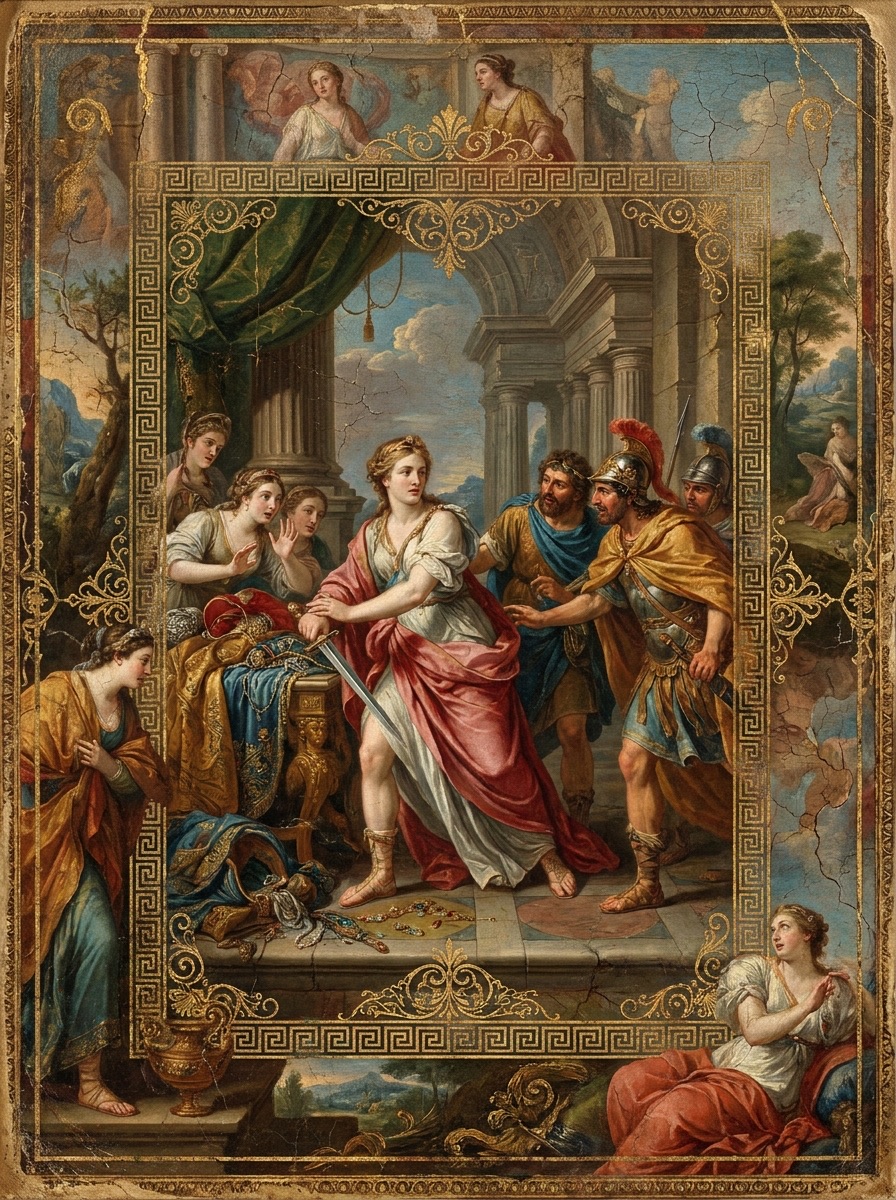
As the Greek leaders gathered for the expedition against Troy, Achilles was still missing. Prophecy said that without this son of Peleus and Thetis, Troy would be hard to take; yet Thetis knew the other side of that fame. If her son went to Troy, he would win unmatched glory and die young. So she carried Achilles to Skyros and hid him among the maidens in the palace of King Lycomedes. Achilles wore a girl's clothing and sat among looms, perfumes, ribbons, and soft fabrics, but he could not truly become someone else. He stood taller and heavier than the palace girls, and whenever he heard horses or the sound of weapons, his eyes betrayed him. Deidamia, daughter of Lycomedes, gradually understood that the stranger concealed a secret, and in the quiet of the halls and gardens the two fell in love. The Greeks could not find the young hero, so they sent Odysseus, the master of cunning. Hearing that Achilles was hidden on Skyros, Odysseus came to the palace disguised as a merchant. Before the maidens he laid out cloth, jewelry, mirrors, and perfumes, but among them he deliberately placed a sword, a shield, and a spear. Achilles stood among the others, and his gaze was quickly drawn to the weapons. To make the truth undeniable, Odysseus had a trumpet and the clash of arms sound suddenly outside, as though enemies were attacking the palace. The girls cried out and scattered, but Achilles rushed toward the wares, seized the sword and shield, and stood ready to fight. In that moment the disguise broke. Odysseus had not forced him by strength; the sound of war and the sight of weapons had made Achilles reveal himself. Achilles understood that he could no longer return to the loom or remain in the shelter his mother had chosen for him. Deidamia wept at the parting, and some traditions say she had already borne him a son, Neoptolemus. At last Achilles put off the disguise, boarded the ship that left Skyros, and joined the Greek expedition, sailing toward Troy, the place that would give him glory and consume his life.
The Sea-Mother’s Plan
Before the Trojan War had truly caught fire, messages were already passing through the lands of Greece. Kings sent summons to the heroes who had once courted Helen. Ships were repaired in harbors, oars were carried onto decks, bronze helmets and long spears were polished one by one. Yet among all the names, there was one young man whom everyone most anxiously sought: Achilles.
He was the prince of the Myrmidons, son of Peleus and of Thetis, the goddess of the sea. Though still young, he was already famed for the swiftness of his running and the astonishing force of his courage. Some said that if he came beneath the walls of Troy, the Greeks would gain their sharpest sword. Others said that without him, Troy would be hard to break.
These words reached Thetis too.
But Thetis heard not only glory; she heard the death hidden behind it. She knew that if her son remained at home, he might live a long and quiet life. If he crossed the sea with the army to Troy, he would shine brighter than all the heroes—and die before his time. Day after day the waves beat upon the shore, white foam curling over the rocks before slipping back into the deep. Thetis looked at her child, and her heart was more troubled than the sea.
She would not let Achilles be carried off to war.
So she took her son away from the places he knew and crossed the water to the island of Skyros. There a king named Lycomedes ruled. His palace was not as stern as Mycenae, nor as broad as Sparta, but it stood near hillside and bay, its white walls bright in the sun, and from within its gates one often heard the voices and laughter of young women. Lycomedes had many daughters. They lived in the inner rooms of the palace, spinning, dancing, offering worship to the gods, and rarely seeing men from outside.
It was there that Thetis entrusted Achilles.
She did not dress him in a prince’s tunic, nor let him wear a sword. She clothed him as a maiden and arranged his hair, placing him among the daughters of Lycomedes. For a boy who had grown up gripping spears, running hard, and hurling stones, it was no easy thing suddenly to sit with lowered eyes beside a loom, to speak softly, to walk with the others through the colonnades. But Thetis’s gaze silenced him.
“Stay here,” his mother told him. “Do not let the Greeks find you.”
Achilles did not quickly agree. He looked toward the far-off sea, the very waters by which the great ships would pass. In the end, he stayed.
The Stranger Among the Maidens
At first the daughters of Lycomedes took the new “maiden” simply for a guest sent by her mother. They made room for him, showed him the palace courts and fountains, and brought out colored sashes, perfumed oils, and soft fabrics for him to see. Achilles stood among them, taller than most, heavier in his step. He was not used to hiding his hands in his sleeves, nor to pretending not to notice when horses neighed nearby.
Among the princesses was one named Deidamia. More quickly than the others, she sensed that something else was hidden in this guest. When the maidens spoke of ornaments and garlands, Achilles’s thoughts often drifted away. If somewhere in the distance men practiced at arms, and the sound of wooden spear striking shield came through the air, his eyes would brighten at once. Deidamia said nothing. She only watched.
The days passed. Achilles wore soft garments, but he could not turn himself into someone else. He could sit beside the loom, yet his fingers kept straying to the edge of the shuttle, as though weighing a short blade. He could follow the maidens to the altar with flowers, but whenever he saw the knife near the sacrificial animal, his eyes lingered too long. Little by little Deidamia understood that what mothers and kings had hidden in the palace was no ordinary girl.
In time, Achilles and Deidamia fell in love.
Their love was hidden among the palace columns, in low voices at night, in small courtyards where no one passed. The palace of Lycomedes remained quiet. Outside, the sea still beat against the shore. Each morning the maidens still arranged their hair. Yet the news of war drew nearer and nearer. The Greek leaders had gathered around Aulis; ship-masts stood in the harbor like a forest, and everyone was asking: Where is Achilles?
The Hero No One Could Find
The Greeks could not wait forever.
They knew that without this young man the expedition would be like a spear missing its hardest point. Then someone thought of Odysseus, master of many devices. Odysseus came from Ithaca. His speech was deft, and his eyes saw deeply. He knew not only how to swing a sword in battle, but how to find a crack where others had noticed nothing. Other Greek leaders went with him; in some traditions, Diomedes was among them.
They had heard a rumor: Achilles had been hidden on Skyros, among the daughters of Lycomedes.
It sounded absurd. How could a boy destined to become the most fearsome warrior on the battlefield be sitting in a palace dressed as a maiden? But Odysseus did not laugh. He knew that the more unlikely a place seemed, the more easily truth might be concealed there.
They prepared goods and disguised themselves as traveling merchants, then sailed toward Skyros. Their ship anchored in the bay, and sailors carried chests ashore. Inside were all sorts of things young women might delight in: soft fabrics, shining belts, gold and silver ornaments, mirrors, perfumed oils, delicate cups. But among these wares Odysseus deliberately placed several things that did not belong in a maiden’s chest: a sword, a shield, a long spear, and perhaps a bronze helmet too.
They came to the palace of Lycomedes, greeted the king, and said they had brought rare goods and wished to let the royal daughters choose among them. Lycomedes saw nothing suspicious and ordered his daughters to be called.
The maidens entered the hall in a group. Sunlight fell through the high windows onto the goods spread out below. Purple, snow-white, and saffron-colored cloth lay heaped together; gold chains glimmered in bowls; polished mirrors caught the young faces bending over them. The maidens quickly gathered around. One picked up a bracelet, another stroked a length of fabric, another breathed in the scent of the oils.
Achilles stood among them too.
He tried not to draw notice. But as his eyes passed over the merchandise, he saw the sword.
It lay beside the fabrics, its scabbard dark, its hilt coldly gleaming with metal. Beside it was a shield, hard along the rim, as though waiting for a hand that knew it. Achilles’s breath caught. He tried to look away, but his gaze returned to the sword. The maidens chose ornaments; his hand almost reached for the weapon.
Odysseus saw.
But he did not expose him at once. He wanted the matter made plainer still, so that no one present could deny it.
When the Bronze Rang Out
While everyone was gathered around the goods, a piercing blast of trumpet suddenly sounded outside the palace. It seemed to surge up from the harbor, cross the courtyard, and strike among the columns. Then came the clash of weapons, as though enemies had already landed and were about to storm the palace.
This was the fright Odysseus had arranged.
The maidens had never faced such a scene. They cried out, dropped the sashes and necklaces in their hands, and scattered toward inner rooms, behind pillars, and beside their attendants. Some covered their ears; some clutched their sisters’ hands. Their steps broke into confusion.
Only one did not flee.
The moment Achilles heard the trumpet, his disguise seemed burned away by fire. He did not reach for a mirror, nor gather up his skirts. He sprang to the goods, drew the sword, and seized the shield. The movement was so swift it was as though he had rehearsed it in his heart a thousand times. He lifted his head toward the door, his shoulders straight, and there was no trace of hiding left in his eyes.
He was ready to meet the enemy.
The hall fell suddenly still. The maidens who had been screaming turned and saw their “companion” standing with sword and shield. Lycomedes’s face changed. Deidamia stood among the others, startled and sorrowful at once. Odysseus only smiled faintly. The man he sought had stepped forward of his own accord.
“This is Achilles,” he said to them all.
Only then did Achilles understand that there was no real enemy outside. The trumpet was a trick; the clash of arms was a trick. Odysseus had not bound him with ropes or dragged him away by force. He had merely set a sword before his eyes and let the sound of war break into his ears. Achilles had revealed himself.
He looked down at the sword in his hand. In that moment he knew he could never return to the seat where he had just been, never sit again beside the loom and pretend he was only one of the daughters of Lycomedes.
Deidamia’s Tears
Odysseus explained why he had come. The Greeks were ready to cross the sea. Agamemnon, Menelaus, and many other kings were gathering their armies. The walls of Troy were high and strong; Hector and the Trojans would not give way easily. The Greeks needed Achilles, and they believed that divine will had bound his name to this war.
These words were not strange to Achilles’s heart.
He had never been a coward. His days in hiding had been painful, not because the palace was unkind, nor because the maidens treated him coldly, but because he could hear the distant war calling him. Yet he also knew why his mother had done this. Thetis did not fear hardship for him; she feared losing her son.
Deidamia came to his side. She did not reproach him before the others, nor did she beg Odysseus for mercy. She only looked at him. Between them lay many words that could not be spoken aloud. She knew that once he left Skyros, he would no longer be merely the young man beside her, but the most awaited warrior in the whole Greek host. She knew too that battle devours many men, and even the bravest, youngest, and most beloved of the gods may not return.
Some stories say that while Achilles was on Skyros he and Deidamia already had a son, later called Neoptolemus. The child was still small, far from the age of holding a sword. When Achilles departed, Deidamia’s tears were not only for the parting before her eyes, but for the father of her child setting foot on a road from which there was no turning back.
Lycomedes could no longer conceal him. He had received these Greek visitors, but he had no power to keep Achilles forever within his palace. The maidens of the palace watched in silence. The ornaments dropped moments before still lay scattered on the floor; a little flask of perfume had rolled to the leg of a table; bright cloth had been trampled into creases. And the sword remained in Achilles’s hand.
At last Achilles made his choice.
He took off the clothing that had hidden his identity and put on the dress of a warrior once more. It was no grand enthronement, and there was no long oath. It was only a young man standing in a palace, taking up the weapons that belonged to him, and admitting that he could no longer hide behind another’s name.
Leaving Skyros
On the morning of farewell, the sea wind of Skyros blew into the harbor. The ship rocked lightly on the water; wet ropes lay along the shore; sailors carried baggage and weapons onto the deck. Odysseus was already waiting there. His stratagem had succeeded, but he did not boast of it. A man like him knew that some victories are not fit for loud celebration.
Achilles looked back at the palace. There were the days of his brief concealment, the fate he had tried for a while to avoid, and Deidamia with the child not yet grown. Thetis had meant this island to shield him from war, but war, like the tide, had found its way around the rocks and risen to his feet.
Deidamia came to see him off. She could not follow the army, and she could not keep the ship from leaving the shore. She could only hold the parting in her heart and watch Achilles board. The sea wind lifted his hair. He no longer looked like the maiden of the palace, but like the hero of song who was about to enter battle.
The oars dipped into the water, cutting white lines across the surface. Skyros slowly receded behind them. Achilles stood aboard the ship and did not turn away from the sea ahead. He knew the place he was going was called Troy, and that there waited high walls, dust, chariots, spears, and the deaths of countless men. He knew too that his own name would be heard by all people there.
From that day on, the disguise on Skyros was ended. Achilles left the hiding place his mother had chosen for him and joined the Greek expedition. The palace of Lycomedes grew quiet once more, yet the trumpet that had sounded in its hall, the scattered ornaments, and the sword snatched up by a young man became a scene no teller of Achilles’ story could ever pass over.