Greek Mythology
Achilles and Hector — Greek Mythology
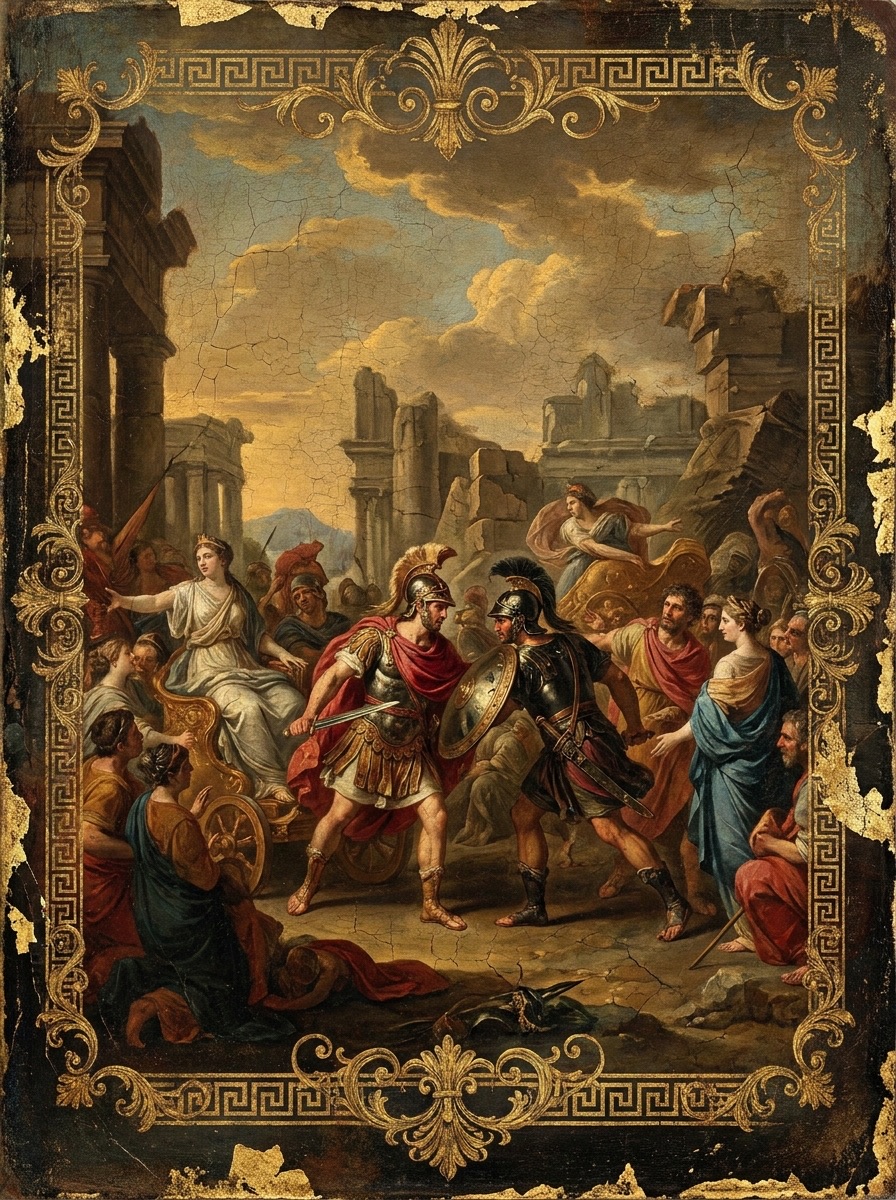
After Patroclus falls beneath Hector’s hand, Achilles takes up arms again and returns to the battlefield to demand blood for blood from the Trojan prince. The two meet in combat outside the walls of Troy; Hector is slain, and the city loses the strongest guardian it had.
Article
Summary
Achilles had withdrawn from the war after being dishonored, and the Greeks were driven back again and again by Hector. Patroclus put on Achilles’ armor and went into battle, saving the Greek ships for a time, but Hector killed him and stripped the armor from his body. When Achilles heard the terrible news, he collapsed in the dust and cried aloud in grief. His mother Thetis came up from the sea and asked Hephaestus to forge new armor for her son. Once the new shield, breastplate, helmet, and greaves were brought into the camp, Achilles cared no longer for his old quarrel. He wanted only to kill Hector. He rushed into battle, and the Trojans fled back toward the city. Hector might have gone inside with the rest, but shame and duty held him before the gates. When Achilles came upon him, fear seized Hector at last, and he ran three times around the walls of Troy. Only after a god’s deception did he stop and turn to fight. Hector threw his spear and missed. Achilles found the opening in Hector’s armor and drove his spear into his throat. As he died, Hector begged that his body be returned, but Achilles refused and dragged the corpse back to the Greek ships. Later, old King Priam came by night into the enemy camp and knelt to beg for his son’s body. Achilles remembered his own father, and at last gave Hector back to the Trojans for burial.
After Patroclus Fell
On the plain outside Troy, the dust had been trampled pale beneath the hooves of horses. The Greek ships stood by the shore, their sterns turned toward the land, row after row like a wooden wall guarding the camp. For many days Achilles had not gone out to fight. In anger at Agamemnon, the commander of the army, he had left his spear in his hut and allowed the Trojans to press the Greeks all the way back to the ships.
But war does not stop for one hero’s anger.
Hector led the Trojans against the Greek camp. He was the son of old King Priam of Troy, and the surest defender the city had. His bright helmet flashed, the horsehair crest shook above it, and again and again his spear struck against Greek shields. Torches were hurled onto the ships, and thick smoke rose between the planks. The Greeks shouted and fell back, while the waves beat the shore behind them.
Patroclus, the beloved companion of Achilles, could bear the sight no longer. He went into the hut and begged Achilles to let him put on the famous armor and lead the Myrmidons into battle. Achilles was still burning with rage, but he could not watch the Greek ships be destroyed by fire. He agreed, yet warned Patroclus over and over: “Drive the Trojans from the ships and then come back. Do not pursue them all the way to the walls.”
Patroclus put on Achilles’ armor, fastened the helmet, and mounted the chariot. From a distance the Trojans saw that armor and thought Achilles had returned. At once their ranks wavered. Patroclus charged with the warriors behind him, drove the enemy from the ships, crossed the trench, and pressed on toward Troy.
He forgot his friend’s warning.
Before the walls, the battle turned. Apollo struck Patroclus from behind and dazed him; the armor loosened on his body. Then Hector came upon him and dealt the fatal blow. Patroclus fell in the dust, but before he died he told Hector that it was really a god and fate that had killed him—and that Achilles would soon come to avenge him.
Hector stripped the armor from Patroclus’ body. It had once belonged to Achilles. Now it shone coldly in the sunlight on the shoulders of the Trojan prince.
When the news reached Achilles, it struck him like a thunderbolt. He scooped up ash and dust in both hands, poured it over his head, and lay on the ground weeping. The sea-goddess Thetis heard her son’s cry from the depths of the water and rose from the sea with her nymphs, coming to the camp. She knew the fate set before Achilles: if he killed Hector, he would win undying glory, but his own death would draw near.
Achilles did not turn back. He said only that he would return to battle, and even if he had to die, he would kill Hector first.
The New Armor Brought from the Sea
Achilles had no armor. The old armor had been taken by Hector, and Patroclus’ body had only just been recovered by the Greeks and brought back to camp. Thetis left her son and went to the house of Hephaestus, the divine smith, to ask him to make new arms for Achilles.
Hephaestus labored beside the furnace. He threw bronze, tin, gold, and silver into the blazing fire; the bellows roared, and the flames lit the rafters. He hammered the metal into a strong breastplate, a gleaming helmet, and greaves that fitted the legs. Last of all he made a great shield. Upon its surface were the sky, the earth, the sea, the sun, the moon, and the stars; there were cities and fields, vineyards and cattle, dancing places and war. It was as though the whole life of humankind had been gathered into one round sheet of shining metal.
Before dawn, Thetis carried the armor back to Achilles’ hut. When the new arms appeared, the room seemed to flash with fire, and those who looked on could hardly bear the brightness. Achilles ran his hand over the shield and helmet, and one thought alone filled his heart: Hector must pay.
Then Agamemnon came to make peace with him. Before the dead Patroclus, their old quarrel now seemed small. Achilles said little. He urged the men only to arm for battle. The Greeks put on their armor, charioteers yoked the horses, and the chariot axles were polished with oil. When Achilles mounted his chariot, even his immortal horses gave a mournful cry, as though they knew their master would never return home safely.
But Achilles would listen to no warning.
He rushed across the plain like a mountain fire racing into dry woodland. The Trojans fell back before him. Some fled toward the river, others toward the gates. Spears came down, shields split, chariots overturned, and the river water churned dark and muddy. Even the river-god grew angry because the channel was choked with bodies, and he raised his waves to pursue Achilles. Still Achilles escaped the riverbank and pressed on toward Troy.
At last the Trojans retreated within the city. The gates opened, fugitives streamed inside one after another, and the gatekeepers hurried to close them again. From the walls, women and old men looked out across the plain, searching for Hector.
He had not come inside.
Hector Before the Gates
Hector stood before the Scaean Gates, wearing the armor he had taken from Patroclus. From the wall, his father Priam saw Achilles coming from the far end of the plain, his armor blazing like a deadly star rising in the night. The old king stretched out his hands and cried to his son from above the wall, begging him to come inside quickly.
“Do not wait for him alone!” Priam cried. “Inside the city are your father, your mother, your wife, and your child. If you die out there, no one will be left to protect us.”
Hector’s mother, Hecuba, also pleaded from the wall. She beat her breast and called her son by name, begging him to return and not meet Achilles face to face.
Hector heard them. It was not that he felt no fear. Achilles was coming nearer and nearer, spear in hand, his stride like something driven by the wind. Hector remembered how he had refused the advice of Polydamas and had not led the Trojans back into the city in time, so that many of them had died on the plain. If he now ran inside, what would the people of Troy say? Would the men and women who had lost their kin not say: Hector trusted too much in his own strength, destroyed the army, and then hid behind the gates?
Shame held him like a chain.
For a moment he even thought of laying aside shield and spear, going forward, and saying to Achilles: Let the Trojans return Helen and her treasure, and add payment besides, so that this war may end. But the thought lasted only an instant. Achilles was coming with the blood-debt of Patroclus in his heart. How could he ever listen to terms of peace?
In another moment Achilles was upon him. Hector saw the rage in his face, and a chill ran through him. He turned and fled.
So the two greatest warriors began to run around the walls of Troy. Hector ran in front; Achilles came after him. The Trojans on the walls held their breath, and the Greeks watched from far away. They passed the watchtower, the fig tree, and the two springs. In ordinary days, one spring ran warm and the other cold, and the women of Troy had washed their clothes there; now only dust and the sound of desperate feet rose beside them.
Hector ran three times around the city. Achilles kept close behind, never letting him reach the gates. When Hector slanted toward the entrance, Achilles cut him off; when Hector veered out toward the plain, Achilles drove after him again. No one could save Hector now.
Then Athena came to Achilles and told him to stop running and prepare for the final fight. After that she took the shape of Deiphobus, Hector’s brother, and came to Hector’s side, saying, “Brother, let us stand against him together.”
Hector believed his brother had risked leaving the city to help him, and courage returned to his chest. He stopped, turned, and faced Achilles.
Two Spears
Hector spoke first. He was still breathing hard, yet he forced his voice to remain steady. “Achilles, I will run no more. Let us make an agreement: whichever of us kills the other shall not dishonor the body. The victor may take the armor, but he must return the corpse to the dead man’s family for burial.”
Achilles looked at him coldly. In his mind he still saw Patroclus lying in the camp by the ships: his friend’s face, his wounds, the armor stripped from him. He answered that lions and men make no peace, and wolves and lambs do not trust one another. He would make no pact with Hector.
Hector lifted his spear and hurled it with all his strength. The spear flew toward Achilles, struck the shield, and was flung back by the firmness of the new-forged metal, falling to the ground. Hector turned to “Deiphobus” and called for a second spear—but there was no one behind him. In that instant he understood that a god had deceived him. His brother had never come out from the city.
Fate had stepped before him.
Hector did not retreat. He drew his sword, great and bright, and rushed at Achilles like a wounded eagle. Achilles raised his spear and came to meet him. He studied the armor on Hector’s body—the very armor stripped from Patroclus. The mail was strong, guarding chest and shoulders, but near the neck, by the collarbone, there was one vulnerable place.
Achilles aimed his spear there and thrust.
The point passed through the soft part of Hector’s throat, though it did not sever his windpipe, so that he could still speak his last words. Hector fell in the dust, his armor clashing around him. Looking up at Achilles, he pleaded: “I beg you, by your own parents, do not leave my body for the dogs. My father and mother will bring ransom. Only give me back to the Trojans, so they may burn me on the funeral pyre.”
Achilles’ anger had not cooled. He said that even if Priam brought him treasure beyond measure, he would not agree. Hector heard and knew there was no hope. Before he died, he foretold that Achilles himself would not live long; Paris and Apollo would bring him down near the Scaean Gates.
Achilles was not afraid. He answered only, “Let death come when it will. Now you die first.”
Hector’s life left his body. Achilles bent and pulled out the spear, while the Greeks crowded around to look at the dead Hector. Some lightly prodded the corpse with their spears, marveling that the man who had once set fire to their ships and driven them into such desperate straits now lay motionless in the dust.
Achilles stripped off the armor. Then he pierced the tendons behind Hector’s ankles, passed leather thongs through them, and fastened the thongs to the back of his chariot. He mounted the car and lashed the immortal horses. The chariot sped away, dragging Hector’s body across the plain, while dust clung to his hair.
Cries rose from the city wall. Priam reached out toward the plain as though he might rush down from the battlements. Hecuba wailed aloud. Hector’s wife, Andromache, had been inside the house weaving and had told her women to heat water for her husband’s bath, thinking Hector would return from battle as he always had. When she heard the crying from the wall, she ran up and saw her husband being dragged toward the Greek ships. Darkness came over her eyes, and she collapsed into the arms of those around her.
The Old King Enters the Enemy Camp
Achilles brought Hector’s body back to the ships. He held funeral rites for Patroclus, slaughtered offerings, built the pyre, and let the flames carry his friend away. Yet his grief did not end with the burial. For several days, every morning he dragged Hector’s body around the tomb of Patroclus. Even the gods pitied what they saw, and secretly protected the corpse so that it did not decay.
Inside Troy, Priam could endure no more. He loaded ransom onto a wagon: golden cups, rich robes, blankets, and precious vessels. By night he climbed into the cart, and with Hermes as his guide he crossed the plain and slipped quietly into the Greek camp. When the old man entered Achilles’ hut, Achilles was sitting there, still filled with thoughts of Patroclus.
Priam did not begin by speaking of the ransom. He went forward, knelt down, clasped Achilles by the knees, and kissed the hands that had killed so many of his sons. Then he said, “Remember your father. He too is old, and far away he longs for your return. But I am more wretched than he, for I have seen with my own eyes the son who guarded me struck down. Give Hector back to me, and let me carry him home for burial.”
When Achilles heard the word “father,” something struck his heart. He thought of Peleus far away in his homeland, of the old man who perhaps would never see him come home. He thought of Patroclus too, and of all the rage and blood of the days just past. He lifted Priam up. One man wept for his son; the other wept for his father and his friend. For a while the hut held only the low sound of their grief.
After they had wept, Achilles agreed to return Hector. He ordered the body washed, anointed with oil, and wrapped in soft clothing, so that Priam would not see too many wounds and be overcome by grief and anger. He accepted the ransom, set food before the old king, and promised that during the days of Hector’s funeral the Greeks would hold back from battle.
Before dawn, Priam brought Hector’s body back to Troy. The gates opened, and grief poured out like a tide. Andromache held her husband’s head and lamented over him; Hecuba cried aloud for her son; Helen too wept for the prince who had treated her gently.
The Trojans built Hector’s pyre, and the fire burned through the night. The next day they gathered the white bones, placed them in a golden chest, covered it with purple cloth, and buried it in the earth. Stones were heaped above him, dust covered the mound, and the people of the city held a funeral feast in his honor.
Hector was dead. The walls of Troy still stood, and the gates were still shut; but the man who had guarded them from outside was gone.