Greek Mythology
The Abduction of Persephone — Greek Mythology
While gathering flowers in a meadow, Persephone is seized by Hades, lord of the dead. Demeter searches everywhere for her daughter, and her grief leaves the earth barren. At last Zeus is forced to intervene, but because Persephone has eaten pomegranate seeds, she must spend part of each year in the underworld and part beside her mother.
Article
Summary
Persephone is gathering flowers with her companions when she sees a wondrous narcissus sprung from the earth. As she reaches for it, the ground splits open, and Hades drives up in his chariot to carry her into the dark underworld; only Hecate hears her cry, while Helios sees the deed from the sky. Demeter hears her daughter's voice, puts on dark clothing, and searches the earth for nine days and nights with torches in her hands. On the tenth day, Hecate leads her to Helios, who reveals that Hades took Persephone and that Zeus allowed the marriage. Grief and anger drive Demeter from Olympus to Eleusis, and she lets the earth stop bearing fruit. Fields fail, altars grow quiet, and famine threatens mortals and gods alike, until Zeus sends Hermes down to the underworld to bring Persephone back. Hades agrees to let her go, but he gives her pomegranate seeds, binding her to the world below. The settlement is fixed: Persephone spends part of each year with her mother and part beside Hades, so her return brings flowers and grain, while her departure lets Demeter's sorrow fall again over the fields.
The Cry in the Flowering Meadow
Demeter had a daughter named Persephone. She was young and radiant, and she often played in the grass with the daughters of the sea. On that day sunlight lay over the soft meadow, and the girls bent among the blossoms, gathering roses, crocuses, violets, and irises. Laughing, they tucked flowers into the folds of their garments. None of them knew that deep beneath the ground someone had been waiting a long time.
Hades, lord of the dead, lived where the sun never shone. There were dark rivers there, roads trodden by the souls of the departed, and hard gates of bronze. He had set his heart on Persephone and wished to bring her to the underworld as his wife. Zeus knew of it and had allowed the marriage, but he had not told Demeter, and he had certainly not told Persephone, who was playing in the bright meadow.
To draw the girl away, the earth brought forth a strange narcissus. Its fragrance drifted far across the grass, and its petals shone as if a little lamp had been lifted out of the soil. Persephone saw it and stopped. Her companions were still gathering flowers elsewhere. She went toward it alone and stretched out her hand to break the stem.
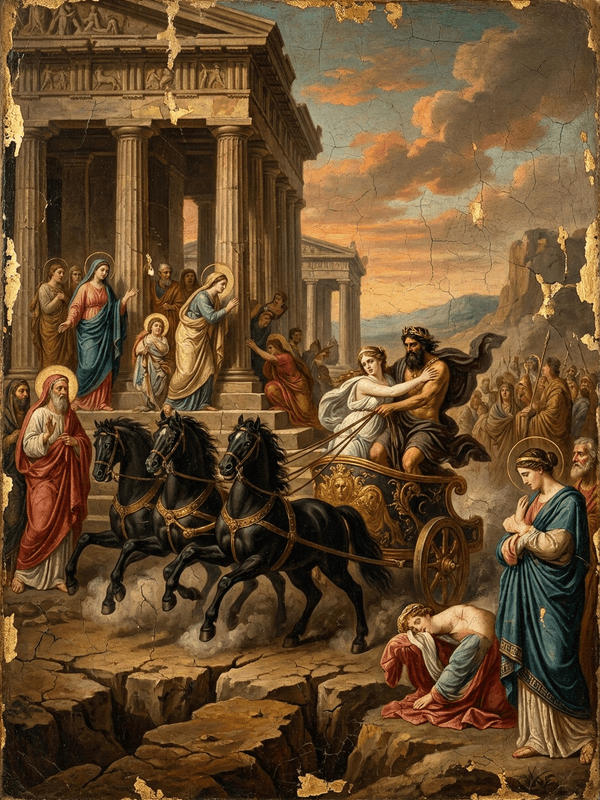
The moment her fingers touched the flower, the earth suddenly split open. From the cleft came the sound of hooves and wheels. Hades drove up from below in his golden chariot. The black horses tossed their manes, the wheels crushed the soil, and the lord of the dead seized Persephone and lifted her into the car.
Persephone screamed. She called to her father Zeus and to her mother Demeter. The flowers fell from her hands, and bright petals scattered in the dust. The chariot had already turned back, carrying her toward the opening in the earth. Then the ground closed again, and the meadow grew quiet, as if nothing had happened.
Yet the cry did not vanish entirely. The goddess Hecate heard the sound from her cave, though she did not see who had carried the girl away. Helios, who travels high across the sky, saw the whole thing, for the eye of the sun looks over all the earth.
The Search for Nine Days and Nights
When Demeter heard her daughter’s cry, it was as if a blade had cut through her heart. She rushed out at once from the dwelling place of the gods. She tore away the adornments from her head, put on dark clothing, and took torches in her hands to search the earth for Persephone.
She would not taste the food of the gods, nor drink their sweet wine. By day she crossed mountains, riverbanks, and the roads of cities. By night she kept searching with her torches raised. Their light fell over her face, over the stones of the wilderness, and over the dust. She questioned the gods she met, the rivers, the valleys, but no one could tell her where her daughter had gone.
Nine days and nine nights passed. On the tenth day Hecate came to Demeter. She too carried a torch, and she said, “I heard your daughter cry out, but I did not see who took her.”
The two goddesses went together to find Helios. Each day Helios drives his chariot from east to west, and he sees many things among gods and mortals. Demeter stood before him and asked urgently, “Who carried off my daughter?”
Helios did not hide the truth. He told her that Hades had seized Persephone, and that Zeus had known of it. Hades, though he ruled the shadowed underworld, was Zeus’s brother and held his own honor among the gods. But none of this comforted Demeter. When she heard that Zeus had permitted the deed, her grief hardened into anger. She left Olympus. She no longer sat among the gods, and she no longer allowed the earth to grow as it had before.
The Goddess Comes to Eleusis
Demeter took the form of an old woman and left the paths of the gods behind. She came to Eleusis and sat beside a well, like a weary traveler at the end of a long road. Some young women of the city came out to draw water. Seeing her seated there alone, they asked where she came from and why she had wandered to that place.
Demeter did not reveal her divine name. She said only that misfortune had fallen upon her and that she had been forced to leave her home. The girls pitied her and brought her back to the palace. Metaneira, the queen of Eleusis, needed someone to nurse her little son Demophon, and she took the strange old woman into her household.
When Demeter entered the palace, she sat in silence. Someone offered her wine, but she refused it. Later a servant mixed barley and water with mint, and then she accepted the drink. She cared for the child in the palace, and day by day he grew strong in her arms, as though some god were secretly touching him.
Demeter loved the child and wished to free him from mortal old age and death. By day she anointed him with sacred oil. By night, when everyone was asleep, she placed him in the fire, as one might slowly dry a damp piece of wood, intending to burn away the mortal part of him. The child was not harmed. Instead, he became more and more like a god.
But one night Metaneira woke and saw her son in the firelight. Terrified, she cried out. She rushed forward, thinking the old woman meant to kill the child. Demeter’s heart was wounded by that cry. She took the boy out of the fire, set him on the ground, and concealed herself no longer.
The radiance of the goddess filled the chamber. She was no longer an old woman. Her hair shone, fragrance breathed from her body, and the lintel and roof beams blazed with divine light. She told the people of Eleusis that they had lost the chance to make the child immortal. Even so, she commanded them to build her a temple and an altar. They did not dare refuse, and they hastened to obey.
When the temple was built, Demeter sat there alone. She still longed for Persephone and would not return to Olympus. She pressed her grief down upon the earth, and the fields ceased to sprout. Seeds lay buried in the soil as if dead asleep. Oxen dragged the plow through the furrows and turned the earth, but no green shoots came up. The smoke of human sacrifice grew thin, storehouses emptied, and hunger crept toward town and countryside alike.
The Earth Bears No Fruit
At last the gods grew troubled. If mortals had no grain, humankind would die, the altars would fall silent, and the fragrant smoke offered to the gods would grow less and less. Zeus first sent Iris to persuade Demeter to return to the company of the immortals. Then he sent other gods with gifts and gentle words. But Demeter sat in her temple and would not yield.
She wanted only one thing: to see her daughter.
Zeus could delay no longer. He sent Hermes to the underworld. Hermes put on his winged sandals, took up his staff, and followed the dark road beneath the earth. He crossed the river Styx and entered the palace of Hades, where he saw Persephone seated beside the lord of the dead. Though she had become queen of the underworld, her heart still remembered her mother and the sunlit meadow of flowers.
Hermes delivered Zeus’s command: Persephone must return to Demeter, so that the earth might grow again.
Hades did not rage when he heard it. He agreed to let Persephone go. But before she set out, he gave her pomegranate seeds. The pomegranate was red as clotted blood, its seeds hidden in their delicate membranes, clear and sweet. Persephone ate a few of them. The act seemed small, yet it bound her to the underworld. Whoever has eaten the food of the world below cannot leave it forever.
Mother and Daughter Reunited
Hades ordered the horses and chariot made ready, and Hermes led Persephone out of the underworld. The chariot passed through the shadowed gates, left behind the place where the dead gather, and came again into the world of wind and sunlight.
From far off Demeter saw her daughter and ran toward her. Persephone leapt down from the chariot and threw herself into her mother’s arms. Mother and daughter held each other and wept for a long time. Demeter touched her daughter’s face and hair, as if to make certain she had truly returned. Then she asked whether Persephone had eaten anything below the earth.
Persephone told her what had happened. Hades had given her pomegranate seeds, she said, and she had eaten them. When Demeter heard this, her heart sank again, for it meant her daughter could not remain with her forever.
Zeus’s settlement was then fixed: for part of each year Persephone must return to the underworld, sit beside Hades, and reign as queen below; for the rest of the year she might come back to her mother. In this way Hades did not wholly lose his wife, and Demeter did not lose her daughter forever.
Though Demeter’s sorrow had not vanished, she at last allowed the earth to wake again. Green shoots rose in the fields, branches put out new buds, and heavy ears of grain bent in the wind. People could grind wheat again, bake bread again, and offer sacrifice to the gods. The people of Eleusis also remembered how the goddess had come to their city, and they worshiped her as she had commanded.
From then on, whenever Persephone returns to her mother, the earth grows warm, flowers open, and grain rises from the soil. Whenever she leaves the sunlight and goes back to the palace beneath the ground, Demeter’s sorrow falls once more upon the fields, the plants fall silent, and the land grows cold. So the days of reunion and separation between mother and daughter remain, year after year, in the changing face of the earth.