Greek Mythology
Thrace — Greek Mythology
Thrace is a broad region north of the Greek world in Greek mythology, often used as the setting for foreign kingdoms, coastal landfalls, and stories of mountains and forests. It is especially important in tales of heroic journeys, since the routes or origins of the Argonauts, Heracles, Orpheus, and other figures are connected with it.
Overview
Thrace is described as a northern region with sea coasts, mountains, and forests, including shores, palaces, stables, slopes, riverbanks, and remote woods. The Argonauts came near the Thracian coast on their way to the Golden Fleece, and Heracles crossed the sea to Thrace in search of the mares of Diomedes. The legends of Orpheus present Thrace as a landscape where mountains, rivers, and Dionysian rites meet.
Article
Place in Greek Mythology
In these stories, Thrace is not a single city but a region made up of coasts, royal courts, forests, rivers, and horse-breeding lands. It is often placed beyond mainland Greece and serves as a setting for marriage into a foreign land, expeditions, prophecy, violent kingship, and heroic deeds on the frontier.
Thrace is also linked with music and Dionysian tradition. Orpheus is called a Thracian singer, and his lyre is heard in mountain country and along riverbanks. The Maenads who kill him are also active in the Thracian mountains. At the same time, figures such as Tereus, Diomedes, and Phineus make Thrace a place of kingship, punishment, and heroic trial.
Geography and Natural Setting
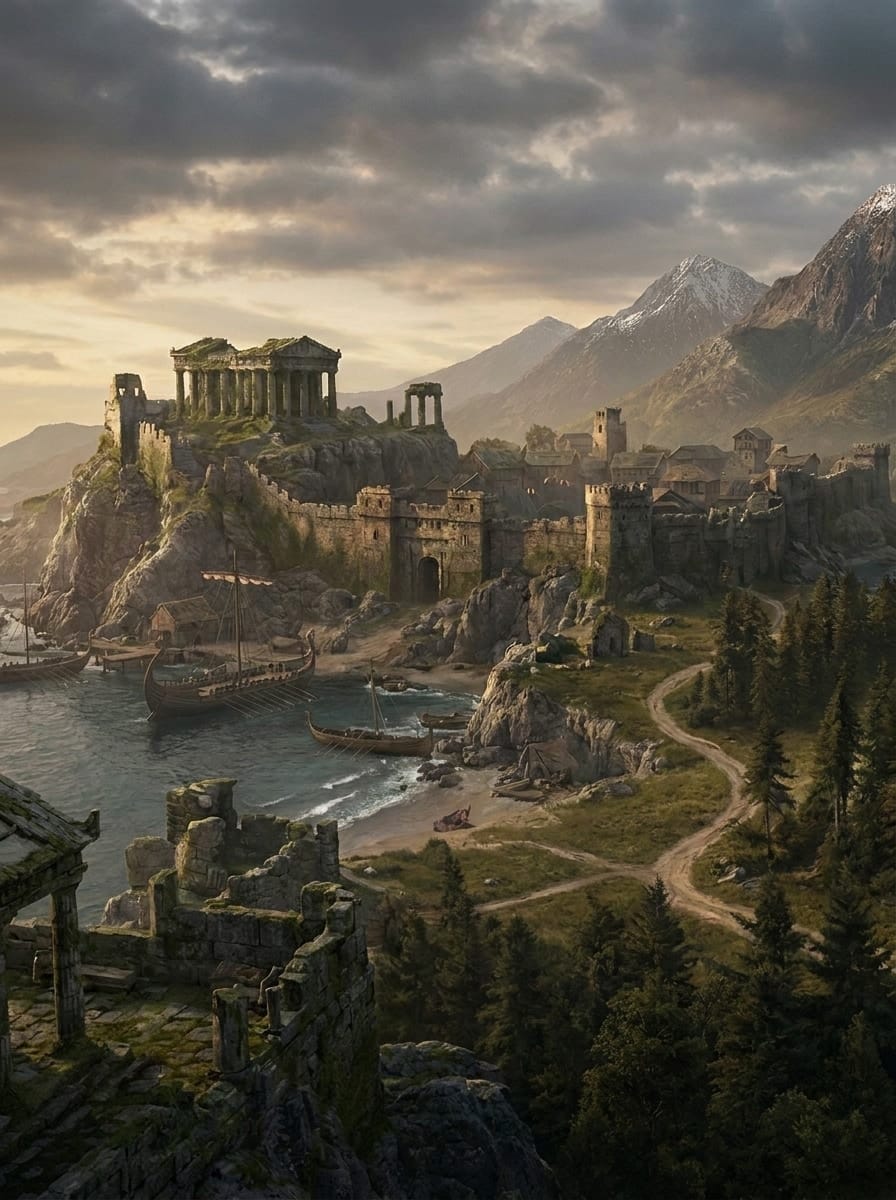
Thrace is often presented as a coastal region near mountains, with forests and rivers. In "Dionysus and Pallene," Pallene lies by the sea in Thrace, in a landscape of sea wind, mountain shadows, and a royal palace. In "Phineus and the Harpies," the Argo comes near the Thracian coast, where the heroes encounter the blind seer Phineus.
"The Death of Orpheus" also mentions the Hebrus River: Orpheus's head and lyre are thrown into the river and drift downstream toward the sea. Taken together, the stories present Thrace as a northern region where coast, hillsides, woods, waterways, and royal territory coexist.
Related Stories
"Dionysus and Pallene" mentions Thrace: Pallene is placed by the Thracian coast, where Dionysus defeats the brutal Sithonian king.
"Procne and Philomela" mentions Thrace: the Athenian princess Procne marries Tereus, king of Thrace, and the central disaster of the story unfolds in this foreign kingdom.
"Orpheus and Eurydice" mentions Thrace: Orpheus is described as a singer from Thrace, and after losing Eurydice he returns to the Thracian mountains and forests to sing.
"The Death of Orpheus" mentions Thrace: Orpheus is killed by Maenads on Thracian hillsides and riverbanks, after which his head and lyre drift away down the river.
"Phineus and the Harpies" mentions Thrace: the Argonauts meet Phineus on the Thracian coast and receive from him guidance for passing through the Clashing Rocks.
"The Cretan Bull and the Mares of Diomedes" mentions Thrace: Heracles goes to Thrace to seize the man-eating mares of Diomedes and leaves a memorial there for Abderus.