Greek Mythology
Tartarus — Greek Mythology
Tartarus is the dark abyss at the deepest level of the Greek mythic underworld, and also one of the primordial powers of the cosmos. It is not merely an underground realm, nor simply a province of the dead, but a place where defeated divine powers and transgressors against sacred order are imagined as being cast into the lowest depth of existence.
Overview
In the cosmology of early Greek poetry, Tartarus lies far beneath the earth and below the ordinary realm of the dead, separated from the world of mortals and the heights of Olympus by vast cosmic distance. It is imagined as an abyss, a prison, and the lower boundary of the universe, where Titans and the gravest offenders are confined and punished.
Article
Name and Essential Nature
Tartarus is one of the most formidable places in Greek mythology. It is not merely a dungeon within the underworld, nor only a later image of posthumous punishment. In the older cosmic imagination, Tartarus itself belongs among the primordial realities, standing near the beginning of the world alongside Chaos, Gaia, and Eros. It marks the deepest, darkest, and least accessible boundary of the ordered cosmos.
To understand Tartarus, both meanings must be kept in view. It is at once a primordial being or personified cosmic force, and a place: an abyss, a prison, and a realm of darkness remote from gods and mortals alike. Greek myth gives Tartarus its power precisely through this overlap between entity and landscape.
Cosmic Depth and Spatial Imagination
Ancient Greek poetry describes Tartarus through measures of extreme distance. It lies beneath the earth, and even beneath the realm of Hades. In the Homeric tradition, it is as far below Hades as heaven is above the earth. Hesiod offers a similarly vivid image: a bronze anvil would fall for nine days and nights from heaven to earth, and for another nine days and nights from earth to Tartarus.
These descriptions are not simple geography. They are a language of cosmic scale. If Olympus represents the shining height of divine authority, Tartarus is its opposite: the buried depth where light, feasting, song, and celestial glory cannot reach. Olympus displays the power of the gods; Tartarus contains the darkness into which defeated disorder is cast.
A Primordial Power in the Structure of the World
In Hesiod’s Theogony, Tartarus is not introduced as a late underworld location, but as one of the earliest presences in the formation of the cosmos. Its relationship with Gaia is especially significant. In some traditions, Gaia and Tartarus produce Typhon, one of the most terrifying monsters in Greek myth, a being whose challenge to Zeus threatens the stability of divine rule.
Tartarus is therefore more than a place of confinement. It is also a source of dangerous power. It does not rule the cosmos openly, yet it functions like a dark reserve of ancient force: suppressed, banished, and still deeply feared.
The Imprisonment of the Titans and the Order of Zeus
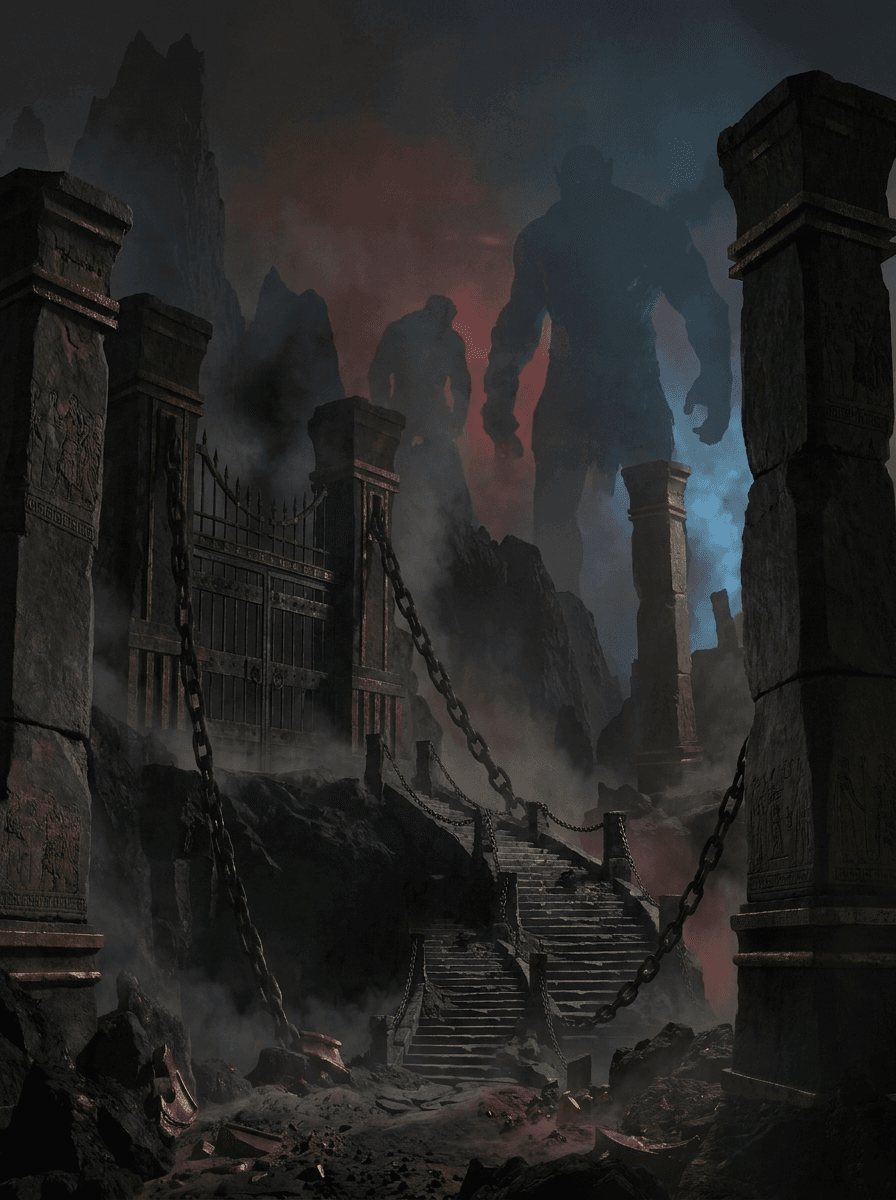
Tartarus becomes central to mythic history after the Titanomachy. When Zeus and the Olympian gods defeat Cronus and the Titans, many of the defeated Titans are imprisoned in Tartarus. In some accounts, the Hundred-Handed Ones stand as guards over the abyss, ensuring that the old divine powers cannot return.
This episode is not only a story of punishment. It is a mythic explanation of political and cosmic succession. The old order is not simply erased; it is driven into the lowest region of the world. The Olympian order is built upon the restraint of ancient chaos. Tartarus thus marks the boundary of Zeus’s sovereignty and preserves the memory of forces that had to be overcome.
A Place of Punishment and Moral Warning
In later literary and philosophical traditions, Tartarus increasingly becomes the place where the gravely wicked receive punishment after death. Figures such as Sisyphus, Tantalus, Ixion, and Tityus are commonly associated with it. Their offenses often involve insulting the gods, violating sacred order, breaking fundamental obligations, or attempting to cross the boundary between mortal and divine.
The punishments are memorable not only because they are severe, but because they are symbolically exact. Sisyphus endlessly rolls a stone that returns to the foot of the hill, turning clever arrogance into futile repetition. Tantalus stands near water and fruit that always withdraw, making desire itself into torment. Tartarus becomes, in this sense, a moral theater of limit, justice, and transgression.
Tartarus, Hades, and the Underworld
Tartarus is often grouped within the underworld, but it should not be treated as identical with Hades as a whole. Hades may refer to the god who rules the dead or to the broader realm where the dead dwell. Tartarus is usually the deepest and most severe region within that broader underworld geography. Ordinary shades do not necessarily enter Tartarus; it is reserved for beings whose crimes or cosmic threat place them beyond the common fate of the dead.
This distinction matters. To translate Tartarus simply as “hell” can obscure the complexity of Greek myth. It is not merely a later religious place of judgment. It is a deep zone where cosmology, divine politics, underworld imagination, and moral punishment intersect.
Literary Tradition and Later Influence
From Homer and Hesiod to mythographers, dramatists, philosophers, and Roman poets, the image of Tartarus changes over time. Early traditions emphasize its role as a cosmic abyss and divine prison. Later traditions increasingly present it as a place of punishment for the wicked. Philosophical writers such as Plato connect it with the judgment of souls and the consequences of injustice, giving it a more explicit ethical dimension.
Roman literature gives Tartarus an even more architectural and dramatic form: gates, walls, fiery rivers, avenging goddesses, and unending punishments shape it into a grand landscape of subterranean judgment. Later European literature and art would repeatedly return to such imagery when imagining abysses, infernal realms, eternal penalties, and imprisoned giants.
Cultural Meaning
The significance of Tartarus lies in its extremity. It is the deepest region of the world, the prison of defeated elder gods, the place of punishment for outrageous wrongdoing, and the dark boundary of the cosmos. It reminds us that Greek myth is not made only of radiant Olympus, heroic glory, and festival song. It also contains fear, guilt, violence, memory, and the buried cost of order.
Tartarus is therefore more than a place of horror. It is an inverted mirror of Olympus. Where Olympus displays the majesty of order, Tartarus reveals the shadow that order must master. Together, they form one of the most powerful contrasts in the Greek mythic imagination.