Greek Mythology
Pontus — Greek Mythology
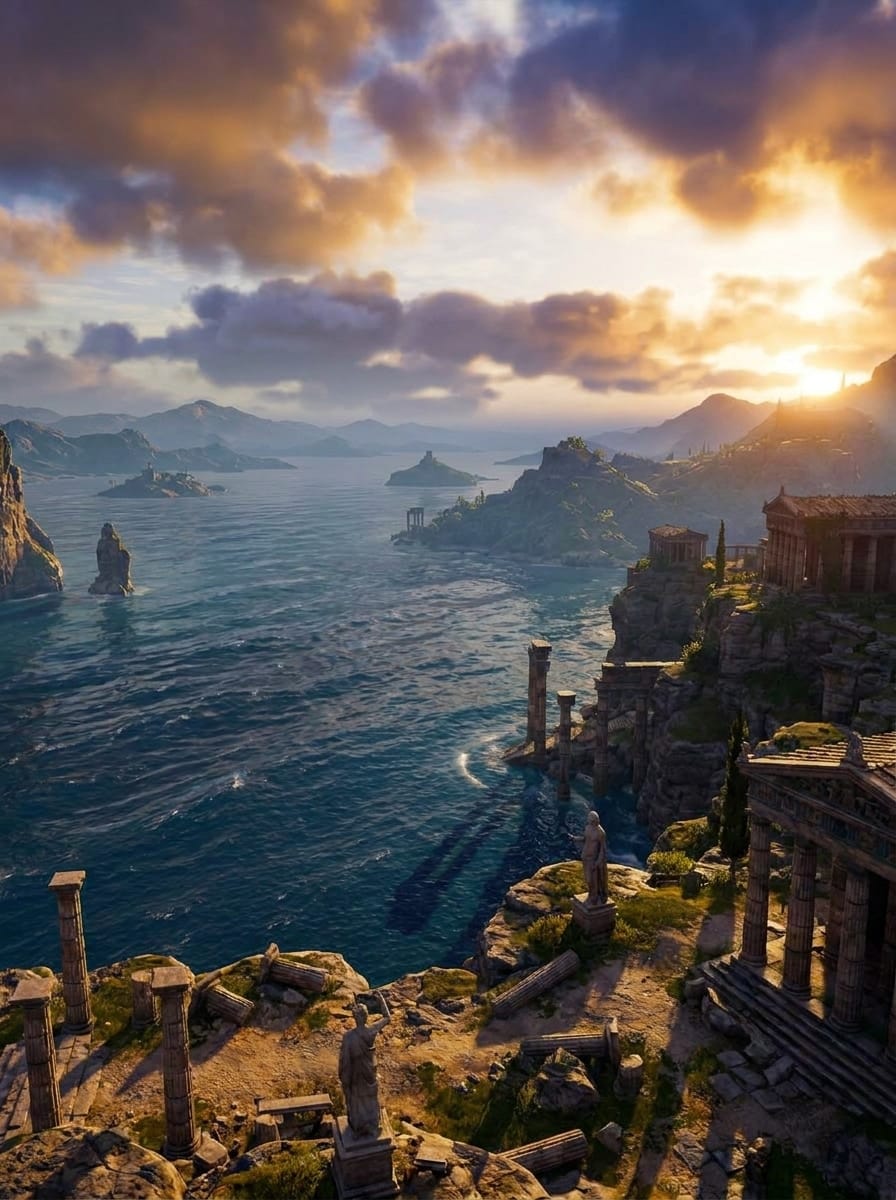
Pontus is the primordial sea of early Greek myth, representing the broad waters that spread beyond the earth. Its importance lies in helping form the basic geography of the early world alongside the sky and the mountains.
Overview
Pontus lies at the edge of the earth brought forth by Gaia, appearing as a wide expanse of seawater. It is not a river or a spring, but a surging sea that beats against the newly formed shore.
Article
Role in Greek Mythology
In accounts of the primordial cosmos, Pontus is born from Gaia alone and belongs among the earliest geographic elements to appear as the world takes shape. Alongside the sky represented by Uranus and the mountains, it gives the mythic world more than empty space and earth: it begins to define the basic divisions of upper sky, land, peaks, and sea.
Geographical Background
Pontus is not presented here as a specific harbor or historical sea, but as the sea itself within the mythic cosmos. The story places it at the edge of the earth and describes it as a vast surface of water that comes from Gaia, forming the marine layer of early Greek cosmic geography.
Related Story
"Chaos and the First Gods" mentions this place: after Gaia brings forth the sky and the mountains, she also gives birth to Pontus, the sea.