Greek Mythology
Plain of Troy — Greek Mythology
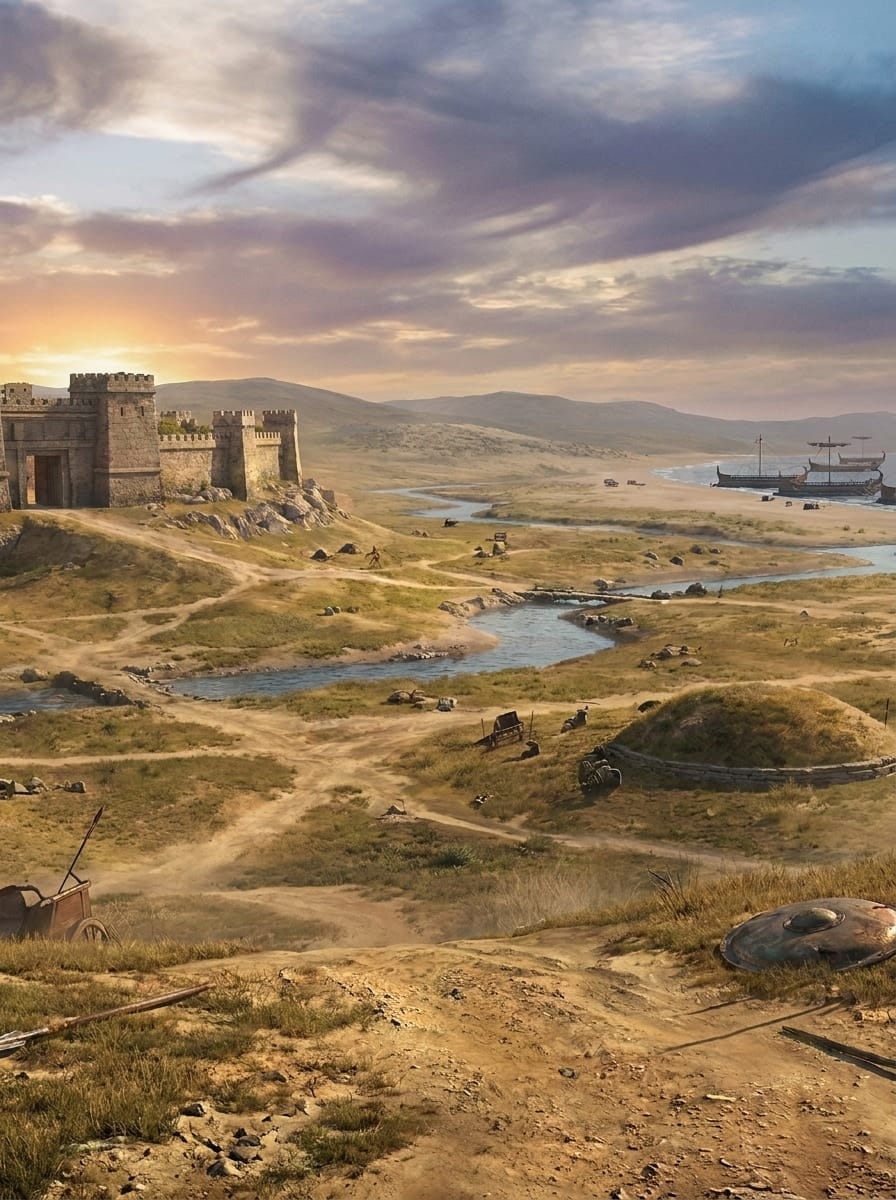
The Plain of Troy is the open battlefield outside the city of Troy in Greek myth, and one of the main settings for the fighting of the Trojan War. It links the city walls and gates with the Greeks' seaside camp and fleet, serving in the war narrative as the space for battle, pursuit, duels, and the arrival of reinforcements.
Overview
The plain lies outside Troy, and the stories often define it by reference to the city walls, the Scaean Gate, the Greek camp by the sea, and the black ships. Ancient tradition placed Troy near the Dardanelles, and the archaeological site is now usually identified with the area of Hisarlik in modern Turkey. The banks of the Scamander, the coast, and the roads leading toward the city gates together form the surrounding geography of the war narrative.
Article
Role in Greek Mythology
The Plain of Troy is the most frequently recurring open space outside the city in Trojan War narratives. Greeks and Trojans form lines, charge, retreat, and fight over bodies there, and many heroes either win or lose their fame on this battlefield.
In the stories, the plain is not an isolated site but the open ground between Troy and the Greek ships. The walls and gates mark the Trojans' defensive boundary, while the beached fleet represents the Greeks' rear and their route home. As the two armies advance and fall back across this space, the plain becomes the clearest setting for shifts in the war's momentum.
Geography and Natural Setting
The Plain of Troy is often associated with dust, chariots, horses' hooves, shields, and corpses, showing that it was imagined as a broad battlefield suited to chariot warfare and large-scale infantry fighting. One end lies near the walls and gates of Troy, while the other leads toward the Greek ships and camp beside the sea.
The plain is also connected with nearby rivers and the coast. In "The Trojans Drive to the Ships," the Trojans are no longer merely driven back toward the Scamander; instead, they cross the Greek ditch and camp wall and press the fighting all the way to the ships. This episode places the plain within a continuous war zone between the city, the river, the camp defenses, and the seagoing fleet.
Name and Literary Tradition
In English usage, "the Plain of Troy" generally means the battlefield outside the city rather than a city or a single structure. Related narratives often speak of the plain before Troy, the plain of Troy, the ground below the city, or the fighting on the plain, emphasizing its function as the place where the war is fought.
Within the Trojan War tradition, this plain corresponds to the central siege setting presented in the Iliad: inside the city are the house of Priam, temples, and the prayers of women, while outside the walls lie the battlefield of heroic duels, advancing battle lines, and divine intervention.
Related Stories
"Hector Returns to the City" mentions this place: Hector comes back from the battlefield outside the walls into Troy, then leaves the gate again for the plain.
"The Trojans Drive to the Ships" mentions this place: the Trojans advance from below the city, cross the Greek ditch and camp wall, and push the battle all the way to the ships.
"Penthesilea Beneath Troy" mentions this place: the Amazon queen Penthesilea leads her women warriors out from the city, attacks the Greek army on the plain, and is finally killed by Achilles.
"Memnon at Troy" mentions this place: Memnon brings eastern reinforcements onto the battlefield and duels Achilles on the Plain of Troy.
"The Arms of Achilles and the Death of Ajax" mentions this place: after Achilles dies, Greeks and Trojans struggle for his body on the battlefield outside the city.
"Disasters on the Greek Returns" mentions this place: after the fall of Troy, the ruined city on the plain and the fleet by the sea form the background for the Greeks' departure.