Greek Mythology
Peloponnese — Greek Mythology
The Peloponnese is an important region and peninsula in Greek mythology, especially associated with Pelops' kingship, marriage, and naming tradition. In several heroic stories, it appears as the wider area containing cities, roads, coasts, and an entrance to the underworld.
Overview
The Peloponnese lies in southern mainland Greece and is a peninsula made up of multiple city-states, mountain areas, coasts, and roads. Troezen stands on the eastern side of the Peloponnese, Taenarum is at its southern end, and the Isthmus of Corinth connects it with the overland route toward Athens.
Article
Role in Greek Mythology
In mythic tradition, the Peloponnese is not a single city but a region containing kingdoms, towns, roads, and coastal sites. After Pelops came to the area of Elis and won Hippodamia and the kingship of Pisa, the peninsula was said to have been named after him, with the name understood as "the island of Pelops."
The Peloponnese also provides a geographic frame for heroic journeys. Theseus set out from Troezen on the eastern side of the Peloponnese and traveled overland toward Athens, passing roads held by robbers, wooded places, cliffs, and areas near the isthmus. In the story of Heracles bringing Cerberus back from the underworld, Taenarum at the southern end of the Peloponnese is described as the site of an entrance to the realm of the dead.
Geography and Natural Setting
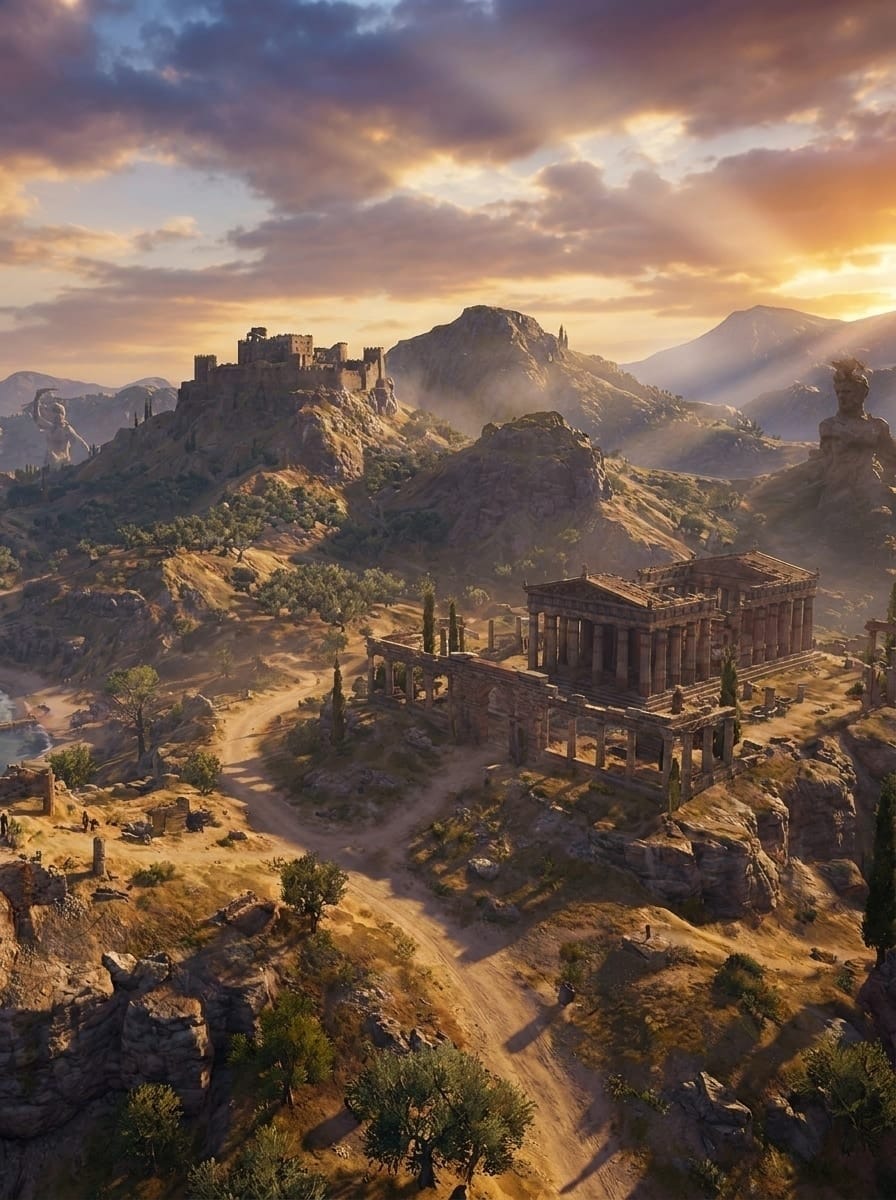
The Peloponnese in these stories includes several concrete kinds of terrain: Troezen and its road toward Athens in the east, the Isthmus of Corinth near the north, and sea-facing Taenarum at the southern end. Related narratives also mention seaside cliffs, pine woods, mountain roads, open country, and coastal caves, but these belong to specific story settings and should not be merged into a single landscape.
Name and Literary Tradition
The name "Peloponnese" is linked in the Pelops tradition to Pelops himself. The story explains it as "the island of Pelops," emphasizing how Pelops' acquisition of land, kingship, and renown became attached to the name of the peninsula.
Historical and Religious Landscape
The Peloponnese was also an important region in the political history of ancient Greece. The "Peloponnesian League" refers to an alliance led by Sparta and including city-states of the Peloponnesian peninsula and other areas. This historical layer belongs to the background of Greek political history and is distinct from the mythic naming tradition of Pelops and the heroic episodes set in the region.
Related Stories
"Pelops" mentions this place: after Pelops won Hippodamia and kingship in the area of Elis, the peninsula was said to have been named after him.
"Cerberus" mentions this place: before completing his final labor, Heracles came to Taenarum at the southern end of the Peloponnese and entered the underworld from there.
"Theseus' Journey to His Father" mentions this place: Theseus set out from Troezen on the eastern side of the Peloponnese, chose the overland route to Athens, and on the way defeated several robbers and monsters who harmed travelers.