Greek Mythology
Olympus — Greek Mythology
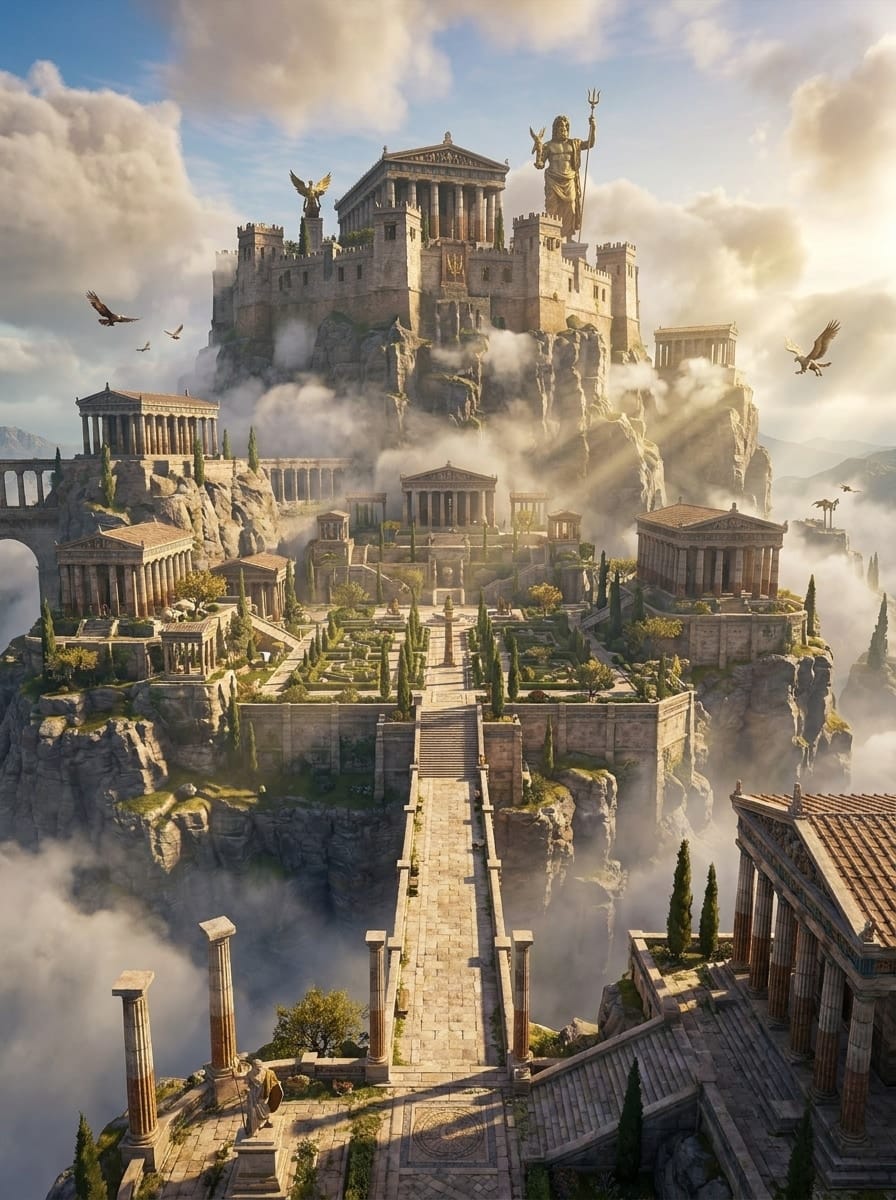
Olympus is the home of the Olympian gods in Greek mythology and the sacred mountain of the new divine order established by Zeus. In the stories, it is the high place where the gods gather, deliberate, and feast, as well as the central seat challenged by hostile powers such as the Titans, the Giants, and Typhon.
Overview
Olympus corresponds to Mount Olympus in northern Greece, near the northern shore of the Thermaic Gulf of the Aegean Sea. As a real mountain, it is the highest in Greece; as a mythic place, it is described as a cloud-wreathed summit dwelling, difficult for mortals to reach and close to the sky.
Article
Role in Greek Mythology
Olympus is the mountain home shared by the new generation of gods after they gain sovereignty. After the Titanomachy, Zeus becomes king of the gods, and the gods take their seats on Mount Olympus while retaining their own honors; this arrangement makes Olympus not only a residence, but also a symbol of divine power and order.
Olympus is also the target in several cosmic conflicts. In the Titanomachy, Zeus and his allies take their position on Olympus against the Titans gathered around Mount Othrys. In the Gigantomachy, the Giants attack Olympus in an attempt to shake the authority of Zeus and the gods. In the battle with Typhon, Typhon too rises against Zeus and threatens the divine throne on Olympus.
Geographical Background
In mythic settings, Olympus is portrayed as a peak rising into the clouds, with mist around its slopes and the palaces and seats of the gods at its summit. It is connected with the authority of the sky, but it is not identical with the whole sky: Zeus rules the sky and thunder, while Olympus is the mountain dwelling where he and the gods take their places.
Olympus is often contrasted with other cosmic regions. Tartarus lies deep beneath the earth, where the defeated Titans are imprisoned; the underworld is ruled by Hades; and the sea belongs to Poseidon. Olympus, by contrast, stands on a high mountain and remains the center where the gods assemble, move among one another, and receive offerings.
Geography and Natural Environment
The real Mount Olympus is in northern Greece, near the northern shore of the Thermaic Gulf. It is a massif with several peaks; the highest is usually called Mytikas, at about 2,900 meters, making it the highest peak in Greece. Because the mountain stands near the coast while also having high alpine terrain, its geography combines mountain and maritime settings.
The standard English geographic name is Mount Olympus. In mythological contexts, the shorter form Olympus is also used, especially when referring to the Olympian gods and the Olympian order.
Related Stories
"The Division of the World and the Olympian Order" mentions this place: after the war with the Titans, Zeus receives authority over the sky, the gods take their seats on Mount Olympus, and the new divine order is formed.
"The Titanomachy" mentions this place: Zeus and his siblings ascend Olympus and fight the Titans gathered around Mount Othrys; after the war, Olympus becomes the center of the new age of gods.
"The Gigantomachy" mentions this place: the Giants attack Mount Olympus, and Zeus and the gods, with the help of Heracles, defend the sacred mountain.
"Zeus and Typhon" mentions this place: after Typhon rises from deep within the earth and challenges Zeus, Olympus is threatened as the sacred mountain where Zeus's throne stands.
"The Sacrificial Meat at Mecone and the Theft of Fire" and "Pandora" also mention Olympus: from the mountain, Zeus watches the fire given to mortals and the condition of humankind, and from there he arranges punishment for Prometheus and humanity.