Greek Mythology
Oceanus — Greek Mythology
Oceanus is the encircling ocean of early Greek cosmology, often personified as the Titan of the same name. It matters because it marks the outer edge of the world and links the sea to the oldest divine lineage.
Overview
Oceanus lies at the far edge of the mythic world and is described as a current that surrounds the earth, not as any identifiable sea. It belongs to the cosmic boundary formed after the separation of heaven and earth, and it is tied to the early mythic background of Gaia, Uranus, and the Titan generation.
Article
Position in Greek mythology
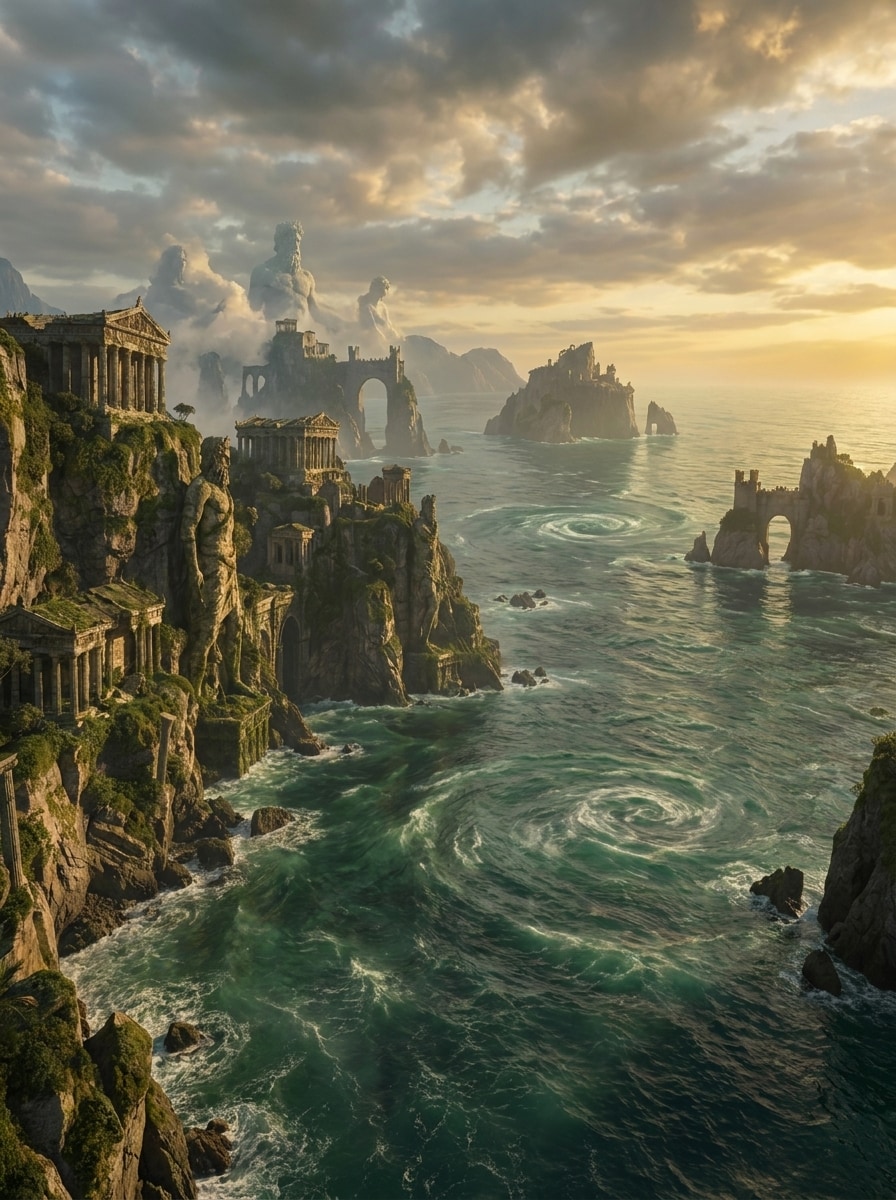
Oceanus is both one of the twelve Titans born to Gaia and Uranus and the ancient waterway understood to encircle the world. As a place entry, it can be treated as the personified world-ocean: both a Titan's name and the water boundary around the earth in early cosmology.
In the Titanomachy, Oceanus did not actively side with Cronus. That sets him apart from the Titans who fought and were defeated, and preserves his boundary role in cosmic geography.
Geographic background
Oceanus is not a city, island, or ordinary bay, but the great watercourse placed beyond the known world in Greek myth. Its spatial role is to surround the earth and form the oceanic edge of the world. Unlike places such as Olympus, Mount Othrys, or Tartarus, which serve as explicit narrative settings, Oceanus appears mainly as part of the cosmic structure.
Related stories
In Gaia and Uranus, Oceanus appears as one of the Titans born to Gaia and Uranus, and he is described as the water encircling the world.
In Cronus Overthrows Uranus, he is listed among the earliest-born Titans and belongs to the ancient divine generation formed after heaven and earth were divided.
In Titanomachy, the story notes that he does not actively help the Titan side in the war, which sets him apart from the main rebels defeated and imprisoned by Zeus.