Greek Mythology
Mount Olympus — Greek Mythology
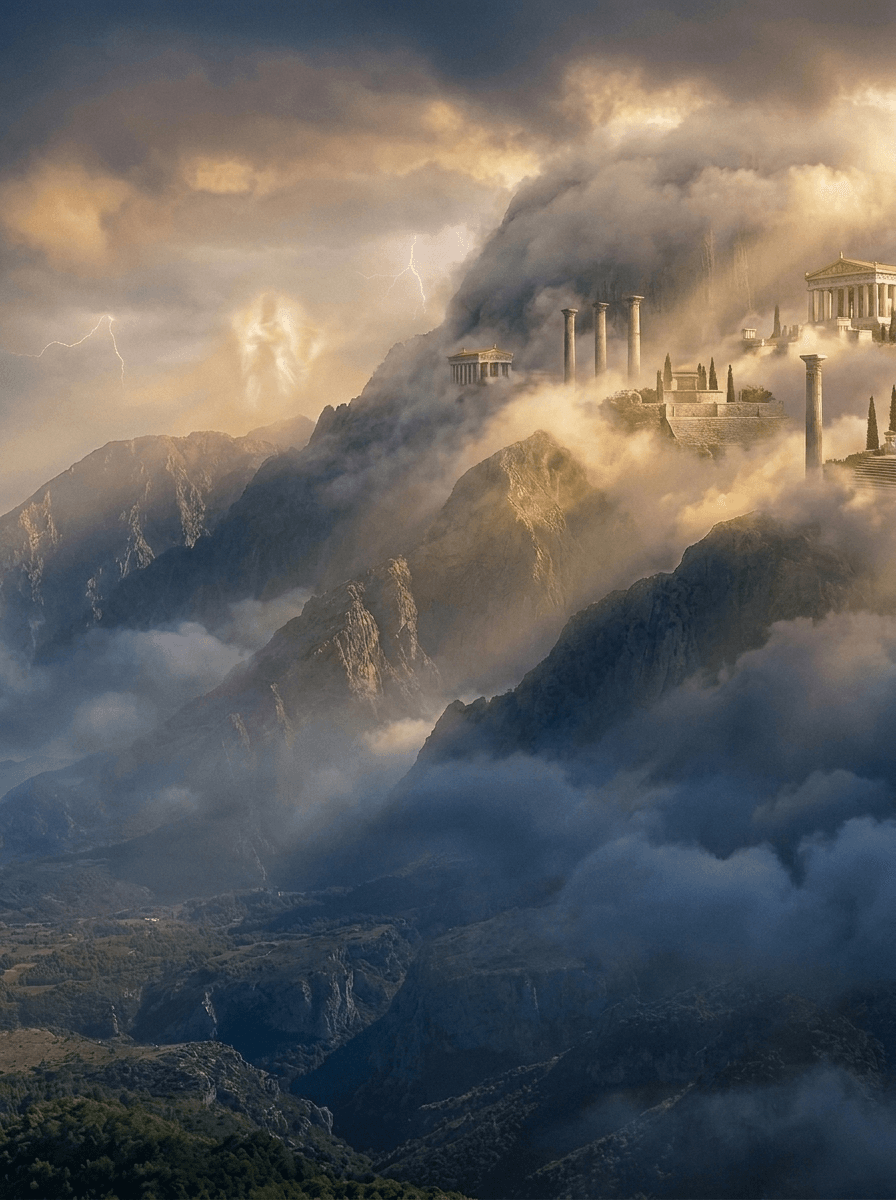
Mount Olympus is the highest mountain in Greece and, in Greek mythology, the celestial seat and dwelling place of the Olympian gods.
Overview
Highest peak of Greece, near the Thermaic Gulf on the border of Thessaly and Macedonia
Article
Geography and Physical Setting
Mount Olympus is the highest mountain in Greece, rising near the Thermaic Gulf of the Aegean Sea on the historic border between Thessaly and Macedonia. Its great massif stretches across the regional units of Larissa and Pieria, where steep ridges, deep ravines, forested slopes, and high alpine peaks create one of the most dramatic landscapes in the Greek world.
The mountain is known for its many summits, among them Mytikas, the highest peak in Greece. Litochoro, set at the eastern foothills, has long served as the principal gateway for modern ascents, while nearby places such as Dion, Pieria, the Enipeas gorge, and the surrounding villages deepen the mountain’s sense of geographic and cultural presence.
Mythological Significance
In Greek mythology, Mount Olympus is the radiant dwelling place of Zeus and the Olympian gods. More than a physical mountain, it became the imagined summit of divine authority: a realm above ordinary human reach where the gods feast, deliberate, quarrel, and rule over the world below.
Ancient poetry often presents Olympus as both a mountain and a celestial threshold. Homeric tradition places the gods there in splendor, while later Greek imagination strengthened its identity as the sacred home of the Olympian order. From this height Zeus reigns as king of the gods, surrounded by the divine company whose stories shape much of Greek myth.
The northern foothills of Olympus were also closely linked with Pieria and the Muses, daughters of Zeus and Mnemosyne. In this tradition, the arts, song, memory, and divine inspiration gather at the foot of the mountain, giving Olympus not only political and cosmic majesty but also a deep association with poetry and sacred performance.
Name and Literary Tradition
The origin of the name Olympus remains uncertain, which adds to the mountain’s aura of antiquity. Ancient and modern explanations have connected the name with Greek, pre-Greek, and Mycenaean possibilities, while literary tradition preserves variants and older associations that show how deeply the mountain’s name entered the Greek imagination.
Across Greek literature, Olympus became a word charged with more than geography. It could evoke the sky, the divine realm, the court of Zeus, or the shining distance between mortal life and immortal power. This layered meaning helped make Olympus one of the most enduring sacred landscapes of the ancient Mediterranean.
Historical and Religious Landscape
In antiquity, the Olympus massif stood at the meeting point of Thessaly and Macedon, making it both a natural boundary and a culturally important landmark. The surrounding region was tied to Macedonian history, local cults, heroic traditions, and sacred sites that linked the mountain with the political and religious life of northern Greece.
Dion, at the foot of Olympus, was especially important as a sanctuary of Zeus and the Twelve Olympians. The wider region also preserves associations with Orpheus, mystery traditions, ancient pilgrimage, and later Christian monuments, including monasteries and chapels that continued to mark the mountain as a place of reverence.
Climbing and Modern Importance
Mount Olympus has drawn travelers, pilgrims, and climbers for centuries. Evidence of ancient religious activity on high summits shows that the mountain was not merely admired from below; it was approached as a sacred height. In the modern era, the ascent of Mytikas in 1913 by Frédéric Boissonnas, Daniel Baud-Bovy, and Christos Kakkalos became a landmark moment in the mountain’s exploration history.
Today Olympus remains one of the most celebrated hiking and climbing destinations in Greece and Europe. Its paths lead through forests, gorges, high meadows, and bare stone ridges, allowing visitors to experience both the natural grandeur of the massif and the mythic atmosphere that has surrounded it for millennia.
Protected Landscape and Biodiversity
Mount Olympus is also one of Greece’s most important natural sanctuaries. It became the country’s first National Park in 1938 and is recognized as a landscape of exceptional biodiversity. Its slopes contain multiple ecological zones, from Mediterranean vegetation and dense forests to alpine habitats near the highest peaks.
The mountain supports a remarkable range of plants, birds, mammals, reptiles, amphibians, and insects. This richness reinforces the ancient sense of Olympus as a world unto itself: a place where stone, cloud, forest, and myth meet in a landscape that remains both earthly and exalted.