Greek Mythology
Mecone — Greek Mythology
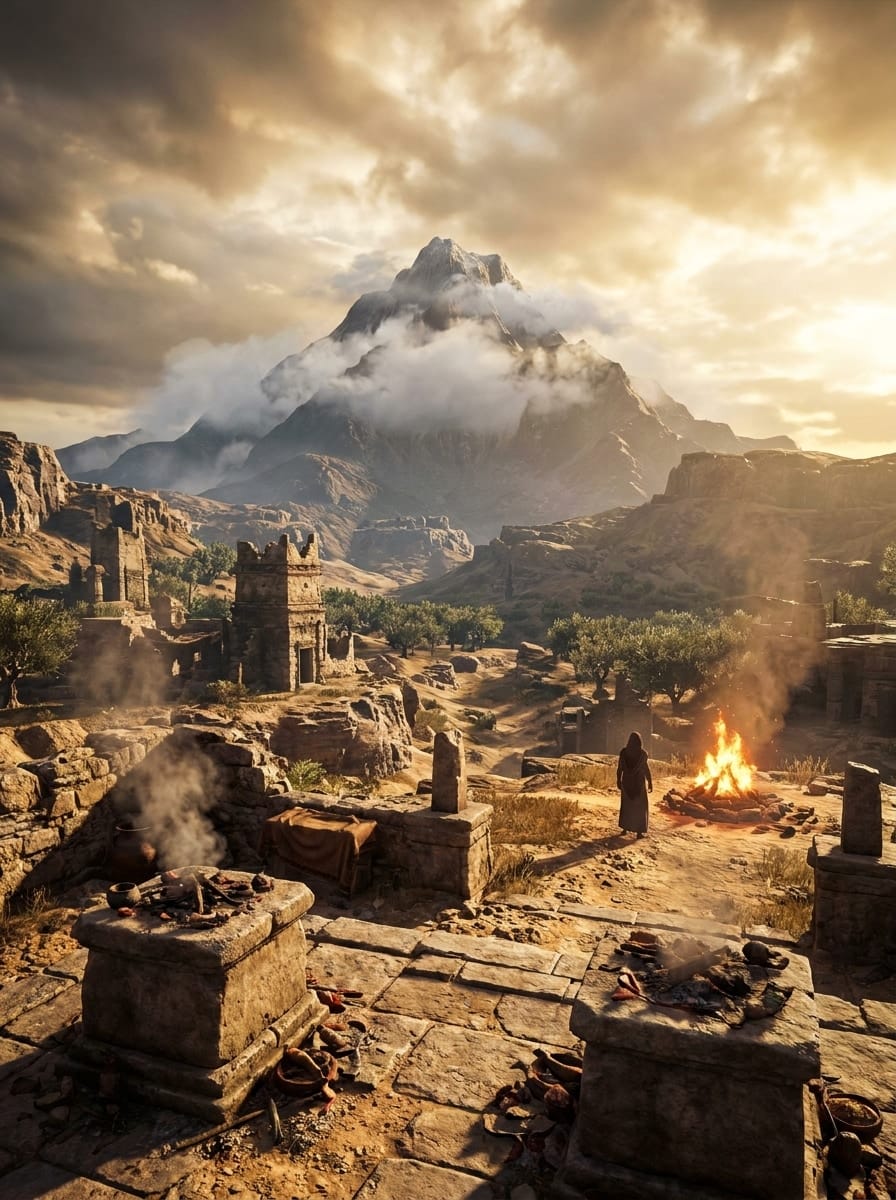
Mecone is the place in Greek mythology where gods and humans agreed on the division of sacrificial meat. Its importance lies in Prometheus' attempt there to secure a share of the sacrifice for humankind, an act that led to Zeus withholding fire and to Prometheus stealing it back.
Overview
Mecone is the place where gods and humans gathered to settle the distribution of sacrifice before the rules of ritual offering had been fixed. The available material does not give it a specific landscape, boundary, or stable identification with another real-world location.
Article
Role in Greek Mythology
In the Prometheus tradition, Mecone is the place where the relationship between gods and humans is redefined. Prometheus divides an ox into two portions: one plain-looking portion concealing the good meat, and another covered in fat but containing white bones. After Zeus chooses the latter, humans offer bones and fat on the altar while keeping the edible meat for themselves.
Mecone therefore becomes a narrative point at which the sacrificial order takes shape. The story does not present it as a city, temple, or mountain, but as the region where gods and humans assemble and the rules are fixed.
Geographical Background
Mecone is chiefly described as the place where gods and humans came together to divide sacrificial meat. The related narrative gives no further description of its natural terrain or real geographical location. In this entry, it should be understood as a mythic place in the Prometheus story, not as a real region whose geography can be expanded from the present sources.
Related Story
"The Sacrificial Meat at Mecone and the Theft of Fire" mentions this place: Prometheus tests Zeus here with the two portions of sacrificial meat, allowing humans to keep the edible flesh. Zeus then takes fire away, and Prometheus steals it back for humankind, making Mecone the starting point of this chain of conflict.