Greek Mythology
Labyrinth — Greek Mythology
The Labyrinth is the enclosed and intricate precinct in the Cretan and Theseus cycle, built by Daedalus for King Minos of Crete to imprison the Minotaur. Its importance lies in bringing together Minos's power, the Athenian tribute, Ariadne's thread, and Theseus's monster-slaying exploit in a single place.
Overview
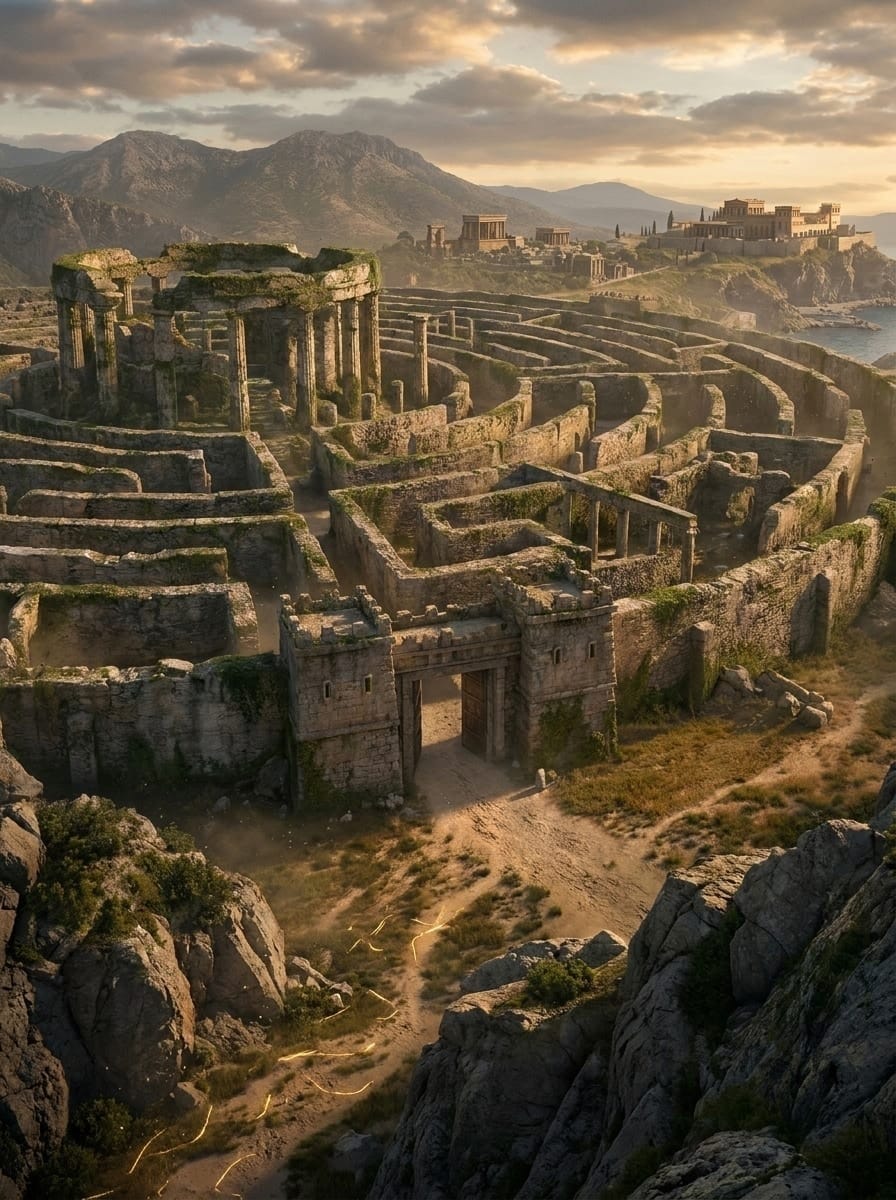
The Labyrinth is on Crete and is usually placed in the stories near the palace of Minos; a stable tradition also connects it with Knossos. It is not an ordinary dwelling, but an enclosed space made up of winding passages, similar stone walls, doors, and an entrance, so that anyone who enters can scarcely find the way back unaided.
Article
Role in Greek Mythology
In Greek mythology, the Labyrinth is first of all a place of confinement. Minos keeps the half-man, half-bull Minotaur deep within it, preventing the monster from escaping and making it nearly impossible for those sent inside to leave alive. The Athenian youths and maidens periodically sent to Crete are brought there as tribute, so the Labyrinth becomes a symbolic site of Athens's subjection to Crete.
The place also displays Daedalus's skill as a craftsman. The stories stress the Labyrinth's complex design: passages coil back on themselves, wall stands behind wall, and door follows door, so that entrants quickly lose their bearings. Its function is not to house people but to trap them; even after the monster is killed, finding the exit remains another danger.
In the story of Theseus, the Labyrinth is the central setting of the hero's ordeal. With the ball of thread given to him by Ariadne, Theseus unwinds a line from the entrance as he goes into the depths, kills the Minotaur, and then follows the thread back. The structure of the Labyrinth makes Ariadne's help an indispensable part of his victory.
Geographical Background
The Labyrinth belongs to the mythic geography of Crete and is linked with the palace of Minos, the Cretan coast, and the sea route by which the tribute ship travels from Athens to Crete. In the story, the youths and maidens first cross the sea from Athens to Crete and are then brought to the palace of Minos and the area of the Labyrinth; after escaping, Theseus also leaves by ship from the Cretan shore.
In more specific traditional accounts, the Labyrinth is often associated with the palace at Knossos on Crete. In the related narratives, however, it appears chiefly as an enclosed area near the palace of Minos, not as a real-world geographic unit with precisely defined boundaries.
Related Stories
"Daedalus and Icarus" mentions this place: Daedalus builds the Labyrinth on Crete for Minos, and the Minotaur is imprisoned inside it; after Theseus escapes from the Labyrinth, Minos suspects Daedalus of revealing the method and then restricts Daedalus and Icarus from leaving Crete.
"Theseus and the Minotaur" mentions this place: Athenian youths and maidens are sent into the Labyrinth, and Theseus, helped by Ariadne's thread, enters its depths, kills the Minotaur, and brings his companions back to the entrance.
"Ariadne and Theseus" mentions this place: the Labyrinth is the key setting in which Ariadne helps Theseus; the thread runs from the entrance into the dark passages, allowing Theseus to find the way back after killing the monster.