Greek Mythology
Garden of the Hesperides — Greek Mythology
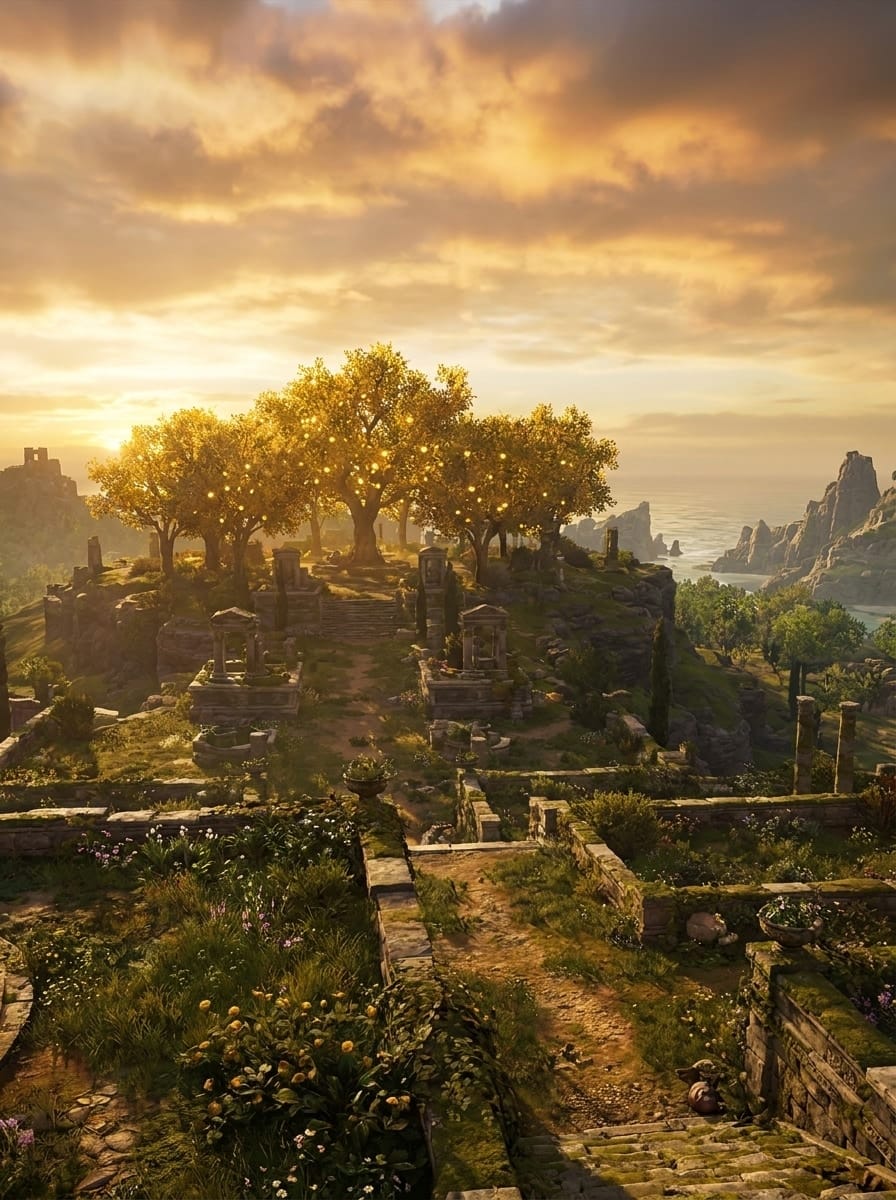
The Garden of the Hesperides is Hera's sacred garden in the far west of Greek myth, where the golden apple tree given to her by Gaia grows. It is an important place in the geography of Heracles' labors because he was ordered to bring back its golden apples.
Overview
Mythic narratives place the garden in the far west, at the edge of the earth, near the end of the sea and the place where night falls. It is closely connected with the place where Atlas holds up the sky. The golden apples are guarded by the Hesperid nymphs, and the dragon Ladon keeps watch beside the tree.
Article
Role in Greek Mythology
The Garden of the Hesperides is first of all Hera's sacred orchard. The golden apple tree came from Gaia's gift at the marriage of Zeus and Hera, so the garden carries the meanings of a wedding gift, a private divine treasure, and a sacred garden at the edge of the gods' world. Its central feature is the golden apple tree, guarded by the nymphs of the evening, the Hesperides, and by the sleepless dragon Ladon.
In the tradition of Heracles' labors, this garden is a place the hero must reach but cannot easily find. Heracles does not know the road to the sacred garden, so he travels westward asking for guidance. From Nereus he learns of the link between Atlas and the golden apples, and from Prometheus he receives the advice not to pick the apples himself, but to have Atlas fetch them. The garden is therefore not an ordinary stop on a journey, but the endpoint of a task shaped by the far western boundary of the world, a sacred tree, and the place where Atlas bears the sky.
Geographical Background
The Garden of the Hesperides is described as a sacred garden in the "far west" and near the "edge of the earth," close to the end of the sea and the direction where night descends. Its location belongs to mythic geography and is not fixed in the story as a single real-world site.
The garden lies beside or near the dwelling place of Atlas. Atlas stands at the edge of the earth holding up the vault of heaven, while his daughters guard the golden apples. Heracles agrees to take Atlas's burden for a time so that Atlas can enter the garden and bring back the apples. This spatial relationship connects the garden with the world's edge, the weight of the sky, and the imagery of western twilight.
Name and Literary Tradition
"Hesperides" refers to the sister nymphs who guard the sacred garden; in the story they are described as goddesses of the evening region. The garden is often named after these nymphs, and it may also be understood as Hera's sacred garden or as the sacred orchard where the golden apples grow. This entry uses "Garden of the Hesperides" because the place is chiefly identified in myth by the tradition of the nymphs guarding the golden apples.
Related Stories
"The Apples of the Hesperides" mentions this place: Eurystheus orders Heracles to travel to the sacred garden in the west and bring back Hera's golden apples. In the story, Heracles learns through Nereus and Prometheus how the garden is connected with Atlas, and in the end has Atlas enter the sacred garden and retrieve the apples for him. Later Athena returns the apples to the nymph-guarded garden.