Greek Mythology
The Cretan Labyrinth — Greek Mythology
The Cretan Labyrinth was the legendary maze built by Daedalus for King Minos of Crete to confine the Minotaur, and later became the perilous setting of Theseus’s descent, victory, and escape with Ariadne’s thread.
Overview
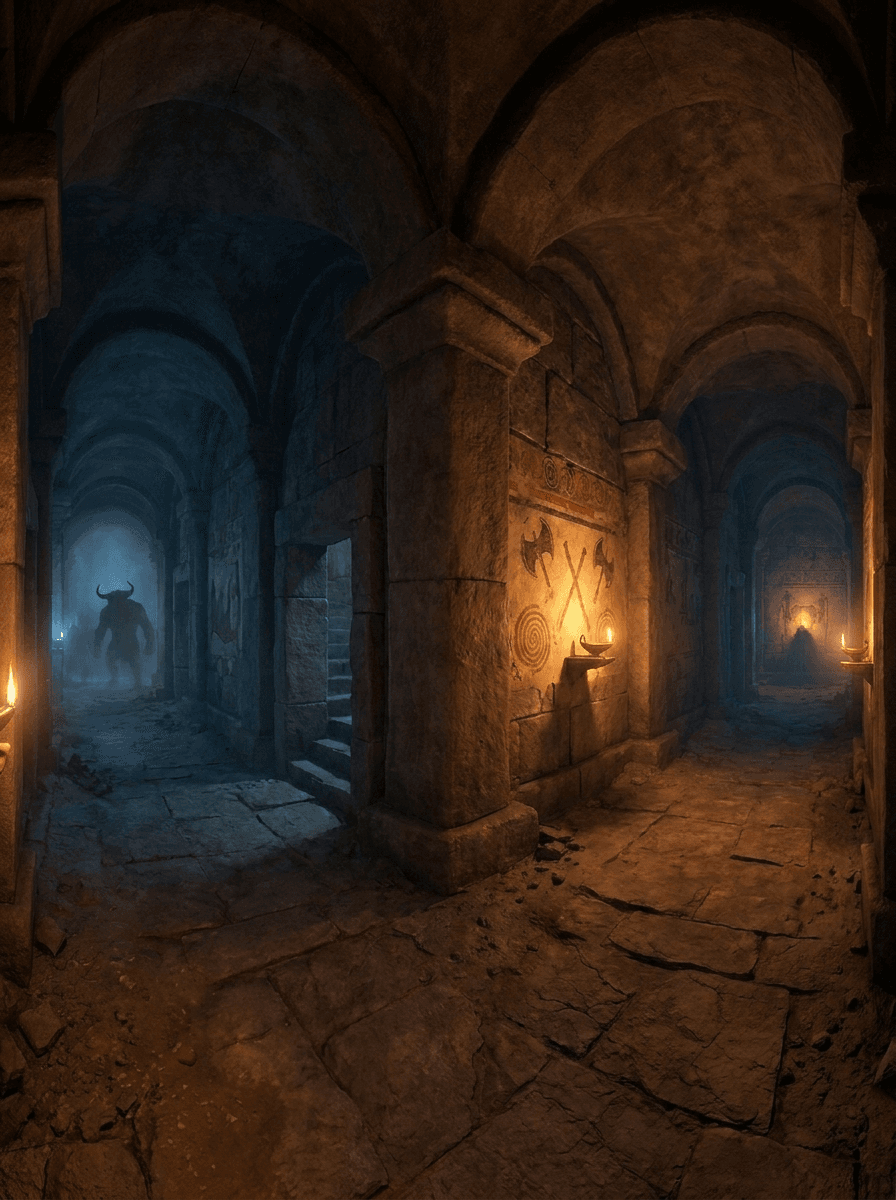
The Cretan Labyrinth is traditionally regarded as having stood on Crete, within the realm of King Minos and closely associated with the palace complex at Knossos. In myth, it lies beneath or near the royal palace, a hidden architectural world designed to confine the Minotaur and to conceal the shame and terror at the heart of the Minoan court.
Article
Place and Mythic Setting
The Cretan Labyrinth belongs to the legendary world of King Minos of Crete. Ancient tradition places it within the orbit of Minos’s palace and royal power: not as an ordinary maze, but as an engineered prison, a hidden architectural marvel, and a threshold between the order of the court and the terror kept beneath it.
Its exact physical location is not fixed by the mythic record. Later imagination often associates it with the palace culture of Crete, especially because the story gathers around Minos, Daedalus, Pasiphae, Ariadne, Theseus, and the Minotaur. In this sense, the Labyrinth is best understood as both a Cretan place and a mythic structure—part palace secret, part sacred horror, part heroic trial.
Daedalus and the Architecture of Entrapment
The Labyrinth was said to have been designed by Daedalus, the master craftsman whose intelligence could turn wood, bronze, stone, and space itself into instruments of wonder. Minos ordered it built to contain the Minotaur, the monstrous child of Pasiphae and the Cretan Bull.
Ancient writers do not present the Labyrinth merely as a tangle of corridors. Its terror lies in design: the path keeps turning back on itself, progress deepens disorientation, and the human sense of direction gradually fails among the repeated windings. Ovid’s tradition especially emphasizes the structure’s bewildering cunning, as though even its maker could scarcely retrace its passages without exceptional care.
The Minotaur at the Center
At the heart of the Labyrinth stands the Minotaur, the creature whose existence exposes the violence, shame, and disorder hidden beneath royal authority. The maze is therefore more than a prison. It is Minos’s attempt to conceal a family catastrophe, a political burden, and a monstrous sign within the seeming stability of Crete.
The center of the Labyrinth is not simply a destination; it is the point where secrecy is forced into confrontation. Whoever enters moves from the public order of kings, ships, and tribute into a deeper, darker interior. There, myth uses architecture to reveal two faces of the same fate: royal power tries to hide the monster, yet also inscribes the path to that monster into the palace’s own hidden structure.
Theseus, Ariadne, and the Thread
The most famous story of the Labyrinth is the exploit of Theseus. With the help of Ariadne’s thread, he entered the maze, reached the Minotaur, and killed it; then he followed the same line back through passages where direction could scarcely be discerned, finding the way out and escaping alive.
The thread gives the episode its lasting symbolic power. Strength alone is not enough in the Labyrinth; Theseus survives because courage is joined to memory, guidance, and trust. Ariadne’s aid transforms a place designed for endless loss into a path that can be entered, endured, and reversed.
Name and Literary Tradition
The word “Labyrinth” has become a general term for any bewildering maze, but in Greek myth it first evokes this specific Cretan structure: the prison of the Minotaur and the stage of Theseus’s decisive trial. For clarity, “The Cretan Labyrinth” better preserves that mythic setting than the broader name “Labyrinth.”
In literary tradition, the Labyrinth is not only a location but an image of difficulty itself. It suggests hidden guilt, royal control, artistic genius, and the terror of losing the way. Plutarch also connects the pattern of the Labyrinth with the Crane Dance performed by Theseus and his companions on Delos after their escape, preserving the idea that the maze’s winding form could be remembered through ritual movement.
Later Imagination and Enduring Meaning
Over time, the Cretan Labyrinth became one of the most enduring symbols inherited from Greek mythology. It can represent imprisonment, initiation, mental confusion, political secrecy, or the dangerous beauty of human craft. Its power comes from the way it binds place and idea together: a building that is also a test, a prison that is also a story, a path that can destroy the lost and reveal the hero.
That enduring richness is why the Labyrinth remains central to the myth of Crete. It gathers many of the tradition’s strongest themes—cleverness and cruelty, secrecy and revelation, monstrosity and heroism—into a single imagined architecture.