Greek Mythology
Colonus — Greek Mythology
Colonus is a sacred grove and sanctuary outside Athens, known in the tradition of Oedipus' late exile as the place where he made his final stop and vanished. Its importance comes from Oedipus' oracular destiny and from the hidden protection Athens gained by receiving him.
Overview
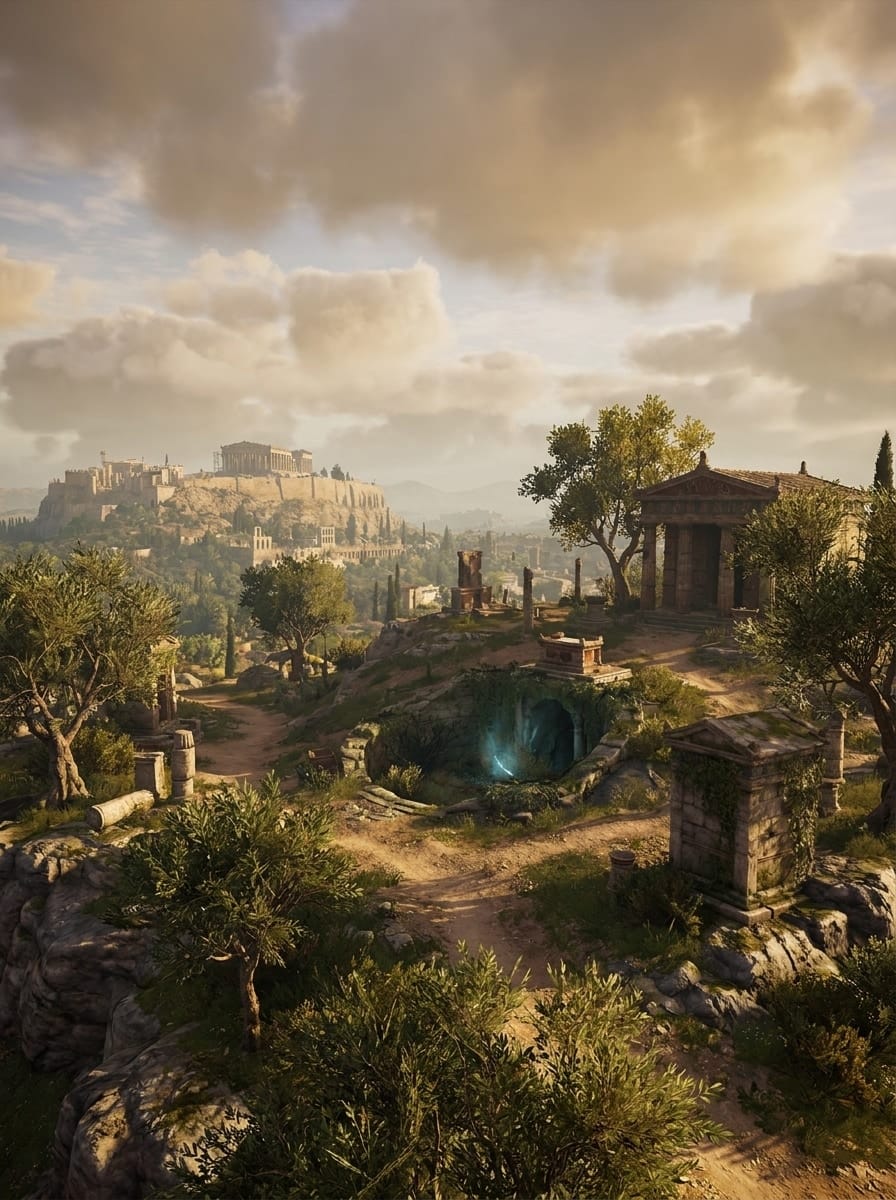
Colonus lies near Athens and is treated as part of Athenian territory, with the city walls visible from a distance in the story. It is described as a quiet suburban sacred grove with slopes, olive trees, the sound of springs, and a road passing nearby, marked by a sense of taboo.
Article
Role in Greek Mythology
In the story of Oedipus' exile, Colonus is not an ordinary resting place but a sanctuary of the dread goddesses. When Oedipus arrives, he recognizes it as the endpoint foretold by the oracle: he will end his life in a place belonging to these goddesses and bring protection to the land that receives him.
Colonus also links the disasters of the Theban royal house with the Athenian tradition of protection and asylum. Creon tries to take Oedipus back to Thebes, and Polynices also comes to seek his father's support, but Oedipus refuses to let his body and the benefit of the oracle be used by Thebes. In the end, he entrusts his final fate to Theseus and Athens.
Geography and Natural Setting
In the story, Colonus stands outside Athens, with slopes, white rock, olive trees, grass, and spring water. The edge of the sacred grove bears signs of ritual use, and the local people believe that outsiders must not enter it freely. Because it also lies near a road, it becomes a meeting place for the exile, local inhabitants, the Athenian king, and figures arriving from Thebes and Argos.
Historical and Religious Landscape
The central religious feature of Colonus is its sacred grove. The local people say it belongs to the dread goddesses, whose names they avoid speaking directly, and they also address them as kindly goddesses. The story also associates the area with sacred precincts of Poseidon and Prometheus. At Colonus, Oedipus asks for purification before death and has Theseus alone accompany him toward the final place; his resting place is made a secret that cannot be publicly identified and is preserved only through the succession of Athenian kingship.
Related Stories
"Oedipus at Colonus" mentions this place: Oedipus receives Theseus' protection here, rejects the demands of Creon and Polynices, and mysteriously dies deep within the sacred grove.
"Oedipus and Antigone in Exile" mentions this place: Colonus is the endpoint reached after Antigone has supported her father through long wandering, and it is where Oedipus leaves his final blessing to Athens.
"Polynices and Eteocles" mentions this place: before attacking Thebes, Polynices comes to Colonus to seek his father's blessing, but instead carries away Oedipus' curse of brother killing brother.
"Antigone" mentions this place: after her father's death at Colonus, Antigone returns to Thebes and is later drawn into the conflict caused by Polynices' burial.