Greek Mythology
Zeus — Greek Mythology
Thunderous God-King of Olympus
Zeus is the son of Cronus and Rhea. Hidden as an infant in a cave on Crete, he later rescued the siblings his father had swallowed, led the new generation of gods in defeating the Titans, received the sky and thunder as his share, and became the god-king of Olympus. He protects oaths, guests, and the order of the gods, but he also brings harsh judgment against arrogance, deceit, and transgression. Behind his majesty there is always a watchfulness born from succession, prophecy, and the fear of disorder.
Domain
Sky, thunder, kingship, oaths, judgment
Symbols
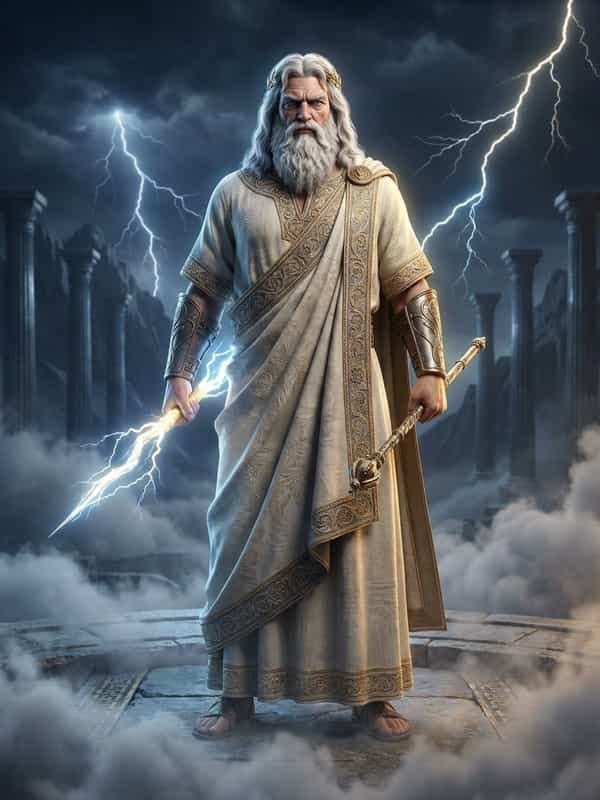
Thunderbolt, eagle, scepter, oak, clouds
Article
Origins and Lineage
Zeus is the son of Cronus and Rhea, and one of the highest-ranking gods among the Twelve Olympians. Fearing that his children would overthrow him, Cronus swallowed each child Rhea bore. With guidance from Gaia and Uranus, Rhea hid her youngest son, Zeus, in a cave on the island of Crete, then tricked her husband by wrapping a stone in swaddling cloth. Zeus therefore grew up concealed in a cave, protected by the goat Amalthea and his guardians, escaping his father’s devouring.
When he came of age, Zeus was no longer merely a hidden infant; he returned actively to the center of divine conflict. He found a way to make Cronus disgorge Hestia, Demeter, Hera, Hades, and Poseidon, whom he had swallowed, and he also freed the imprisoned Cyclopes and Hundred-Handers. The Cyclopes forged thunder, lightning, and the thunderbolt for him, while the Hundred-Handers crushed the old gods beneath a storm of stones. After the Titanomachy ended, Cronus and the rebellious Titans were confined in Tartarus, and Zeus rose to the position of the new god-king.
Divine Roles and Attributes
Zeus’s divine office is not limited to being “god of the sky.” More broadly, he represents the sky, thunder, kingship, oaths, guest-order, and divine judgment. As god-king, he must preserve the honors allotted among the gods, and he must also ensure that oaths and the laws of hospitality among mortals are not treated lightly. In his hands, thunder is not only a weapon but also the language of order: when people cross boundaries, commit sacrilege, break oaths, or test the gods through cunning, Zeus often answers with lightning and judgment.
At the same time, Zeus is always marked by wariness toward prophecy and succession. He has seen firsthand how his grandfather’s generation, his father’s generation, and his own generation overthrew one another in a cycle of power, so he never dismisses future threats. This alertness makes him seem cautious, forceful, and often guarded; he is not a benevolent king without shadows, but a ruler who has lived through the fear of inheritance.
Major Myths
The central myths of Zeus include rescuing his siblings, leading the Titanomachy, dividing the world, and establishing the Olympian order. He, Poseidon, and Hades drew lots to divide the sky, the sea, and the underworld, giving the divine world clear boundaries of authority. Afterward, he settled the gods on Mount Olympus, moving the divine family from wartime chaos into a relatively stable hierarchy.
Many of his stories concern judgment and transgression. Lycaon deliberately tested him with human flesh; when Zeus saw through the crime, he overturned the banquet, burned the palace, and transformed Lycaon into a wolf, showing how sternly he defends guest-law and human order. The battle with Typhon, meanwhile, highlights his endurance: Typhon once tore away his sinews and imprisoned him in a cave, but with Hermes’ help Zeus recovered his strength, pursued the monster again with thunder, and finally pinned Typhon beneath Mount Etna.
He also changes the destinies of others because of prophecy. Zeus swallowed the pregnant Metis, trying to prevent the birth of a son who would one day threaten his throne; after learning that Thetis’s son would become stronger than his father, he married her to the mortal Peleus. Such stories reveal a complex sense of power in Zeus: he is both the defender of order and the one most afraid that order will be broken by the next generation.
Worship and Influence
Zeus was widely worshiped throughout the Greek world, often appearing under titles such as Olympian Zeus, Zeus Ktesios, Zeus Horkios, and many local epithets, associated in different ways with kingship, the household, oaths, protection of guests, and sacred order. For Greek city-states, Zeus was often the supreme witness to sworn promises, alliances, legitimate rule, and public order. People swore oaths to him before altars, and they also called on his protection during state festivals and political acts.
His influence on later culture is profound. Zeus is both the archetype of the “highest god” and “lord of thunder,” and a concentrated expression of how the classical world imagined power, patriarchy, judgment, and sacred order. Although the later Roman Jupiter corresponds to him, Zeus in the Greek tradition retains a sharper mythic cycle of succession, royal replacement, and the shadow of judgment.
Character Overview
Zeus should appear majestic, stable, and oppressive in presence. He is not simply a kindly old king, nor merely a tyrant who only knows how to rage, but a god-king who rules the order above and remains constantly alert to disorder. Visually, he can be built around thunder, clouds, the eagle, the scepter, and a high mountain throne; emotionally, he should carry the double pressure of someone who “can be merciful, and can also judge at once.” His authority comes from victory, but also from a deep memory of being overthrown.