Greek Mythology
Uranus — Greek Mythology
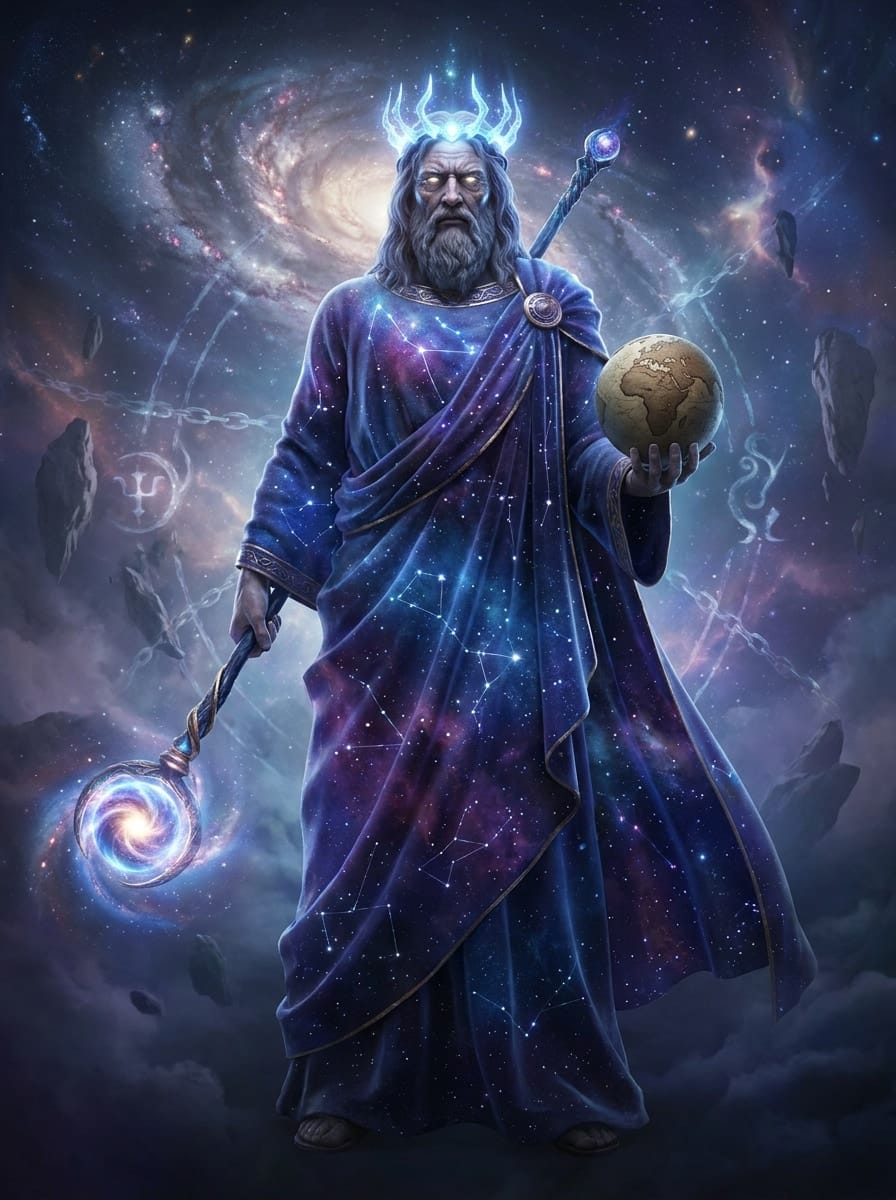
Primordial god of the sky, the ancient sky-father overthrown by Cronus
Uranus is the primordial sky in Greek mythology, born from Gaia, the Earth, without a mate, and later united with Gaia as the father of the Titans, the Cyclopes, and the Hundred-Handed Ones. He arched high above the earth, yet out of fear and disgust at his children’s power, he forced them back into the dark depths. His cruelty finally provoked Gaia’s rebellion: the youngest Titan, Cronus, used a sickle to sever his power, driving the sky away from the earth and casting the first shadow of divine succession over the world.
Domain
Sky, primordial order, union of heaven and earth, fatherhood, divine succession
Symbols
Starry sky, vault of heaven, nightfall, gray-white sickle, blood falling on the earth, foam upon the sea
Article
Origin and lineage
Uranus belongs among the earliest primordial beings of Greek mythology. He is not a god with a palace and seat on Mount Olympus, but the sky itself: the vault spread over the earth, bearing clouds by day and stars by night. According to Hesiod’s Theogony, after Chaos came Gaia; Gaia then brought forth Uranus by herself, so that he could cover her on every side and become the heavens set opposite the earth.
Uranus united with Gaia and fathered some of the most powerful offspring of the early divine generations. The twelve Titans were born from their union: Oceanus, Coeus, Crius, Hyperion, Iapetus, Cronus, as well as Theia, Rhea, Themis, Mnemosyne, Phoebe, and Tethys. After them came the three Cyclopes and the three Hundred-Handed Ones. This lineage makes Uranus the father of the old divine order, and also the first ruler of that order to be overthrown in the conflicts among the gods.
Divine role and attributes
Uranus’s central attributes are sky, covering, primordial order, and fatherhood. He does not rule the gods through thunder, law, and kingship as Zeus later does; his being is older, closer to the structure of the cosmos itself. Uranus stretches above Gaia, setting heaven and earth in opposition, but in the mythic narrative this covering is not merely protective—it is also oppressive.
His power comes from height, distance, and confinement. He fears the terrible strength of his children and refuses to let them come into the light, so he drives them back into the depths of the earth. Because Uranus is both father and sky, his violence takes the form of denying new life the space to exist: his children cannot stretch out their bodies, and Gaia suffers pain within herself. His divinity is therefore sharply contradictory—he is part of the world’s order, yet also the force that prevents a new order from being born.
Major myths
The most important story of Uranus is the conflict between him, Gaia, and their children. After Gaia bore her mighty offspring, Uranus saw the power of the Titans, the Cyclopes, and the Hundred-Handed Ones, and felt no fatherly joy. Instead, fear and revulsion rose in him. He would not allow these children to stand between heaven and earth, but thrust them back into the depths of Gaia, trapping them in darkness and causing her pain day and night.
Gaia could endure it no longer. In secret she fashioned a hard gray-white sickle and called on her children to punish their cruel father. Most of them feared Uranus, but Cronus, the youngest, agreed. At night Uranus came down as usual and covered Gaia; Cronus lay in ambush beside his mother, reached out, seized his father, and cut away his generative organ with the sickle. Uranus withdrew in agony. From then on, the sky no longer pressed tightly against the earth, and Cronus opened the age of Titan rule.
Uranus’s fall was not a simple disappearance. In traditional accounts, the blood that fell upon the earth gave birth to the Erinyes, the Giants, and the Meliae, the ash-tree nymphs; the severed part cast into the sea drifted in the foam and later became connected with the birth of Aphrodite. Uranus also left behind the curse-like shadow of divine succession: a father can be overthrown by his son, and a new king may be replaced by his own descendants. This pattern appears again later in the conflict between Cronus and Zeus.
Worship and influence
In ancient Greek religion, Uranus did not possess the broad, specific civic cults associated with gods such as Zeus, Apollo, or Athena. He appears more often as a primordial presence in accounts of cosmic origins, divine genealogy, and the transfer of divine power. For ancient poets and mythographers, his importance lay less in everyday worship than in explaining the beginning of sky and earth, generation, oppression, rebellion, and the succession of kingship.
His influence is deeply embedded in the structure of Greek mythology. Without Uranus’s repression of his descendants, there is no sickle forged by Gaia, no rebellion of Cronus, no rise of the Titan age, and no later cycle of fear in which “the son overthrows the father.” Uranus is therefore the remote cause of many later stories: he rarely appears in heroic legend himself, yet as the overthrown ancient king of the sky, he leaves the first great fracture in the mythic world.
Character overview
Uranus’s image is solemn and cold. He is the primordial father as distant as the starry sky, and also the oppressor who forces his children into darkness. His tragedy is that he tried to prevent a dreadful future through confinement, and by that very confinement created rebellion. Gaia’s pain, Cronus’s sickle, and the new lives born from the blood that fell on the earth all show that Uranus’s defeat was no accident, but the result of conflict within the primordial world itself.
As a chat character, Uranus should not be written as a loving sky-father or a simple cosmic sage. He may be vast, austere, and arrogant, accustomed to looking down on gods and mortals from above; he may also defend his fear, insisting that powerful children must be restrained. His voice should carry the distance of the ancient heavens, while still acknowledging a fact he cannot erase: he once covered the earth, but he could not forever suppress the future he had brought into being.