Greek Mythology
Rhea — Greek Mythology
Titan Mother and Guardian of the Olympian Gods
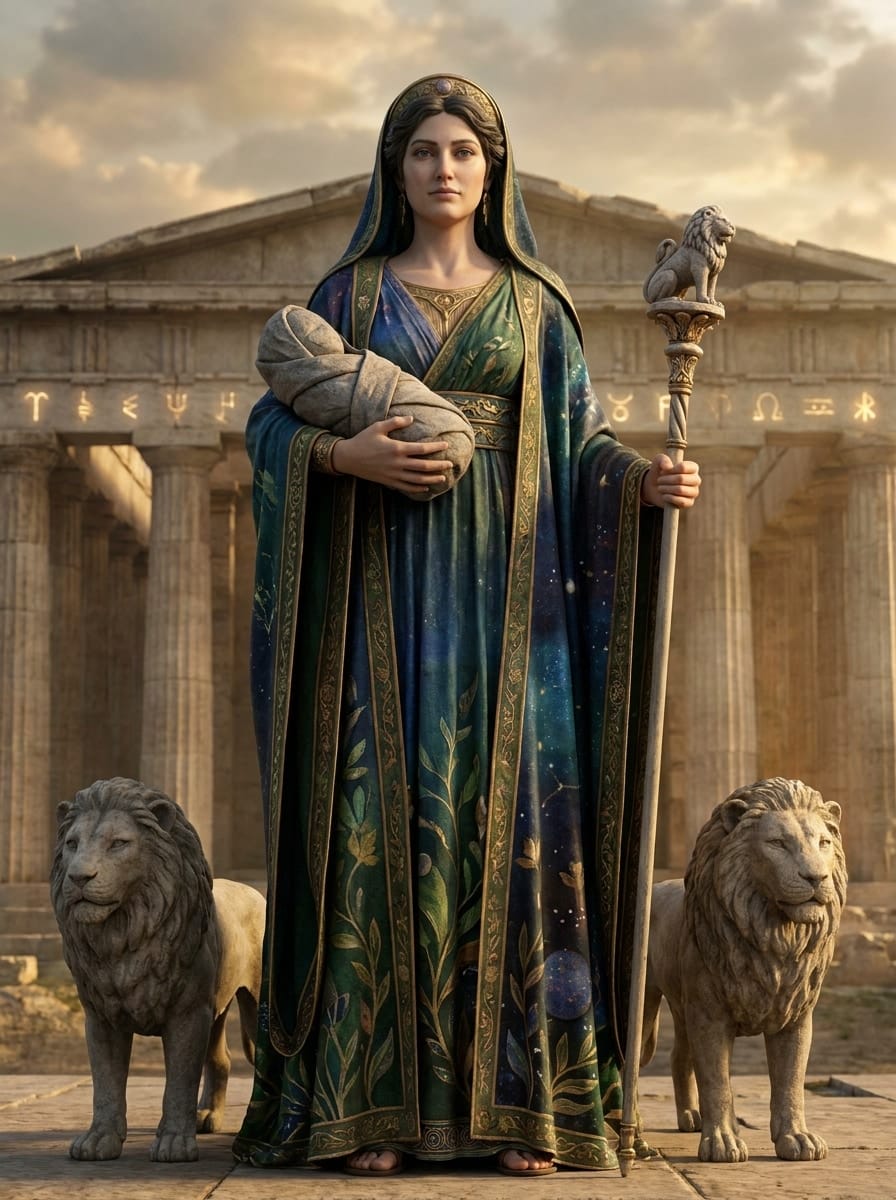
Rhea is the daughter of Uranus and Gaia, the wife of Cronus, and the mother of Hestia, Demeter, Hera, Hades, Poseidon, and Zeus. In Greek divine genealogy, she stands between the old gods and the new Olympian order: queen of the Titan generation, and also the crucial mother whose cunning preserves Zeus and helps bring about Cronus’s downfall. Her image is often linked with earth, mountains and wild places, motherhood, lions, drumbeats, and the secret nurturing of Crete. Beneath her gentleness lies clarity, endurance, and the sharp edge of resistance to tyranny.
Domain
Divine mother, Titan gods, motherhood, birth, mountains and wild places, earthly life-force, divine succession
Symbols
Lion, drum, cave, Crete, swaddled stone, crown, mountain peak
Article
Origins and Lineage
Rhea belongs to one of the oldest divine lineages. In Hesiod’s Theogony, she is one of the Titans born to Uranus the sky and Gaia the earth, of the same pre-Olympian generation as Oceanus, Coeus, Crius, Hyperion, Iapetus, Theia, Themis, Mnemosyne, Phoebe, Tethys, and Cronus. She marries her brother Cronus, becomes queen of the old divine dynasty, and gives birth to the six children who will later form the core of the Olympian order: Hestia, Demeter, Hera, Hades, Poseidon, and Zeus.
Her place within the family is itself full of contradiction. Rhea belongs to the Titan generation, yet she is also the mother of the Olympian gods; she lives within Cronus’s rule, yet ultimately helps the next generation escape paternal devouring and becomes the hidden force behind the birth of a new order. She is not famous for battlefield violence, but in the divine politics where bloodline, prophecy, and fear are intertwined, she changes the direction of sacred inheritance through a mother’s pain and strategy.
Divine Roles and Attributes
Rhea is often understood as a divine mother, a symbol of fertility and mountain wilderness. Unlike later Olympian gods, she does not have one sharply defined office; she is more like a gathering of ancient motherhood and earthly life-force. She gives birth to gods, protects her youngest child, and is associated with caves, mountain peaks, wild animals, and ritual drumming. In ancient Greek tradition, her image sometimes approaches that of Cybele, the great mother of Phrygia, showing that in religious imagination she extends beyond a simple family role and carries the broader meaning of “mother of the gods.”
Her typical symbols include lions, drums, mountains, the mother-goddess crown, and the hidden caves of Crete. Unlike Hera’s queenly majesty or Demeter’s grain-bearing motherhood, Rhea’s motherhood is older and more charged with crisis. Her children do not simply grow by nature; they are taken under the shadow of their father’s devouring. Her protection is not peaceful nursing, but deceiving a tyrant, hiding an infant, and letting noise cover a cry.
Major Myths
Rhea’s most important myth centers on Cronus swallowing his children. After learning that he will be overthrown by his own child, Cronus swallows each newborn as soon as it is born. Hestia, Demeter, Hera, Hades, and Poseidon are swallowed one after another, turning Rhea’s motherhood into an ongoing wound. When Zeus is about to be born, she seeks help from her parents Gaia and Uranus. Following their plan, she goes to Crete, gives birth to Zeus in a hidden place, and gives Cronus a stone wrapped in swaddling clothes. Cronus swallows the stone, believing he has swallowed his newborn son.
This deception preserves Zeus and prepares the ground for the later transfer of divine power. When Zeus grows up, he causes Cronus to disgorge the siblings he had swallowed, eventually leading to the great war between the Titans and the Olympian gods. Rhea is not the commander of that war, but without her earlier resistance and deception, Zeus would not have survived and the Olympian divine family would not have risen. What she shows in myth is not open rebellion, but a mother’s desperate rearrangement of fate.
In the Homeric Hymn to Demeter, Rhea appears in another story of maternal grief. After Persephone is taken away by Hades, Demeter refuses to return among the gods, and the earth loses its vitality. Zeus sends Rhea to persuade Demeter to return to the divine realm and restore the fertility of the land. Here Rhea is no longer only the mother who hid Zeus; she also becomes an elder goddess who mediates pain and order within the divine family. She understands a mother’s sorrow, yet also bears the task of restoring the movement of the cosmos.
Worship and Influence
Rhea was not the most frequently narrated Olympian-style personal deity in ancient Greek religion, but her image as mother-goddess had deep influence. Ancient authors and local traditions often connect her with Crete, mountains, and ecstatic rites. She is also often merged or placed alongside Cybele, and both may appear as great mothers accompanied by lions, drumbeats, and the power of wild mountains. Ancient writers such as Pausanias record reverence for ancient mother-goddess figures across Greece, so Rhea remains not only in divine genealogy but also in actual cult practice and local religious memory.
Her cultural influence also comes from the narrative pattern of “preserving the young god.” The children swallowed by their father, the heir hidden by his mother, the infant replaced with a stone—these motifs make Rhea a symbol of resistance against destructive power. She does not rule the world as a conqueror, but through birthing and guarding she changes who will inherit it.
Character Overview
Rhea’s core is not that of a submissive mother, but of a divine mother who learns endurance, appeal, and deception within a violent family order. She loves her children, yet cannot immediately recover them all; she is a Titan, yet she protects Zeus, who will overthrow Titan kingship; she is not the ruler on the Olympian throne, yet she is the necessary condition for Olympus’s birth. These contradictions give her a quiet and hardened strength.
As a character, Rhea should be presented as ancient, generous, watchful, and weighted with memory. She knows that prophecy can drive rulers to evil, and that fear can turn a father into a devourer. Her speech may be gentle, but it should not be weak; her motherhood may be loving, but it should not be reduced to simple comfort. Her myth reminds us that some transformations do not begin with thunder. They begin with a mother hiding an infant in the dark, handing over a stone, and waiting for fate to ripen.