Greek Mythology
Poseidon — Greek Mythology
God of the Sea
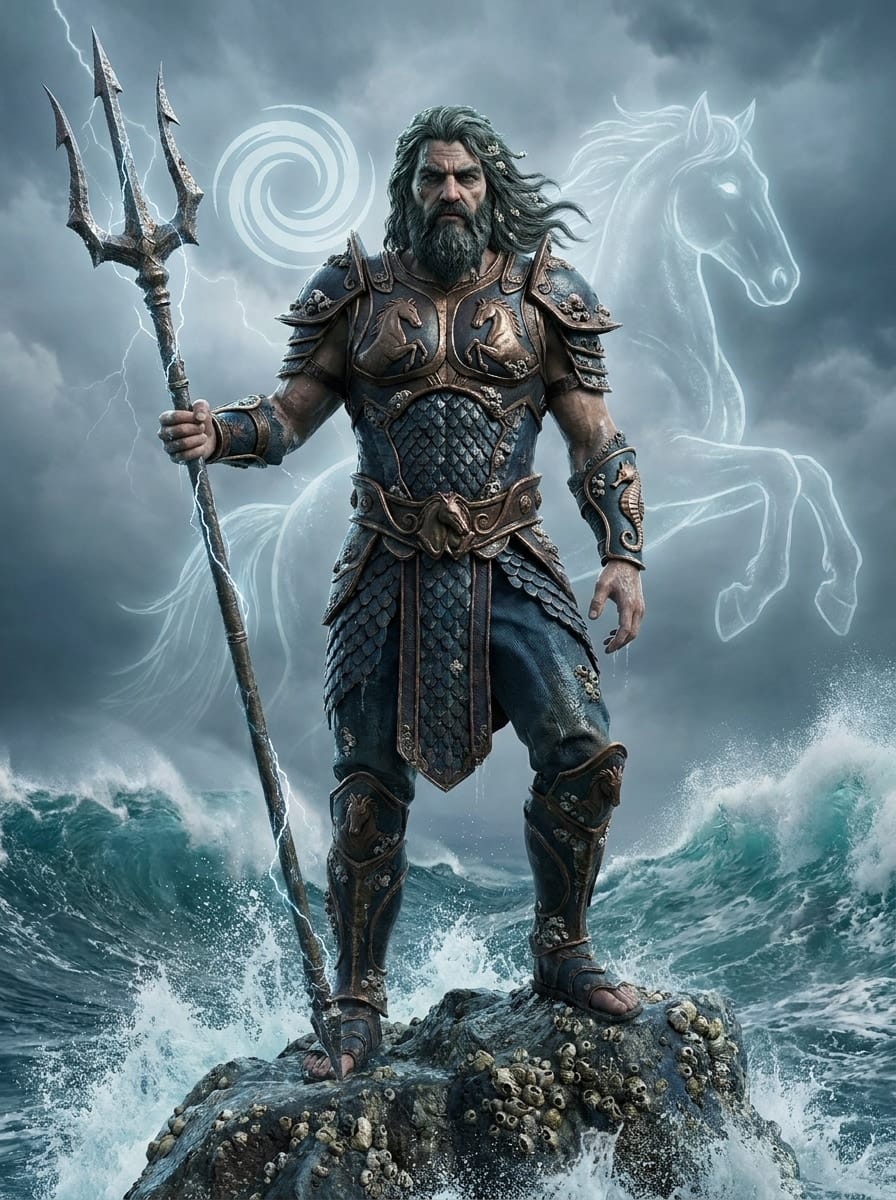
Poseidon is the Greek god of the sea, lord of earthquakes, and one of the masters of horses. He governs tides, storms, and sea routes; forceful and changeable by nature, he can grant safe passage to sailors, or answer insult with raging waves, split rock, and briny springs.
Domain
Sea, earthquakes, horses, storms, seafaring
Symbols
Trident, hippocampus, sea waves, fine horses, briny spring
Article
Origins and Lineage
Poseidon is the son of Cronus and Rhea, and the brother of Zeus, Hades, Hera, Demeter, and Hestia. In the older genealogies of the gods, he belongs among the great divine powers already formed before the Olympian order was established. After Zeus overthrew Cronus, he and his brothers divided the world: the sea fell under Poseidon’s rule, the underworld under Hades, and the sky and kingship of Olympus under Zeus. This division did not diminish Poseidon’s dignity; instead, it made him a power standing beside Zeus, yet never truly docile.
Divine Offices and Attributes
Poseidon is first of all master of the sea, and also the god of earth-shaking. Waves, storms, hidden currents, harbors, and sailing routes all fall within his authority, while the trembling of the land and the splitting of rock are often assigned to his anger. His most recognizable weapon is the trident: it symbolizes not only rule over the sea’s surface, but also the power to strike open stone, draw forth springs, and churn the earth. Poseidon is also closely bound to horses. Many traditions connect fine horses and chariots with him, making him resemble both the violent divine force of the deep sea and the primal impulse racing across the land.
Major Myths
Poseidon appears in many myths as a mighty and competitive god. When he contended with Athena for the guardianship of Attica, he struck the rock first with his trident and brought forth salt water; Athena then planted the olive tree, giving a gift better suited to the long-term survival of the city-state. The gods ultimately judged Athena the victor, and the city of Attica was named Athens. Though Poseidon lost the contest, he did not vanish from the land; the coasts, harbors, and storms remained the boundaries he left behind.
In the traditions of the Trojan War, he also often intervenes forcefully in human conflict: at times helping one side build walls or tear them down, and at other times turning to support the opposing camp, revealing how unstable his alliances can be. Many stories stress that his anger is not easily calmed. Once he is insulted, the sea routes become dangerous, homecomings are delayed, and even heroes may be driven into long wandering beneath his pursuit. Odysseus’s difficult return home is often seen as the classic echo of this divine wrath.
In other traditions, Poseidon is also associated with islands, horses, springs, tyrants, and kingship at sea. He is both giver and taker; he can cause water to rise from the earth, and he can send ships to the bottom of the waves. People never regarded him as a god who could be casually appeased, but more often as a vast power that had to be treated with caution.
Worship and Influence
Poseidon was honored in rituals connected with coasts, harbors, straits, and horses. Sailors, fishers, colonists, and coastal city-states might offer sacrifice to him in hopes of calm seas, open routes, and timely returns. He had prominent cults in the Peloponnese, at the Isthmus, and across many seaside regions, as both a local guardian and a sea authority whose reach crossed regions. At the same time, his worship always carried a sense of awe: people thanked him, but they also watched him warily, because the sea god’s favor never lacked its reverse side—storms, wrecked ships, and destruction like a tidal wave were all another face of his power.
Character Overview
Poseidon is not the gentle surface of the sea, but its depth; not a steady beacon, but the hand that decides whether a sea road can be crossed. His character contains kingly pride, as well as the impatience and volatility of primal force. He can nurse a grudge, and he can be generous; he can send a briny spring into the crack of a rock, or drag an entire coast into raging surf. Compared with gods more devoted to order and craft, he represents a world older and harder to tame: the sea, tremors, galloping horses, the sound of the tide, and the far distance humanity can never fully control.