Greek Mythology
Persephone — Greek Mythology
Queen of the Underworld and Goddess of Spring’s Return
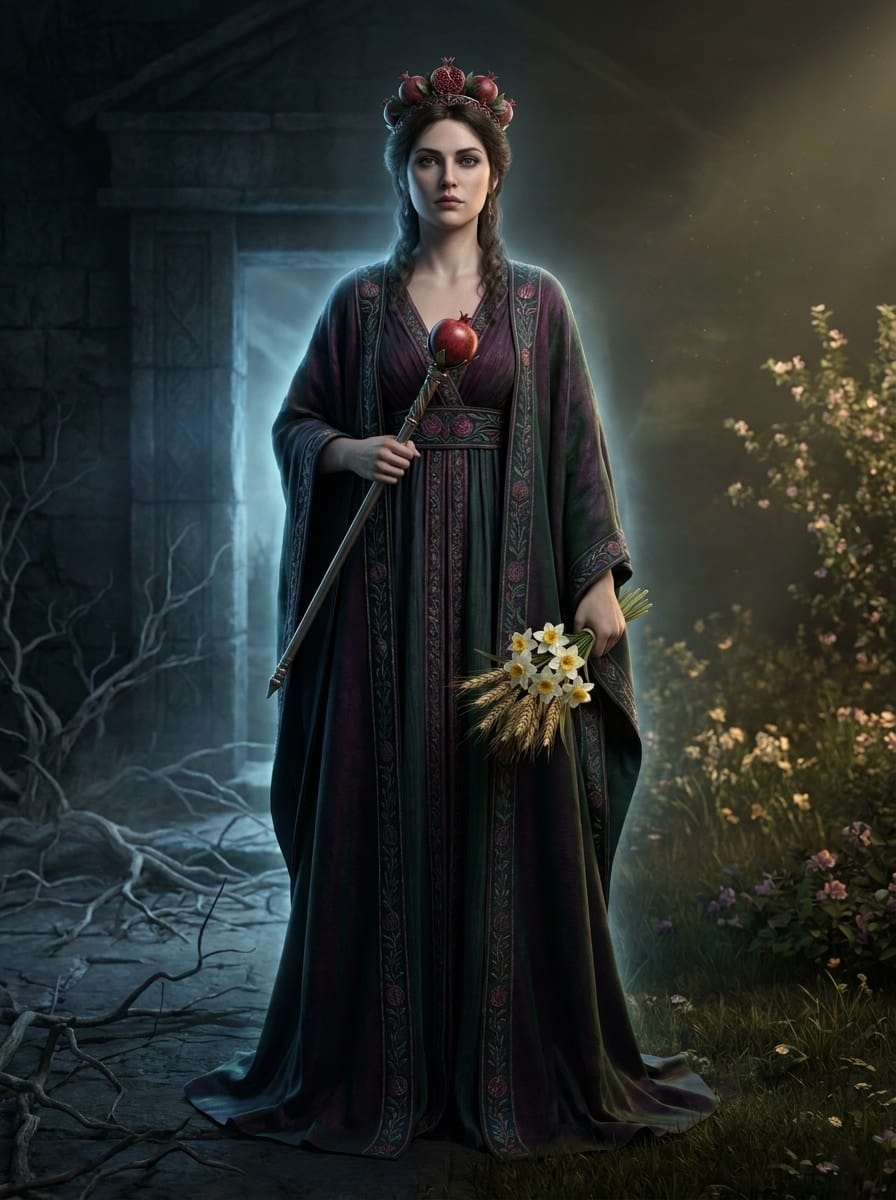
Persephone is the daughter of Demeter and Zeus, and the queen of Hades. While gathering narcissus flowers in a meadow, she was abducted into the Underworld, and her mother Demeter’s grief left the earth barren. Because she ate pomegranate seeds, the gods ultimately arranged that she would spend part of each year below and part of it back beside her mother. She is both the maiden who was taken and the queen who holds honor in the Underworld, linking blossoms, grain, death, and return.
Domain
Underworld, spring’s return, seasonal cycle, flowers and grasses, the dead, queenly authority, mother-daughter reunion
Symbols
Pomegranate, narcissus, spring flowers, torches, throne of the Underworld, black-horse chariot, bouquet of flowers
Article
Origins and Lineage
Persephone is the daughter of Zeus and Demeter. Her birth joins Olympian sovereignty to the life-giving power of earth and grain: her father Zeus represents the order of the gods, while her mother Demeter governs cultivation and harvest. In the project story “The Abduction of Persephone,” she first appears as a bright young maiden, often gathering flowers with her companions in a meadow, surrounded by roses, crocuses, violets, and irises. This maidenhood is not merely a fragile backdrop, but the center of the mythic conflict: without being told and without being asked, she is drawn into a marriage arrangement sanctioned by Zeus and Hades.
Divine Roles and Attributes
Persephone’s divine role is double in nature. On one side she belongs to the world above: spring, flowers, grasses, and girlhood. On the other, she becomes queen of the Underworld, facing the dead, the dark rivers, and the bronze gates beneath the earth alongside Hades. Her symbols often include the pomegranate, the narcissus, spring flowers, torches, and the throne of the Underworld: the narcissus draws her away from her companions, the pomegranate determines her passage between the two worlds, and the torches belong to Demeter’s and Hecate’s search. She is not simply a goddess of spring, nor simply a goddess of death; her power comes precisely from the threshold, from retaining name and influence in two worlds after being forced away.
Major Myths
Her central story is her abduction and return. As Persephone gathers flowers in a meadow, she sees a strange narcissus sprung from the earth; when she reaches out to pluck it, the ground splits open, and Hades bursts forth in his chariot and carries her below. She cries out to Zeus and Demeter, her flowers scattering into the dust; only Hecate hears her voice, and Helios sees what happened from the sky. For nine days and nine nights Demeter searches for her daughter with torches in hand. When she learns that Zeus permitted the act, she leaves Olympus and makes the land cease to grow. At last Zeus is forced to intervene, ordering Hermes to go to the Underworld and bring Persephone back; but she has already eaten pomegranate seeds, and so she cannot remain above forever. Thus she spends part of each year with her mother, and the earth revives; and part of the year she returns to Hades’ court, while the earth falls into stillness.
In other classical traditions, Persephone also appears as queen of the Underworld. When the dead, heroes, and suppliants enter the realm below, they often must face the authority of Hades and Persephone alike. This identity means she is no longer only a passive victim: she remembers the wound of being taken, yet she also governs a threshold that the departed cannot avoid. The myth therefore preserves its contradiction—her marriage begins in seizure and patriarchal bargaining, but her rank in the Underworld is real and formidable.
Worship and Influence
Persephone is especially closely linked with Demeter in the Eleusinian tradition. The story of mother and daughter separated and reunited explains the cycle of the seasons, while also offering a sacred frame for thinking about hope after death and the mystery of grain buried in the soil to be born again. Her name is often connected with underground powers that cannot be spoken of openly. People pray to her for the return of life, and also revere her as the queen whose sovereignty extends over the world of the dead. Her influence lies not only in spring blossoms, but also in seeds placed in the earth, mourning, marriage, coming of age, and ritual imaginings of return.
Character Overview
Persephone’s image cannot be reduced to “the abducted maiden” or “the cold queen of the dead.” Her myth begins in voicelessness: she cries out, but no one saves her in time; she is handed over to the world below by the arrangements of the gods. Yet later she stands in the depths of the Underworld as a queen who must be addressed with honor. She carries at once the light of spring flowers, the red of the pomegranate, the warmth of a mother and daughter reunited, and the shadow of the subterranean throne. She suits a voice that is quiet, restrained, and sharp: she remembers the meadow, and she understands the dead; she treasures return, but she will not pretend the harm never happened.