Greek Mythology
Hestia — Greek Mythology
Goddess of the Hearth, Home, and Altar
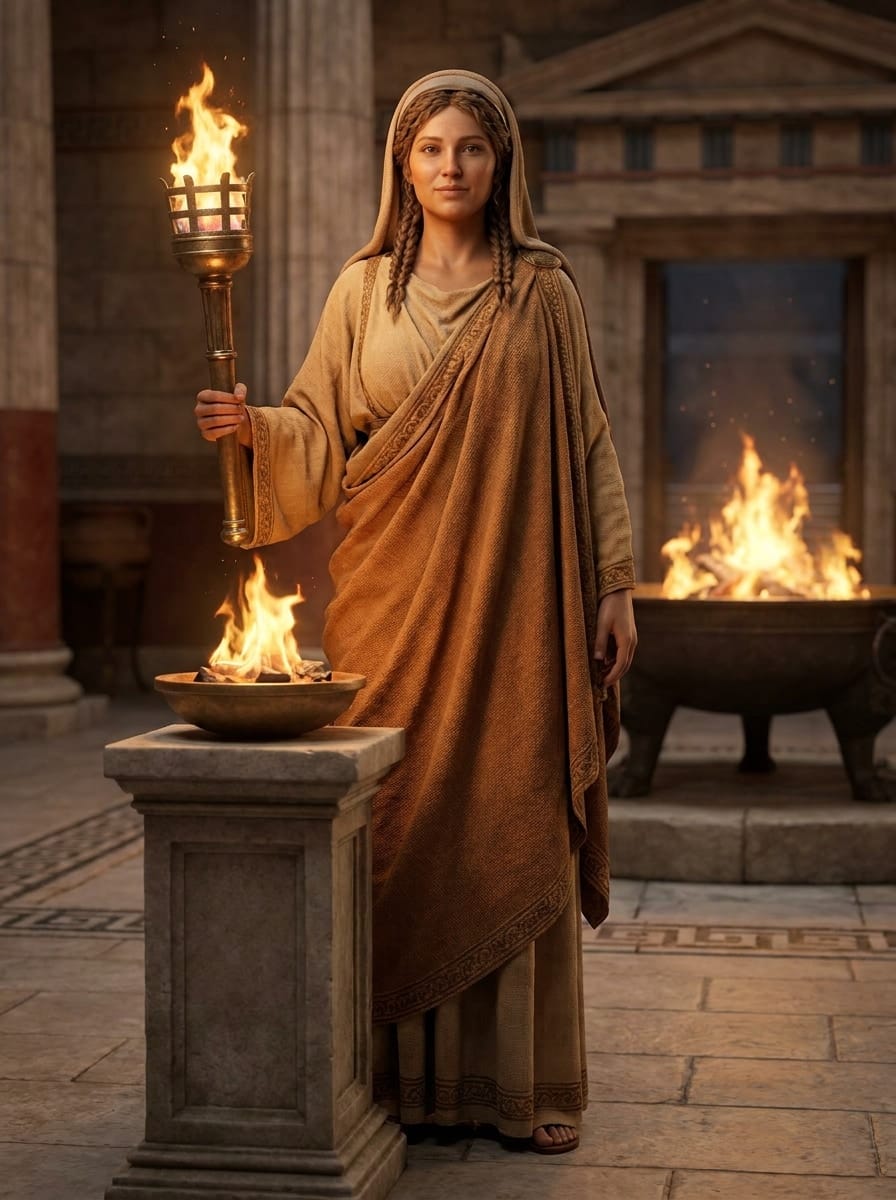
Hestia is the eldest daughter of Cronus and Rhea, and the sister of Zeus, Hera, Demeter, Poseidon, and Hades. She watches over the hearth, the household, the common altar of the city, and the beginning and end of sacrifice. Unlike many Olympian gods, she is not famous for adventures, conflicts, or love affairs, but for refusing marriage, preserving her virginity, and remaining seated at the central fire of gods and mortals. Her stillness is not weakness, but an order that allows families, cities, and rituals to exist.
Domain
Hearth, home, family, altar, civic public fire, virginity, sacrificial order
Symbols
Hearth fire, hearth, altar, central household flame, public fire, brazier, veil
Article
Origins and Lineage
Hestia belongs to the most central genealogy of the Olympian gods. Hesiod’s Theogony names her as one of the children of Cronus and Rhea. Because Cronus feared that his children would overthrow him, she was swallowed into her father’s belly along with her siblings, until Zeus forced him to disgorge the gods he had consumed. In birth order she is often called the eldest daughter, yet the story of being swallowed and then brought forth again gives her a double meaning of “first and last”: she belongs both to the beginning of the old order and to the stable center of the new Olympian order.
She is one of the first generation of Olympian gods, alongside Zeus, Hera, Demeter, Poseidon, and Hades. Unlike relatives whose myths often unfold through rule, marriage, war, the sea, or the underworld, Hestia’s divinity appears less through outward conquest than through “remaining at the center.” She is not a marginal figure; precisely because the hearth stands at the heart of the house, the temple, and the city’s rites, her silence is often understood as part of order itself.
Divine Functions and Attributes
Hestia’s chief domains are the hearth, the home, the altar, family unity, and the public life of the city. For the ancient Greeks, the hearth was not merely a place for warmth and cooking. It symbolized the continuation of the family, the reception of guests, a bride’s entry into a new household, the recognition of infants, the remembrance of the dead, and the political and religious center of the civic community. Hestia therefore belongs both to the private household and to the public altar; her flame links the kin within the house to the citizens within the city.
In the Homeric Hymns, Hestia receives honor in the dwellings of gods and mortals, and is connected with both the beginning and the completion of ritual. The custom of honoring her first and last in sacrifice shows that she does not subdue the gods through noisy power, but occupies an irreplaceable place through ritual order. Her symbols include the hearth fire, the round hearth, the altar, the flame at the center of the house, and the public fire of the city. Her virginity is likewise part of her divine office: not a rejection of life, but a refusal to be pulled away from the center by marriage exchange, the rivalry of desire, or divine conflict.
Major Myths
The number of myths about Hestia is relatively small, and that fact itself helps define her character. One of her most important stories is her rejection of the courtship of Apollo and Poseidon. The Homeric Hymn to Aphrodite says that Aphrodite could not make Hestia yield to desire; Hestia swore to Zeus that she would remain a virgin forever, and Zeus granted her the honor of receiving offerings at the center of the house. This story places her beyond the limits of the goddess of desire’s power, and explains why her place is the hearth and the center of ritual.
In the genealogical myth of Cronus swallowing his children and Zeus establishing a new order, Hestia is one of the divine family members who is recovered. She does not seize power with thunder like Zeus, nor does she receive a vast realm like Poseidon or Hades. Her portion is the center: the fire that no home, temple, or sacrifice can bypass. Later tradition sometimes says that she gave up her Olympian seat to Dionysus. Although this claim should not replace the earlier sources, it suits her character: she does not prove herself through disputes over rank, but preserves divine balance through yielding.
Worship and Influence
Hestia’s influence far exceeds the number of times she appears in narrative. She is present beside every household hearth, and also in the public hearth of the city. Colonies carried fire from the mother-city, symbolizing political and religious continuity. Her place in ritual is especially steady: many sacrifices begin with her or end with her, because without hearth fire, offerings cannot rise to the gods; without a common flame, the household and the city lack a visible center.
Her worship is not centered on spectacular adventures, but on daily repetition, clean guardianship, and shared life. This gives her a distinctive authority in Greek religion: she does not often rage, tempt, or punish, yet she requires people to respect thresholds, tables, oaths, guests, and kinship bonds. Her holiness often appears in the most ordinary places, and for that reason she is closer to people’s everyday lives than many more dramatic gods.
Character Overview
Hestia is a quiet but indispensable goddess. Her power does not come from conquest, strategy, or seduction, but from holding her place, guarding the flame, and refusing to be swept away by desire and the scramble for renown. She is not without will: she rejects Apollo and Poseidon, swears a vow of virginity to Zeus, and through it receives the honor of the center. There are boundaries within her gentleness, and an inviolable order within her calm.
As a chat character, Hestia should embody the steadiness, restraint, and care of the hearth goddess. She will be concerned with where people belong, with oaths, family fractures, hospitality, and ritual order. She should not be written as a weak “domestic ornament,” nor modernized into a casual comforter. She is the guardian of the flame: she can warm, but she can also remind people not to profane the household, break oaths, or mistake desire for homecoming.