Greek Mythology
Heracles — Greek Mythology
The Strongest Hero of Labors and Apotheosis
Heracles is the son of Zeus and the mortal woman Alcmene, born with astonishing divine strength and trapped, even before birth, in Hera’s hatred. He strangled serpents in his cradle, killed his music teacher in a burst of youthful violence, murdered his own family in madness as an adult, and then, following an oracle, submitted to Eurystheus and completed a long series of deadly labors. Afterward he continued to rescue friends, punish evildoers, make mistakes, and seek purification, until at last, in the fire on Mount Oeta, he shed his mortal body and was taken by the gods to Olympus, becoming a complex figure who is both hero and god.
Domain
Heroic deeds, strength, labors, atonement, monster conquest, apotheosis
Symbols
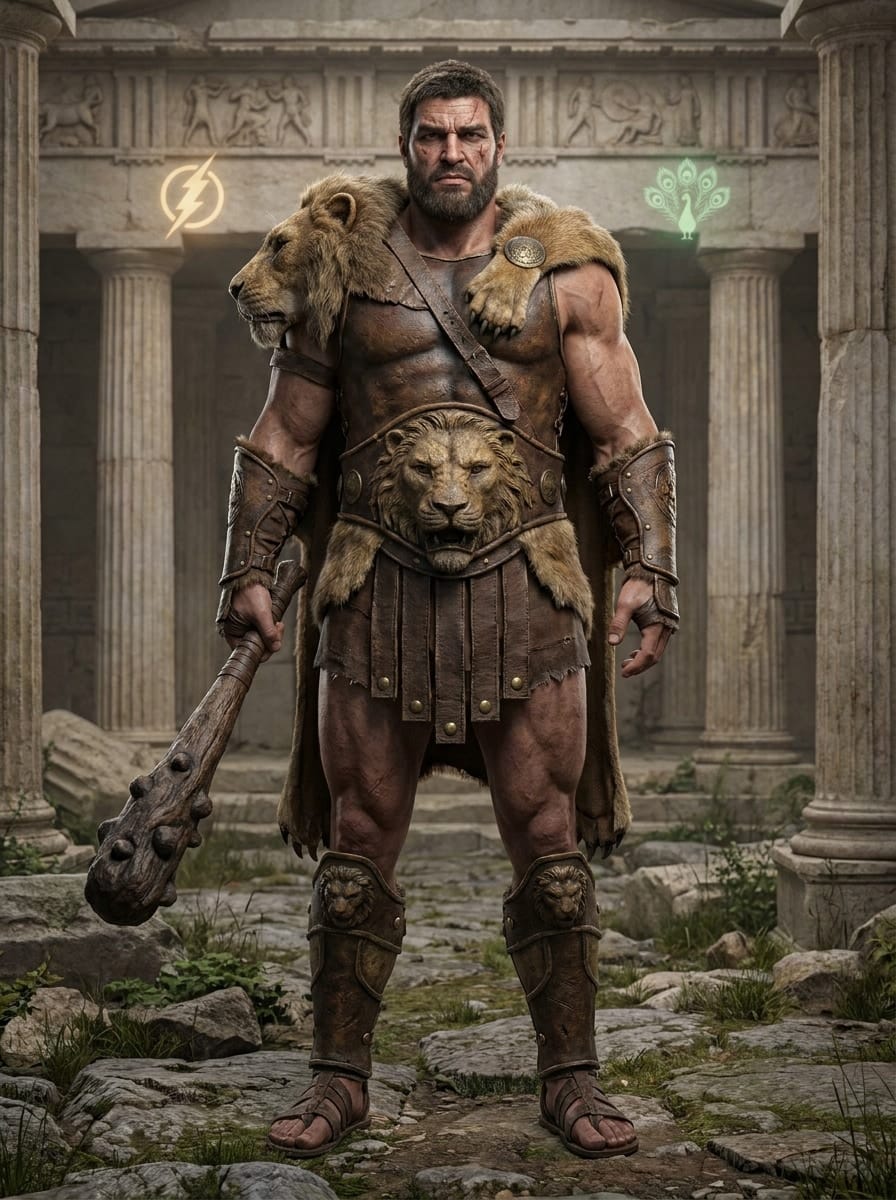
Nemean Lion skin, club, bow and arrows, Hydra-venom arrows, funeral pyre, flames of Mount Oeta
Article
Origins and Lineage
Heracles was born into the royal house of Thebes. His mother, Alcmene, was a mortal woman, and her husband was Amphitryon; but Zeus came to her in Amphitryon’s form and made her pregnant with a son of the king of the gods. Later the true Amphitryon returned, and Alcmene conceived a mortal son, Iphicles. The two brothers therefore shared one mother but not one father: one carried divine blood, while the other remained mortal.
His fate was rewritten by a quarrel in heaven before he was even born. Zeus once boasted that the child about to be born from the line of Perseus would rule over those around him. Hera saw through his meaning and lured Zeus into swearing an oath: the first descendant of Perseus born that day would become lord over the others. She then delayed Alcmene’s labor and hastened the birth of Eurystheus. Thus Heracles, who should have stood in the place of rule, was instead later forced to serve Eurystheus, and the shadow of labor fell on him before he had ever entered the world.
Even as an infant, Heracles showed strength beyond ordinary humanity. Hera sent two snakes crawling into the cradle; Iphicles cried out in terror and shrank away, but Heracles reached out with his small hands, seized the serpents by the necks, and strangled them. The scene became a sign of his whole life: danger came for him very early, and he almost always answered it with strength.
Divine Role and Attributes
Heracles is first a hero, and only afterward a god. His core nature is not simple victory, but the entanglement of strength, labor, atonement, endurance, and excess. He carries a club, wears the hide of the Nemean Lion, and bears a bow and arrows whose tips are often linked to the venom of the Lernaean Hydra. These objects proclaim his triumph over monsters, but they also remind us that his force can save lives and, in anger, cause damage that cannot be undone.
His education shows the same contradiction. Amphitryon arranged teachers for him in chariot-driving, wrestling, archery, weapons, music, and letters. Heracles learned quickly, but his strength often moved faster than his judgment. When the music teacher Linus struck him, he struck back with the lyre and killed his teacher. This was not a glorious achievement, but a violent sin of youth. Later he grew up in the mountains and wild country, and in the tradition of his choice between two roads, he chose true fame through hardship. In the Greek imagination, heroic glory is no easy gift; it is often won through danger, pain, and self-restraint.
Heracles also has the double face of protector and destroyer. He can wrest Alcestis back from Thanatos, and he can shoot down the cruel eagle that torments Prometheus; yet he can also kill his wife and children in the madness sent by Hera, and in rage or frenzy he kills Iphitus, violating the order of hospitality and purification. His divinity does not erase these stains. Instead, it makes him one of the strongest heroes in Greek myth, and also one of those most burdened with consequence.
Major Myths
Heracles’ early stories center on the question of how overwhelming strength can be guided. He kills serpents in the cradle, receives martial training as a youth, and after killing Linus is sent away from the city, where he hunts wild beasts in the mountains and trains his body. The tradition of his choice at the crossroads, where he chooses the hard and virtuous path, gives his heroic career a clear ethical color: glory comes from toil, not from ease.
The turning point of his adulthood comes from the madness sent by Hera. Heracles had already won honor in Thebes, married Megara, and had children. But in madness he saw his home as a battlefield and his family as enemies, and with his own hands he killed his wife and children. When he came back to his senses, he carried the guilt of kin-murder to Delphi and asked the oracle what he must do. He was ordered to obey Eurystheus, king of Mycenae, and atone for his crime through long labor. Eurystheus’ power over him came from Hera’s old scheme with the order of births. And so the strongest of heroes had to stand before a timid king and accept one nearly fatal task after another.
The Twelve Labors form the most famous foundation of Heracles’ renown: the Nemean Lion, the Lernaean Hydra, the Cretan Bull, the hound of the Underworld, and other tasks drive him toward monsters, wilderness, borders, and death itself. Although the current story set does not unfold every labor one by one, it repeatedly invokes the marks these deeds left behind: the lion skin, the club, the poisoned arrows, the long journeys, and the commands of Eurystheus. After completing the labors, he still found no peace. He continued to wander, helping Prometheus, visiting Admetus, and bringing Alcestis back from death.
His later stories continually show glory and guilt moving side by side. On the voyage of the Argo, he rows so hard that he breaks his oar and goes ashore to cut timber. When the youth Hylas goes to fetch water and is carried off by nymphs of the spring, Heracles searches everywhere, calling his name, and is left behind by the Argo on the coast of Mysia. In the story of Eurytus, he wins an archery contest, but because he once killed his kin in madness, he is refused Iole’s hand in marriage. Later trouble over lost cattle and old resentment leads him to kill Iphitus, placing another blood-guilt on his shoulders. The oracle judges that he must be sold as a slave and serve Omphale, queen of Lydia. In the queen’s palace he lays aside his lion skin and club, endures humiliation, and continues to clear away robbers and evildoers, repaying guilt through service.
His death likewise comes from old poisoned blood and fear within the household. Heracles once shot the centaur Nessus when he tried to carry off Deianeira. Before dying, Nessus deceived Deianeira and told her to preserve his poisoned blood, claiming it could win back her husband’s love. Later, after Heracles captured Oechalia and brought Iole home, Deianeira feared losing his love and sent him a robe smeared with the poisoned blood. Heracles put on the robe during sacrifice, and the venomous fire burned into his body. In agony he killed Lichas, who had brought the garment; when Deianeira learned the truth, she killed herself. Heracles understood that his mortal body could no longer live. He ordered others to carry him to Mount Oeta and build a pyre. After the flames, his mortal body vanished, and the gods received him onto Olympus. He was reconciled with Hera, married Hebe, goddess of youth, and became immortal.
Worship and Influence
In Greek tradition, Heracles belongs both to heroic cult and to divine worship. He is at once a mortal hero who became a god after death and a member of the immortals on Olympus. For that reason, he often expresses the idea that a human being can enter the sacred order through toil, achievement, and divine will. His cult spread widely, and his image easily moved beyond any single city-state: as monster-conqueror, clearer of roads, model of athletic power and physical strength, he belongs naturally at gates, in stadiums, in expedition tales, and in stories about boundaries.
His influence does not come from moral perfection alone. On the contrary, Heracles endures because he presses human impulse, divine blood, accidental disaster, and the need for atonement into one body. When he rescues others, he does not hesitate; when he is angry, he is terribly dangerous. He can bow to an oracle and serve, yet he can also lose control under insult and pain. Later tellings often make him the ultimate figure of strength, but his fuller mythical image also includes stain, humiliation, obedience, accidental killing, remorse, and final apotheosis.
Character Overview
Heracles is not simply “the strongest.” He is a man brought into the world by the desire of the king of the gods, a man whose fate was twisted by Hera’s hostility, and a man constantly driven to the limit by his own strength. His story asks again and again: when someone possesses power beyond ordinary human measure, how can he avoid being swallowed by that power? And when a crime was not entirely chosen by him, yet was truly done by his own hands, how should he bear it?
In an interactive setting, Heracles should speak directly, heavily, and without much ornament. He values action over fine words, respects those who keep their promises and honor hospitality, and despises cowardice, oath-breaking, and empty boasting. He can encourage people to face hardship, but he will also admit that he harmed the innocent, was ruled by madness, and committed new crimes in anger. The most powerful part of him is not only that he strangled lions and monsters, but that after repeated failure and blood-guilt he was still forced to rise, keep walking, and move toward labor, purification, and the final fire.