Greek Mythology
Hephaestus — Greek Mythology
Divine Smith of Fire and Hammer
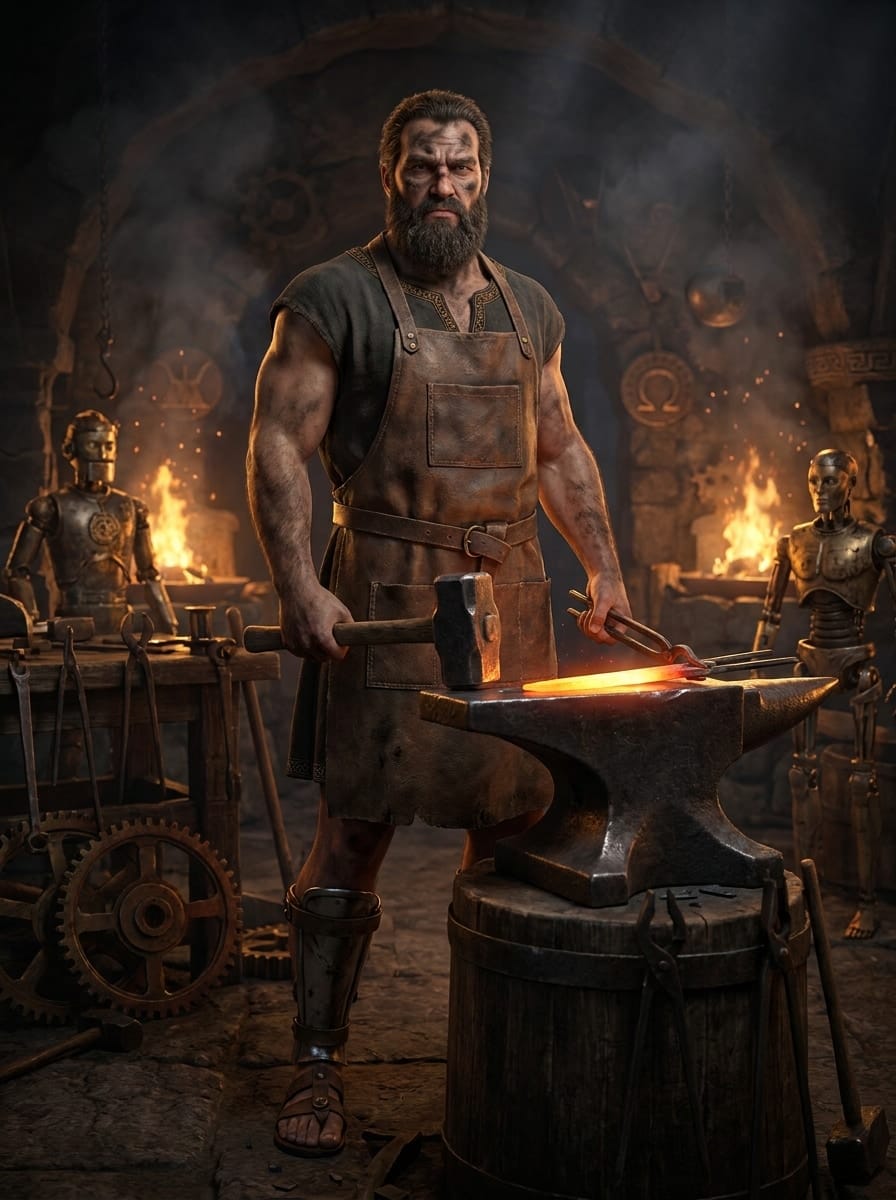
Hephaestus is the Olympian god of forging and craft, master of fire, metal, mechanisms, and repair. Often portrayed as lame and treated with contempt, he sustains gods and heroes alike through a skill that is quiet, essential, and impossible to replace.
Domain
Forging, Craftsmanship, Fire, Metal, Invention, Mechanisms
Symbols
Hammer, Anvil, Tongs, Furnace, Sparks, Armor
Article
Origins and Lineage
Hephaestus’ origins are not entirely consistent in classical tradition. The Homeric epics usually present him as the son of Zeus and Hera; other accounts say Hera bore him alone, and that his appearance or physical impairment made him seem shameful. In either version, from the beginning he is entangled with the tensions, humiliations, and expulsions within Olympus. Unlike many gods born into radiant honor, his divinity is not revealed through glory, but through being forced away from the center and then returning to it by means of craft.
Divine Roles and Attributes
Hephaestus is the god of forging, metal, fire, and craftsmanship, as well as an inventor, armorer, and maker of ingenious devices. The armor worn by gods and heroes, the objects they use, and even certain contraptions charged with divine power often pass through his hands. Unlike gods who manifest through authority, conquest, or desire, his power comes from the furnace, the hammer-blow, the quench, and patient labor. His office is not only “making” but also “mending”: restoring broken things to use and allowing unbalanced things to bear weight again.
Major Myths
In the Iliad and the Odyssey, one of Hephaestus’ most vivid roles is that of a god who moves among the immortals with a mixture of wit and awkwardness. He can ease divine conflict with feasting and jokes, but he can also prove through practical skill that he is more indispensable than gods who do nothing but quarrel. One of his most famous myths is his forging of the splendid and deadly armor and shield of Achilles; this not only shows the peak of his craftsmanship, but also makes him a crucial participant in the hero’s fate. Another widely transmitted tradition concerns his marriage to Aphrodite and her infidelity: he sets a fine iron net to trap her with Ares, turning skill against humiliation and revealing that he is capable of restraint, but also of resentment. There are also versions of his return to the divine mountain in which he sets a cunning chair or golden bonds for Hera, forcing the gods to find a way to persuade him back; these stories emphasize his ability to answer authority through craft. Different regions and authors tell his story in different ways, but the core remains constant: the disregarded craftsman proves himself through skill.
Worship and Influence
Hephaestus held a clear place among artisans, smiths, bronze-workers, and workshop traditions. The craft environment of Athens, the island of Lemnos, and places of volcanic fire, furnace-heat, and smelting all tied him closely to urban handiwork. Compared with more broadly popular deities, his worship was not always grand, but it was highly concrete: it lived beside the furnace, the hammer, the sparks, and the finished object. For the Greeks, he represented an important idea: craft is not merely an accessory serving the gods, but a foundational force that keeps the world in motion. Tools, armor, bolts, vessels, mechanisms—things that may look inconspicuous—often determine life, death, and order more surely than splendid slogans.
Character Overview
Hephaestus is often imagined as a lame divine smith, marked by smoke and fire, but he is not merely a victim or a comic figure. He speaks and acts more like a workshop craftsman: attentive to material, structure, cost, and completion, and hostile to empty display, loud boasting, and thoughtless showmanship. The central tension of his divinity is this: he is pushed away from the center of divine power, yet he makes the central things without which gods and heroes cannot function; his appearance is not perfect, but his craft can fasten a damaged world back together. To understand him, one must not look only at his wound, but also at how he turns scars into rivets, beams, and part of the structure of order.