Greek Mythology
Helios — Greek Mythology
The All-Seeing Sun God
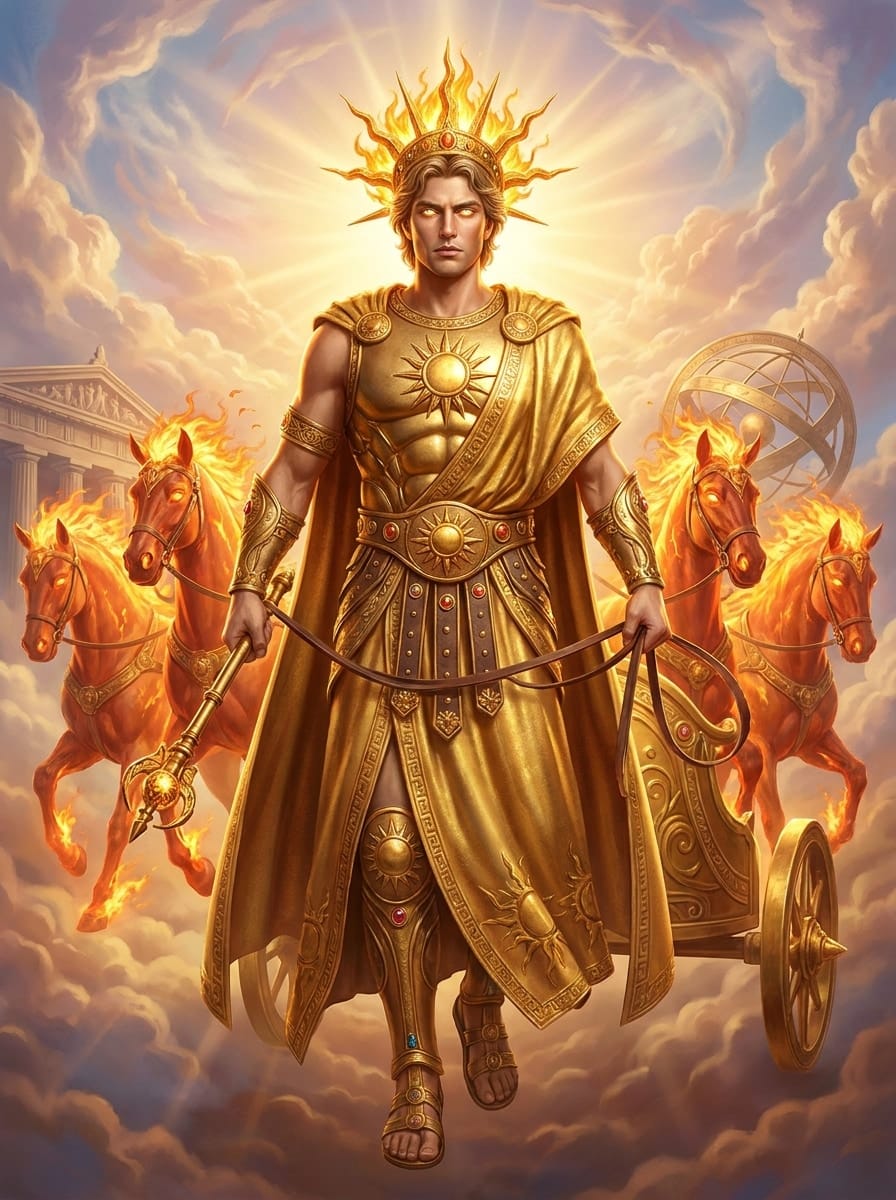
Helios is the Greek god who drives the chariot of the sun across the sky each day, born from the Titan line and often called “the All-Seeing.” He looks upon the hidden deeds of mortals and gods alike: he told Demeter the truth of Persephone’s abduction, exposed the affair of Ares and Aphrodite, and, during Odysseus’s homeward voyage, demanded that Zeus punish those who slaughtered his sacred cattle. In him, sunlight becomes bright, orderly, and unwilling to tolerate sacrilege.
Domain
Sun, light, the course of the sky, witness, oaths, sacred cattle
Symbols
Solar chariot, sun disk, four divine horses, radiant crown, sacred cattle, rooster, Colossus of Rhodes
Article
Origins and Lineage
Helios comes from the ancient bloodline of the Titans. In Hesiod’s Theogony, he is the son of Hyperion and Theia, and his sisters are Selene, goddess of the moon, and Eos, goddess of dawn. This origin means he is not one of the youngest gods of the Olympian order, but a power of light carried over from an earlier cosmic structure: dawn opens the way, the sun rises, the moon takes up the night sky, and together the three shape the visible rhythm of time.
In later mythic traditions, Helios is also tied to several important families. He is often named as the father of Aeëtes, king of Colchis, of the enchantress Circe, and of Pasiphaë, queen of Crete; through them, his bloodline reaches the edges of stories about the Golden Fleece, the wanderings of Odysseus, and the Cretan labyrinth. These genealogies do not always hold the same weight in every tradition, but they strengthen the image of Helios as an ancestral god behind distant islands, foreign kingship, sorcery, and burning desire.
Divine Role and Attributes
Helios’s central divine office is the sun. Each day he rises from the east in his radiant chariot, crosses the sky, and descends in the west; by night he returns by mysterious means to his place of departure, ready for the next dawn. His light is not merely a warm adornment of the world, but a power that sees all things, which is why ancient poetry often calls him the god who “sees everything and hears everything.”
This all-seeing nature often makes Helios a witness to secrets. He does not hold supreme kingship like Zeus, nor does he possess the broad range of music, prophecy, and purification associated with Apollo. Helios is more like an unblinking eye suspended in the sky. What mortals do in daylight, and what gods hide in the shadows of their desire, may still be touched by his light. His sense of justice has the same hard edge of witness: when someone violates what is sacred to him, he demands compensation rather than offering easy forgiveness.
Major Myths
In the Odyssey, Helios enters the story in two crucial ways. The first comes at the feast of the Phaeacians, when the poet sings of the affair between Ares and Aphrodite: Helios sees them meeting behind Hephaestus’s back and tells the craftsman god the truth, leading Hephaestus to set his ingenious net and trap the two lovers before the assembled gods. Helios is not the center of that episode, but he is the point from which the secret begins to unravel.
The second comes during Odysseus’s journey home. Circe solemnly warns Odysseus that on the island of Thrinacia are Helios’s cattle and flocks, guarded by goddesses, never increasing and never diminishing, and that they must not be harmed. Odysseus makes his companions swear not to touch the sacred cattle, but hunger and hardship finally overpower the oath. While Odysseus sleeps, the crew slaughter the cattle, and ominous signs follow: the meat cries out on the spits, the hides crawl, as though sacred order itself were protesting. When Helios learns what has happened, he demands punishment from Zeus and the gods, threatening that if he receives no compensation, he will go down to the underworld and shine among the dead. Zeus ultimately smashes Odysseus’s ship with thunder, destroying everyone except Odysseus himself. This story makes Helios appear majestic and fearsome: he does not wield the thunderbolt with his own hand, but the insult to his divine right compels the highest god to enforce punishment.
In the Homeric Hymn to Demeter, Helios is again the witnessing god in the disappearance of Persephone. As Demeter searches everywhere for her daughter, Helios tells her that Hades carried Persephone away with Zeus’s consent. Here Helios is no comforter. What he offers is the truth, and the hardest part of the truth: the mother’s suffering is not a random disaster, but is bound up with the power arrangements among the gods.
Later tradition also links Helios to the tragedy of Phaethon. Phaethon demands proof that he is the son of the sun god and takes the reins of his father’s solar chariot, but he cannot control the divine horses, nearly burning heaven and earth before Zeus strikes him down with a thunderbolt. This tale highlights the danger of Helios’s office: the chariot of the sun is not a glorious toy, but a heavy authority that sustains the order of the world.
Worship and Influence
Helios was not everywhere the most prominent city god in the Greek world, but his worship was especially important on Rhodes. Ancient tradition closely connected Rhodes with the sun god, and the later famous Colossus of Rhodes became one of the symbols of reverence for him. Compared with the Olympian gods, Helios’s religious image remains closer to the visible movement of the heavenly body: people could see his rising and setting every day, and so oaths, witness, the direction of sea travel, and the order of time were easily linked with him.
As religious thought developed in the Greek and Roman periods, Helios could sometimes draw near to Apollo or to broader images of a solar god. Yet in early epic and hymn, he retains a clear independent identity. Apollo may be a god of archery, music, prophecy, and plague; Helios is the sun itself in its daily course, the sleepless gaze and the lord of radiant possessions that cannot be violated.
Character Overview
Helios’s nature should not be simplified into that of a warm and benevolent sun. He does bring light, time, and order to the visible world, but in myth he more often appears as witness, accuser, and claimant. He sees Persephone being carried away, sees Ares’s secret affair, and sees Odysseus’s companions commit sacrilege against his cattle; once a truth enters his light, darkness can hardly cover it again.
For that reason, Helios is best understood as a “bright overseer.” He may not always judge with his own hand, but he makes hidden things visible and causes oaths and prohibitions to bear consequences. His light can guide, but it can also condemn; he is both the solar disk on which life depends and the gaze from which neither mortals nor gods can long escape.